Why an ICE shooting in Houston isn’t leading to mass protests
HOUSTON — In the days after federal agents shot and killed Renée Good in Minneapolis, tens of thousands of people flooded that city’s streets in protest. When agents shot Alex Pretti to death three weeks later, the crowds exceeded 50,000 people.
But the immediate fallout in Houston looked entirely different after an Immigration and Customs Enforcement officer shot and killed Lorenzo Salgado Araujo on his way to work Tuesday morning.
Despite being the nation’s fourth-largest city — with more than five times as many residents as Minneapolis — Houston has never been known as a “protest city.”

Why doesn’t Houston have large protests?
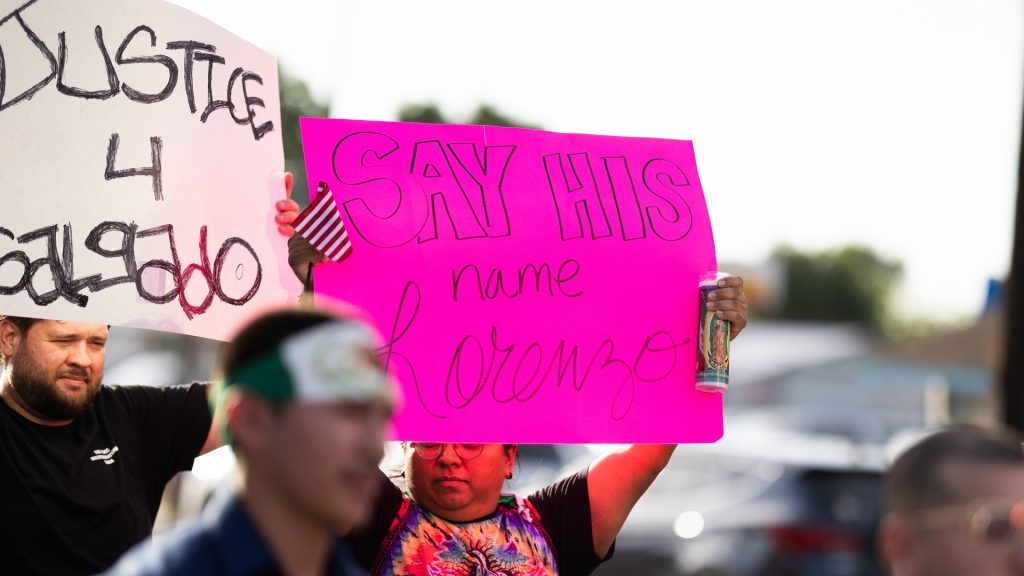
More than 1,000 people attended a protest and vigil Wednesday evening on Canal Street, an under-construction stretch of road in Houston’s historic East End where Salgado Araujo was shot the day before. Protestors walked several blocks of the neighborhood; elected officials shouted into megaphones demanding accountability and change; mourners lit candles.
That size crowd is a significant turnout — especially for Houston. But it stayed firmly within the bounds of a somber, highly organized gathering. The deluge seen elsewhere never appeared. It rarely does.
“Houston does not respond like a lot of the other liberal cities, especially like Minneapolis did,” David Contreras said. Contreras has lived in both Houston and Minneapolis, though Houston is his hometown. It’s where he made a name for himself as a local historian, eventually earning the role of national historian for the League of United Latin American Citizens (LULAC), and where he now serves as chairman of the Harris County Hispanic Cultural Heritage Commission.
“And I really don’t know why,” Contreras told Straight Arrow. “We don’t get that response from the Latino community, and have not in the past.”
Some of the low headcount can be explained by the chilling effect ICE’s presence has had on communities of color, particularly in the East End. Earlier this year, LULAC canceled its annual Cinco de Mayo parade due to “growing concerns surrounding ICE enforcement activity,” according to the press release the organization published at the time.
“We canceled it because of fear of arrest, especially in the youth, and deportations,” Contreras told Straight Arrow.
“There’s a visceral fear in immigrant communities of what’s going on,” said Joe Higgs, lead organizer at the Gulf Coast Leadership Council, a community organizing group in Houston. “And so they’re not going to go out and protest. The question is: Is it agitational enough to others?”
Even in the nation’s most diverse metropolitan area, where 44.2% of city residents are Latino, translating one community’s fears into broader civic outrage has long been a high hurdle to clear. And the city has, for decades, struggled to generate large-scale turnouts for movements that see larger crowds in smaller cities.

How Houston sprawl limits mass mobilization
Houston is often derided as the nation’s “worst planned city.” As the largest city in the U.S. without a traditional zoning code, Houston’s sprawl over the past half century has shaped its shapelessness. Protests in other cities can shut down entire neighborhoods. Houston’s decentralization makes that task feel impossible.
“Imagine protestors in Houston saying, ‘We’ll shut down the street. We’ll shut down downtown,’” Daniel Cohen, then a political organizer, told the Houston Landing in 2024. “OK, which one? The city’s too big. You can’t shut down the city for the most part.”
This isn’t to say there have never been massive protests in the city. George Floyd was killed in Minnesota, but he was raised in Houston’s Third Ward. In 2020, 60,000 Houstonians marched downtown in the wake of his death, marking the city’s largest-ever protest — and one of the largest in the nation during a summer in which more than 15 million Americans took to the streets.
Contreras sees that moment as an outlier, rather than a prediction of what could come in the wake of Tuesday’s shooting.
“We’re not as united as the African Americans,” Contreras said of Houston’s diverse swath of Latinos, “because we’re divided in religion, we’re divided in politics, we’re divided economically, educationally, so on and so forth.”

What actually happened during the ICE shooting?
But that fragmentation hasn’t dulled the growing local fury over how Salgado Araujo died.
An ICE spokesperson told Straight Arrow Tuesday that Salgado Araujo tried to evade arrest, rammed an ICE vehicle, ignored multiple verbal commands and “weaponized his vehicle” while trying to run over an officer. ICE said the officer fired in self-defense.
That narrative has not been accepted in Houston. On Wednesday morning, the Houston Chronicle’s editorial board published its first editorial on the topic with a succinct headline: “ICE lies. And now they’ve killed a Houstonian.”
By the evening, elected officials shared similar thoughts with the Canal Street crowd.
“ICE came to Houston and killed one of our own,” said U.S. Rep. Christian Menefee, D-Houston, according to The Texas Tribune. “This is not the first time this has happened … and every single time they come and they tell us their version of events, but we don’t see any evidence.”
Unlike in Minneapolis, where the incidents involving both Good and Pretti were recorded by citizens who had mobilized against a massive deployment of federal agents, there has been no widely shared video evidence of what happened on Canal Street at 6:50 a.m. Tuesday.
“That’s why I always carry a camera with me,” said Patricia Cruz, a longtime East End resident who attended a small protest on Tuesday evening, “because it’s your word against mine.”
Video could still turn up.
“We know that this was a good man,” Higgs said. “We know that he lived a good life, and he raised his family. What we don’t know yet is how he died. And when that comes out, that will potentially help a desire for change.”
Already, Contreras told Straight Arrow, he sees something different in the crowd of folks who gathered Wednesday.
“There were more younger people than there were older people,” he said. “That raises the question: Were these younger people children of immigrants?”
As a new generation grows in Houston, so too could the city’s capacity for protest.
Maybe, Contreras said, Houston just isn’t a protest city — yet.
Round out your reading
- Scientists are now eyeing a possible ‘Mega El Niño’.
- Critics mocked Mamdani’s AC request. Republicans made the same ask.
- Social Security was supposed to be a safety net. To young Americans, it’s a broken promise.
- What happens when the water dries up? Much of the American West is close to finding out.
- Political insiders are targeting the two-party system’s grip on America.
Ella Rae Greene, Editor In Chief