How shedding the terrorism designation could reshape Syria’s future
Syria will soon no longer carry the scarlet letter of being a state sponsor of terrorism in the world. Losing that title, now carried by just a handful of countries, will open up a literal world of economic opportunities for Syria’s new government that it hasn’t seen since the 1970s.
The Trump administration has officially begun the process of removing that designation from the Middle Eastern country.
“Today marks a significant milestone in the revived U.S.-Syria bilateral relationship and in Syria’s history as a nation,” the State Department said in its official release.
Policy change
It will take 45 days of Congressional review before Syria officially loses the designation as a State Sponsor of Terrorism (SST).
That’s expected to happen with bipartisan support.
They’re one of only four countries with that designation from the U.S., the others being Iran, North Korea and Cuba.
“It’s a legal requirement of the United States from Congress for many decades now to identify the key states in the world who are state sponsors of terrorism,” William Wechsler, senior director for Middle East programs at the Atlantic Council, told Straight Arrow.
Once this change goes through, it’ll be the first time since 1979 that Syria is not on that list.
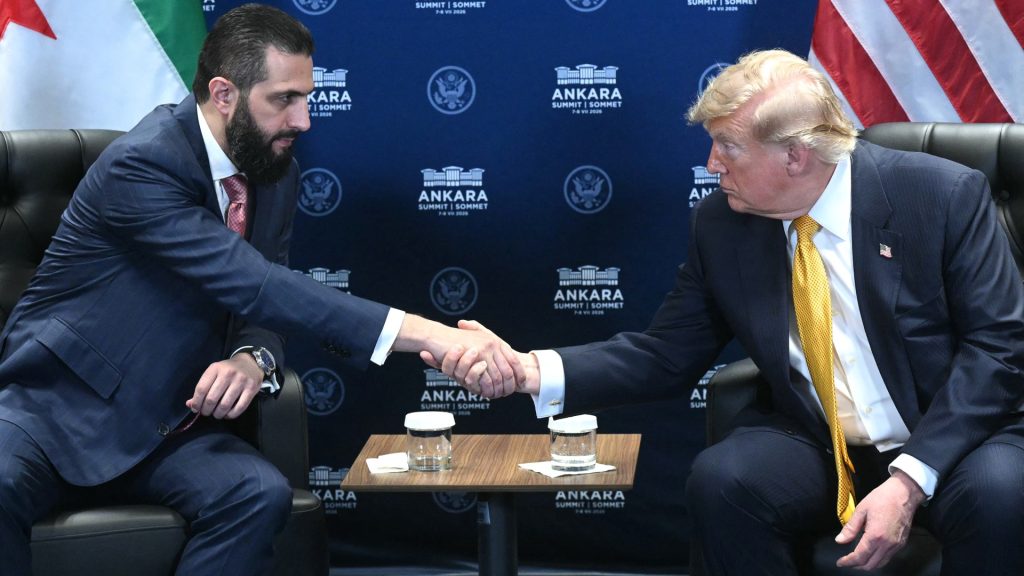
Trump made the announcement while sitting next to Syrian leader Ahmed al-Sharaa at the NATO Summit in Turkey.
“He’s done a great job,” Trump said of al-Sharaa.
The new Syrian leader took over the country from Bashar al-Assad, a man the U.S. has previously accused of supporting Hezbollah and al-Qaeda, as well as hosting Palestinian militant groups.
Despite Trump’s fond views of al-Sharaa, he comes with a checkered past as well when it comes to terrorism.
He previously founded and led an al-Qaeda affiliate before cutting ties with them in 2016 and then leading the insurgent revolution to take over Syria.
“Saudi Arabia made a very quick switch to saying that they would support the new government,” Wechsler said. “Countries like the UAE were much more skeptical about the new government, seeing that al-Sharaa came out of terrorist jihadist Muslim Brotherhood background.”
Trump has wanted to strengthen relations with the Saudis and has already lifted sanctions on Syria following al-Sharaa’s rise to power. The Saudis also assured Trump that the new regime is different from the old.
Unlike al-Assad, the new Syrian regime is extremely anti-Iran and anti-Hezbollah.
“Right now, you’d be hard-pressed to make an argument that the government in Syria is actually a state sponsor of terrorism abroad,” Wechsler said.
What it means
The new designation means several things, but overall, it means Syria has greater access to the largest economy in world history.
“[That designation] is part of the web of sanctions and designations that have made foreign companies reluctant to do business in Syria,” Wechsler said.
For the most part, no company wants to be associated with a terror group.
Removing Syria from that list will open the dam that pushed American companies, banks and more from doing business with that nation.
The U.S. government has not shied away from investigating any business that could allegedly have ties to funding terror groups.
“Lifting sanctions on Syria will unlock international trade and investment, give Syria a chance to rebuild, and open up a new chapter for the Syrian people,” the State Department said.
America is clearly a world leader, and this decision could impact other foreign nations to open relations with the Syrians.
Saudi officials, who’ve clearly been supportive of the move, praised it.
Several Saudi firms have already pledged billions of dollars in investments in that country, as have other Gulf states.
Syria’s central bank governor also said this will help push his country back into the global financial system.
While the financial element for a rebuilding country is clearly the biggest piece, this is also a sign of diplomacy and that Syria is now welcome to engage with the West.
“A stable, unified Syria at peace with itself and its neighbors benefits not only the region, but the entire world,” the State Department said.
Remaining concerns
With al-Sharaa’s past connections to a terror group, some nations have shown concern about bringing Syria back into the global economic community. But overall, there’s been little negative reaction, including from inside the U.S.
If there’s one nation that might show some potential pushback, it’s Israel.
“Israel is concerned about Syria,” Wechsler said.
There used to be tens of thousands of Jews in that country, but that number has gotten extremely close to zero.
Israel has not officially commented on this latest move but has expressed concerns.
Where those concerns lie does not really come from al-Sharaa or even Syria itself, but rather from Turkey, which has also pushed the U.S. to normalize relations with Syria.
The Israelis have already shown their dismay at the U.S. potentially selling fighter jets to Turkey.
Turkey and Israel are roughly 800 miles apart, whereas Syria and Israel share a border.
“Their concerns are about Turkey and Erdogan using Syria in the future as a launching stage for a very powerful military that is closer to Israel’s borders,” Wechsler said.
Round out your reading
- Scientists are now eyeing a possible ‘Mega El Niño’.
- Critics mocked Mamdani’s AC request. Republicans made the same ask.
- Social Security was supposed to be a safety net. To young Americans, it’s a broken promise.
- What happens when the water dries up? Much of the American West is close to finding out.
- Political insiders are targeting the two-party system’s grip on America.
Ella Rae Greene, Editor In Chief