Ukraine’s drones reach Siberia, exposing Russia’s energy vulnerability
Ukraine’s long-range drone campaign is pushing deeper into Russia, increasing pressure on Moscow’s energy system and forcing the Kremlin to defend targets far beyond the front lines.
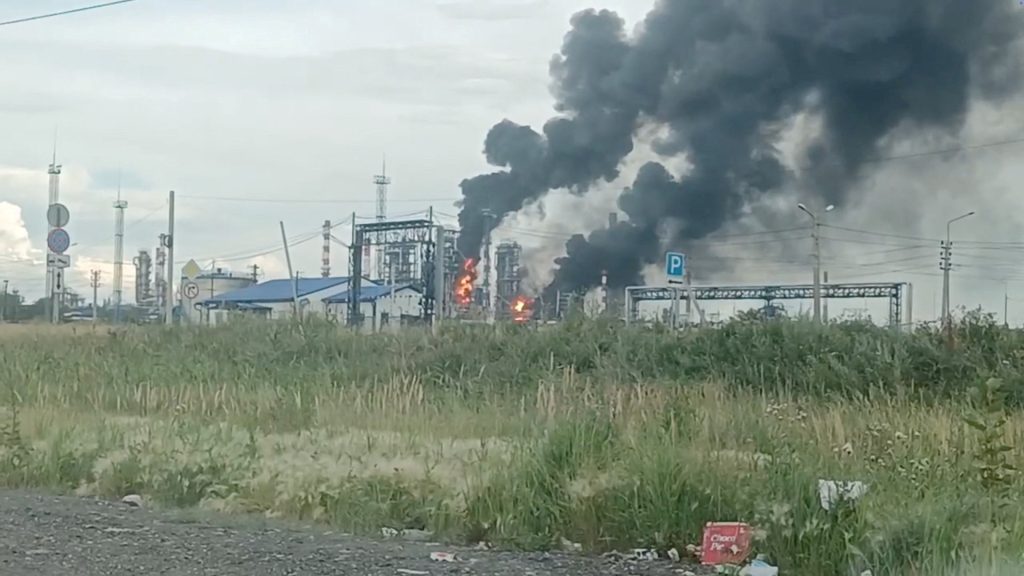
Ukrainian drones struck Russia’s largest refinery in Omsk on Monday, sparking fires nearly 1,500 miles from Kyiv-controlled territory. The strike marked a major expansion of Ukraine’s deep-strike campaign, which had largely focused on European Russia.
The drones used in the Omsk operation can fly as far as 2,100 miles, according to Ukrainian manufacturer Fire Point. That range puts more of Russia’s oil-and-gas industry, military facilities, pipelines and pumping stations within reach.
Why Omsk matters
Omsk sits deep in Siberia, well beyond the areas Russia had prioritized for protection against Ukrainian drone attacks.

The Wall Street Journal reported there was little air defense around the refinery because Russian authorities had assumed it was too far from Ukraine to be at risk. The attack also hit as Russia was already grappling with fuel shortages, long lines at gas stations and rationing.
Russia announced a diesel export ban Wednesday after the attack. Russia’s gasoline production is estimated to have fallen by at least one-quarter following refinery strikes this year.
The wider fuel squeeze is now spilling across borders. Kazakhstan deployed 59 checkpoints along its border with Russia to stop motorists from smuggling fuel out of Kazakhstan.
The bigger problem for Moscow
The deeper Ukraine can strike, the more territory Russia has to protect.
That creates an increasingly difficult air-defense challenge. Russia must defend the front line, occupied territory, major cities, military sites and energy infrastructure across the world’s largest country.
Retired Royal Air Force Air Marshal Edward Stringer told the Journal that Russia has a limited number of air-defense assets and cannot place them everywhere. The more territory Russia has to defend, he said, the more openings Ukraine may find.

Ukraine is also intensifying strikes closer to the front lines. In occupied Crimea and southern Ukraine, guided drones have targeted fuel tankers, storage sites, military logistics and electricity infrastructure.
Ukraine struck nine oil tankers in the Black Sea on Tuesday night. Ukrainian officials have said they are trying to isolate Crimea from Russia’s mainland.
How Ukraine is finding targets
Ukraine’s strike campaign relies not only on attack drones, but also on reconnaissance.
CBS News reported that the American-made V-BAT surveillance drone has helped Ukraine identify Russian targets from long range. A Ukrainian naval drone operator using the call sign “Negative” said the system lets Ukraine confirm what is present, collect imagery and provide intelligence without getting too close.
“We focus on targets that are expensive, strategically valuable, or difficult to replace,” the operator said.
Ukraine has also used reconnaissance drones to locate Russian air defenses, including S-400 systems. The V-BAT has AI software that can program routes based on known Russian air-defense locations.
What drones can and cannot do
Ukraine’s drones are creating tactical and economic pressure, but analysts caution they are not a stand-alone path to victory.
Retired Canadian officers Charles S. Oliviero and Phil Halton argued that drones should be understood as an evolution in warfare, not a replacement for combined arms operations. They say that drones can deny parts of the battlefield and limit movement, but they cannot seize, control or hold terrain.
The analysts argue the campaign can increase the cost of the war for Russia, but is unlikely to determine the outcome on its own.
What’s next
President Donald Trump voiced support for Kyiv’s long-range strikes after meeting Ukrainian President Volodymyr Zelenskyy at the NATO summit in Turkey.
“It’s an escalation, but it’s also an escalation that can help lead to an end,” Trump said.
President Vladimir Putin has acknowledged the strikes are intended to damage Russia’s economy and create social tension, but insists the country’s energy system remains resilient.
Round out your reading
- Scientists are now eyeing a possible ‘Mega El Niño’.
- Critics mocked Mamdani’s AC request. Republicans made the same ask.
- Social Security was supposed to be a safety net. To young Americans, it’s a broken promise.
- What happens when the water dries up? Much of the American West is close to finding out.
- Political insiders are targeting the two-party system’s grip on America.
Ella Rae Greene, Editor In Chief