The yellow jets go dark: What happens to Spirit’s fleet?
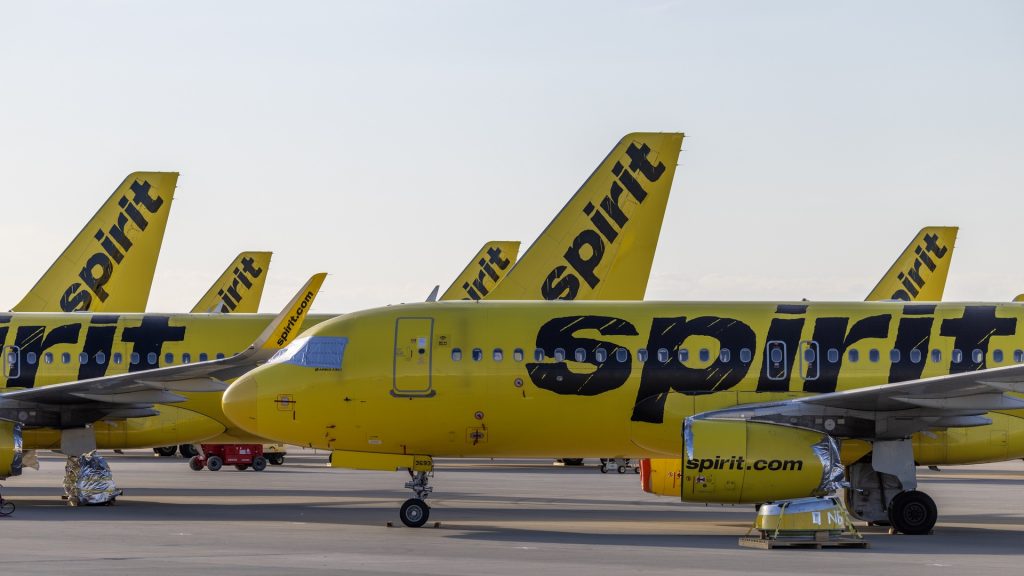
Americans won’t be seeing those big yellow Spirit Airlines planes flying overhead anymore now that the company has shut down. But what’s going to happen to those planes?
Both customers and other airlines will feel the impact of the Spirit closure.
However, experts said many of those impacts will not be felt immediately.
What happens to the planes?
According to data from avionics analytics company Cirium, Spirit had 172 planes in its fleet.
Only 95 of those were in service, with another 77 in storage. Most of those stored planes are in Arizona, with Spirit parking them there after taking them out of service to attempt to stay in business.
So, what happens to all these planes?
Most were leased to the airline. Those planes will be immediately returned to the leasing company.
“They will be repainted in the colors of another airline, and fly for that airline,” Jan Brueckner, professor of economics emeritus and University of California, Irvine, told Straight Arrow.
As for the planes Spirit actually owns, they’ll be sold off.
“The planes that Spirit owns will be sold, and there’s a good market for used planes, so no problem selling the planes,” Brueckner said.
Life expectancies of planes are typically measured in decades, which means most of the planes, especially the ones that were actively being used, are still good to fly.
Airlines tend to last for roughly 60,000 flight hours or 20,000 pressurization cycles.
An airplane pressurization cycle is the process where conditioned air from the engines or auxiliary systems is pumped into the cabin and regulated during climb, cruise, and descent to maintain a safe, comfortable cabin pressure despite changing outside altitude.
“They will be reused,” Douglas Baird, professor at the University of Chicago and chair of the National Bankruptcy Conference, told Straight Arrow. “Now, by whom is not clear. And, not necessarily in the United States, but these are large capital assets.”
It’s also unclear the status of many of those planes that have been grounded in the southwestern U.S. for an extended period of time.
However, the main reason they’re kept in places like Arizona is that the desert climate helps to avoid corrosion.
The facility holding Spirit’s planes is run by AerSale, which sells aftermarket aircraft and parts.
They can also help prepare planes that are heading from one carrier to another.
“It’s not as if the assets had been lost,” Baird said. “It just means this particular business that used these assets in a particular way turned out not to succeed in the marketplace.”
This could also be a chance for other airlines to pick up planes for a discount.
“They’re popular models,” Brueckner said. “So, it’s not like they’re a bunch of loser planes by any means. So, there should be ample room for other airlines to sort of exploit the situation and get planes that are maybe a bit cheaper than they would have been otherwise.”
Other infrastructure
Of course, it’s not just planes that Spirit owns. It’s hard to miss that big yellow counterspace at major airports.
Baird said the way bankruptcies are set up may make those spaces fairly valuable.
“It doesn’t destroy assets,” he said. “It’s a process by which you try to maximize the value of the assets, and that means putting the assets, whatever they are, to their highest value use.”
One thing that is likely to happen is that airports will just replace Spirit’s counter space with another airline.
There are also baggage carts, service vehicles and other operational machines.
“The main capital is airplanes,” Brueckner said. “They’re very expensive, and the rest of it is not that important.”
Then there are the tens of thousands of Spirit employees who are now out of a job.
A large majority of them are in Florida. Because of that, CareerSource Broward held a rapid response event to provide those employees with the necessary resources.
The U.S. Department of Transportation also said some other airlines will offer preferential job interviews to those impacted.
Impact on costs
Spirit Airlines was famously a low-cost, no-frills airline. So, how does their demise affect consumer costs?
Most likely, you’re not getting any cheaper plane tickets.
First of all, one of the reasons Spirit was struggling so much in recent months was the surging price of jet fuel due to the U.S. war with Iran.
Then, there’s the fact that Spirit was a lower-cost carrier.
“On routes where Spirit and Frontier and the other ultra-low cost carriers flew, fares tended to be lower,” Brueckner said. “In other words, the major carriers needed to cut fares in order to match the competition.”
Those other carriers will also be more likely to try to fill the gaps created by Spirit’s departure.
JetBlue has already announced some major moves to fill some of that void.
But overall, the cost of flying is up. Spirit Airlines is down. And flyers have one less option to take to the skies.
“People tend to forget that what’s happened here is that the U.S. government launched a war that is having negative effects worldwide, and one of the effects is higher jet fuel prices, and so the airlines are getting hammered by this war,” Brueckner said.
Round out your reading
- First, it was the schools. Now they’re coming for your cellphone at work.
- Why one of America’s top economic forecasters is worried about a recession.
- AI companies may not be adhering to their own guidelines — with potentially deadly outcomes.
- Data centers are a thorny issue for Democrats. Maine shows us why.
- We’re building a new Straight Arrow. Help us shape our future by taking our survey.
Ella Rae Greene, Editor In Chief