Is the US still at war with Iran — or not?
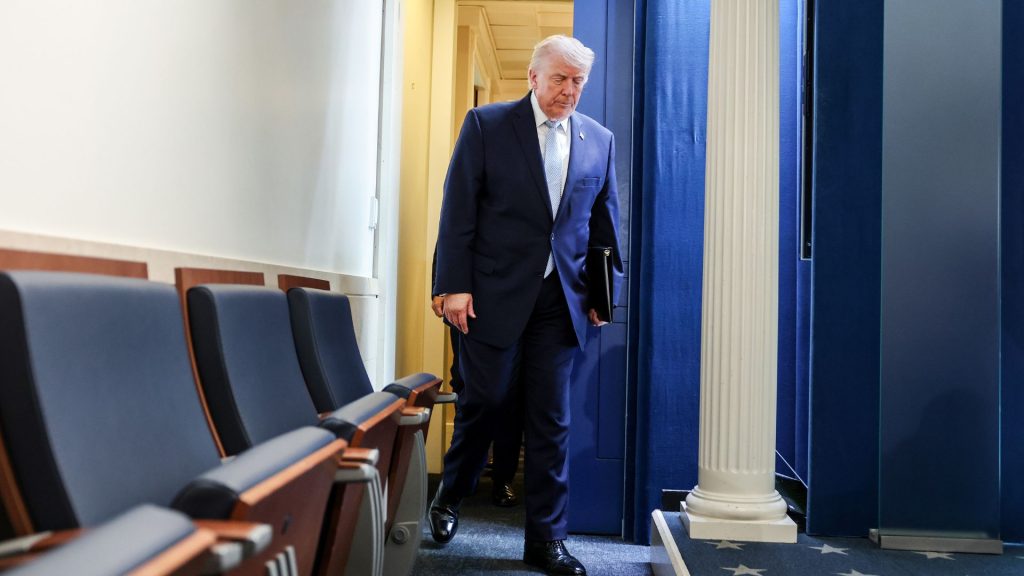
It’s no stretch to say Americans are confused and upset over the war in Iran. Polling throughout the war has shown broad dissatisfaction with President Donald Trump’s handling of the conflict and a strong feeling that the administration never adequately explained why the U.S. was attacking Iran to begin with.
Now, as Trump awaits Iran’s response to a formal peace proposal, Americans are left to wonder whether the nation is actually at war.
Trump and other administration officials have said they have ended the war, that the war is ongoing but it’s almost over, and that the U.S. is actually not at war with Iran at all.
Moreover, the administration has given shifting reasons for why it struck Iran in the first place. First, it was because of an “imminent threat,” then it was regime change and now it’s about the country’s nuclear program, which the administration previously said it destroyed in 2025.
This week alone, Trump announced that the U.S. military would escort ships through the Strait of Hormuz — only to discontinue the effort one day later. The Strait — which connects the Persian Gulf with the Gulf of Oman and through which at least one-fifth of the global oil supply normally passes — is a particular source of uncertainty. The U.S. is blocking traffic from Iranian ports, Iran is allowing only a few ships to pass and Trump once even mused about a joint venture with Iran to charge tolls for traversing the waterway.
Iran said late Thursday it was working with the U.S. to reopen the Strait for 30 days, allowing for additional talks.
And Trump said the war will be over “very quickly” — echoing some of his earlier statements while at the same time contradicting his suggestions that the conflict had already ended.
If the war ends, or if it’s already over, how will Americans be able to tell?
What do experts say Trump is doing?
Experts and analysts said Trump is using a strategy similar to former President Richard Nixon’s “Madman Theory.”
Nixon believed that if he publicly acted irrationally, adversaries would take him more seriously. People who knew him have said Nixon wanted to appear “somewhat crazy” and capable of the “bloodiest brutality.”
On paper, this could work. But history shows it didn’t work for Nixon. And, as Slate reported, success would require playing the madman all the time. Making a threat and then backing out a few days later can make subsequent threats less credible.
Benjamin Giltner, a policy analyst at the Cato Institute, a libertarian think tank, wrote that he didn’t believe Trump’s use of Nixon’s failed theory was working on Iran. He said that the U.S. couldn’t carry out some of Trump’s more outlandish threats. In one example of this, Giltner wrote that the U.S. was on track to run out of Tomahawk missiles, an expensive and advanced weapon used heavily in Iranian strikes.
“In just slightly over four weeks, the United States launched about 850 of these missiles against Iran out of the total 3,100 missiles in its inventory, and only produces around 90 missiles per year,” Giltner wrote. “These two facts already rendered Trump’s threats kaput.”
What’s the latest on the war?
One of the most important global factors regarding the war is the Strait of Hormuz. While the U.S. imposed a naval blockade, Iran has been boarding and attacking merchant ships and deploying sea mines.
Experts told The Washington Post that even if the Strait were to reopen today, it could take up to six months before it’s back to normal because of the mines. The Strait is a massive global trade bottleneck and the closure has led to increased gas prices globally. The average price for a gallon of gas in the U.S. rose to nearly $4.60 Thursday. Axios reports these higher prices could remain for months, all the way up to the midterm elections in November.
The latest peace proposal from Trump’s negotiators resembles the 2015 deal the president criticized and withdrew from during his first term. Some reports have suggested that Trump has even mulled over a deal that would be even friendlier to Iran than the deal he pulled out of in 2018.
Iran remains defiant to the U.S. and continues to make demands. On Wednesday evening, Mohammad-Bagher Ghalibaf, the Iranian Parliament speaker, mocked Trump in a post on X: “Operation Trust Me Bro failed.”
As negotiations continue, it’s unclear which side will blink first.
Robert Malley, a key U.S. negotiator on the 2015 Iranian deal, told The New York Times that neither side is predictable.
“Trump is impulsive and temperamental,” Malley said. “Iran’s leadership is stubborn and tenacious.”
Round out your reading
- First, it was the schools. Now they’re coming for your cellphone at work.
- Why one of America’s top economic forecasters is worried about a recession.
- AI companies may not be adhering to their own guidelines — with potentially deadly outcomes.
- Data centers are a thorny issue for Democrats. Maine shows us why.
- We’re building a new Straight Arrow. Help us shape our future by taking our survey.
Ella Rae Greene, Editor In Chief