White House and data at odds over who’s to blame for screwworm invasion
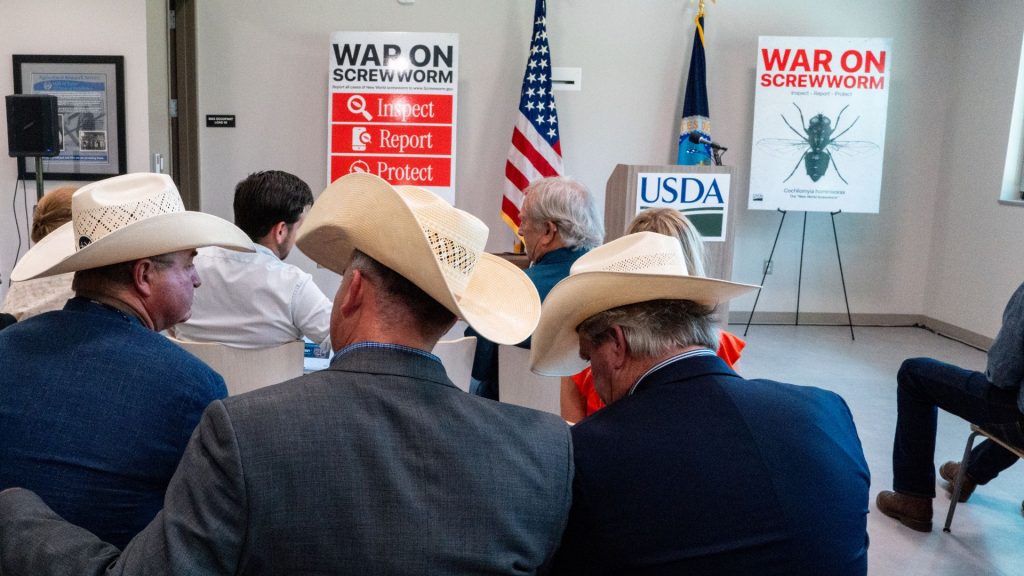
The U.S. is under invasion, not from a foreign government or an infiltration from within, but from an insect that many people couldn’t distinguish from a common house fly.
The new world screwworm has made its official return to the U.S. after a 60-year hiatus, and its return has the cattle industry and those along the U.S.-Mexico border especially concerned.
The flies’ return couldn’t have come at a worse time for the cattle industry, as the country’s beef suppliers are already facing drought and shrinking cattle numbers. Ground beef prices have surged by 13% compared to last year, driven by these overlapping challenges, according to the Bureau of Labor Statistics.
As the situation continues to deteriorate along the border, some southern officials and lawmakers have raised concerns that the current administration isn’t doing enough to stop the pest.
What are screwworms?
Screwworms are a type of parasitic fly that targets mammals, including humans, but we’re not their primary host. Additionally, it is not the fly’s adult stage that causes the most significant issues.
The screwworm begins life as an egg that an adult fly lays in an open wound. But these flies aren’t picky about where they choose to lay eggs. Even a recent bite from another insect can lead to an infection, and they also love to infect soft tissues, like the eyes.
This is one reason why domestic pets can become targets. If left untreated, even in humans, screwworm infestations can kill.
Once they hatch, the screwworms begin to burrow into and feed on their hosts. Like a much more disgusting butterfly, screwworms go through a full metamorphosis, and after about a week of aggressively feeding on their host, they will drop from their host’s wound. In the soil, they will pupate, harden and stay there for about a month before they emerge from the soil as an adult fly.
While their gross factor might be enough for some to launch an eradication effort, the devastating effects on the cattle and farming industries prompted a large-scale campaign in the U.S.
According to North Carolina State University, screwworms caused more than $100 million per year in economic losses to those industries in the states bordering the Gulf of Mexico during the first half of the 1900s.
How did they get here?
The way screwworms entered the U.S. is contested, with the current administration blaming its predecessor. But Mexican officials confirmed its first case in November 2024. Former President Joe Biden closed southern ports of entry to live cattle imports to prevent the spread, according to The Texas Tribune.
A few months later, after President Donald Trump returned to office, he reopened the ports to help cattle ranchers affected by the closing. In May, Secretary of Agriculture Brooke Rollins again barred cattle, horse, and bison imports through U.S. ports of entry along the southern border. She said this was because of the “rapid northward spread of New World Screwworm in Mexico.”
At the time, officials had reported screwworm sightings about 700 miles from the U.S. border. Then, in early June, Texas officials reported their first case in Zavala County, Texas, after a rancher reported screwworms in a 3-week-old calf.
Still, researchers aren’t sure how the screwworms reached South Texas. Now, officials in two states have confirmed at least six cases, including an infection in a small domestic dog.
The blame game
The Trump administration has placed the blame for the current screwworm situation squarely on Biden and his actions. In an interview with CNBC, Rollins blamed lax immigration policies for the spread.
“I do think it’s important to note that under the last administration, with the massive movement under the open borders policy, the cartels, et cetera, border security — that’s when it began to make its way back up toward America,” she said.
But it’s important to note that Biden did close the border to cattle once he was aware of the growing screwworm threat. Trump reopened them only to close them again months later.
Another contradiction against Rollins pushing blame on Biden was that Trump’s own program, the Department of Government Efficiency, cut funding to track and prevent the spread of screwworms.
While DOGE was still active, the group cut about 5,300 grants and programs from USAID, including funding for parasite prevention, according to HuffPost. The funding reportedly supported more than 180 outbreak investigations across 22 countries and helped construct labs for testing and biosafety.
But DOGE’s screwworm cuts went further after the group slashed 1,300 jobs from USDA’s Animal and Plant Health Inspection Service, according to Common Dreams. USDA later cut another 15,000 employees, seeing a nearly 27% reduction in the workforce from September 2024 to December 2025, according to Wisconsin Public Radio.
Texas officials, like state Agriculture Commissioner Sid Miller, have criticized the Rollins’ screwworm response, pleading directly to Trump for more help. Miller asked Trump to “take direct control of this response” and urged the USDA to implement the Screwworm Adult Suppression System. This is the same system that the USDA used to neutralize screwworm populations in the 1970s. The process uses insecticides and sterile flies. The U.S. is currently not using pesticides in its screwworm response, CNBC reported.
Rollins discounted Miller’s comments, pointing out that he’s on his way out of office.
“That is a very unserious comment, from perhaps an unserious ag commissioner with just a few months left,” she said. “It is also a very dangerous suggestion.”
Now what?
Screwworms have the potential to wreak havoc on the Lone Star State. Texas ranks first in cattle production, at 12 million head a year. But if the problem gets out of hand, the effects will ripple through the economy, since Texas accounts for nearly 15% of total U.S. cattle production.
The USDA estimates that Texas could suffer $1.8 billion in economic damage through livestock deaths, labor costs, and medication expenses.
“We need those quarantine zones, and we actually have a methodology to treat them in terms of sterilization of those flies,” local rancher Christian Biedenharn told Texas Public Radio. “We need funding and we need to be able to deploy those flies as fast as possible. We kind of need all-the-above strategies right now.”
Round out your reading
- People are overdosing on GLP-1 injections. What does that look like?
- Researchers put chatbots in a simulation. Grok ended the world in 4 days.
- Fearing more e-bike injuries, Illinois looks to become 10th state to mandate registration, insurance.
- Why are young professionals facing such a tough job market? Hint: It’s not just AI.
- We’re building a new Straight Arrow. Help us shape our future by taking our survey.
Ella Rae Greene, Editor In Chief