War intensifies in Middle East as Iran strikes US targets
Attacks are intensifying as the war in Iran widens. Iran targeted the U.S. Embassy in Riyadh with a drone early Tuesday morning, according to regional officials.
The U.S. is urging Americans to leave 14 Middle Eastern countries, including Iran, Israel, Saudi Arabia, Qatar, the United Arab Emirates, Bahrain, Egypt, Iraq, Jordan, Kuwait, Lebanon, Oman, Syria, Yemen and the Palestinian territories.
However, getting out may not be easy. Much of the region’s airspace remains restricted or closed, and multiple airports have suspended operations. Thousands of travelers are stranded as airlines cancel flights.
The latest from the US
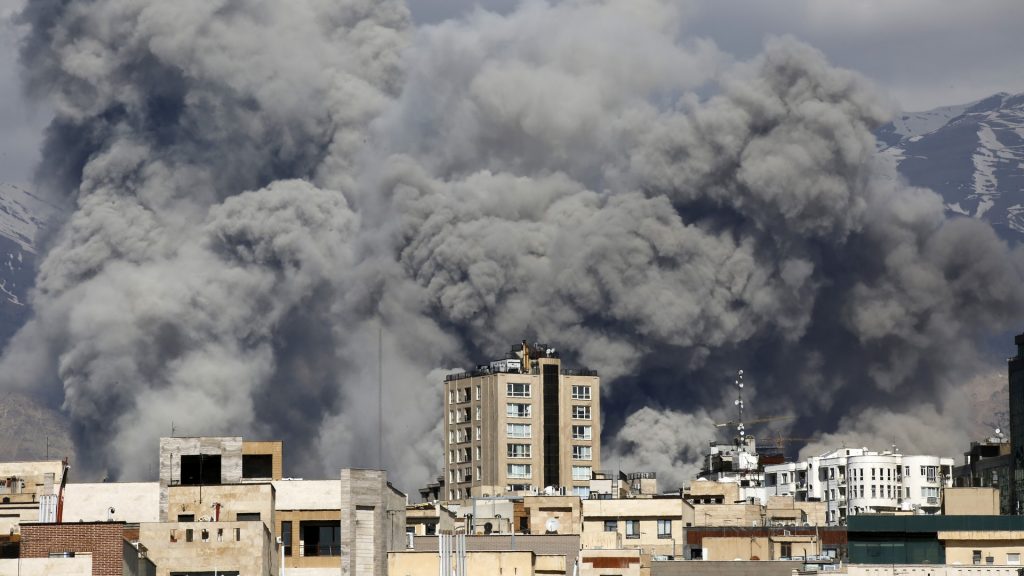
Monday night into Tuesday morning, explosions rocked Tehran as American and Israeli airstrikes continued.
U.S. Central Command (CENTCOM) said American forces have “destroyed Islamic Revolutionary Guard Corps command and control facilities, air defense systems, missile and drone launch sites, and military airfields” since the initial strikes Saturday.
The Iranian Red Crescent says at least 787 people have been killed in Iran since the fighting began.
President Donald Trump posted on social media late Monday night, saying the U.S. has a “virtually unlimited supply” of weapons and said “wars can be fought ‘forever'” using those resources.
Trump administration officials, including Secretary of State Marco Rubio, Secretary of Defense Pete Hegseth, CIA Director John Ratcliffe and Joint Chiefs Chair Gen. Dan Caine, are set to brief all members of the House and Senate on the situation in Iran today.
Impacts felt across the Middle East
Meanwhile, Iran and its allies are expanding retaliatory strikes, hitting Israel, gulf states, and targets critical to the world’s oil and natural gas production.
Iran continues to block traffic through the Strait of Hormuz, one of the world’s busiest shipping lanes. About 20% of the world’s oil passes through there.

This story is featured in today’s Unbiased Updates. Watch the full episode here.
An Iranian military spokesperson warned on Iran state TV that any vessels attempting to get through would “set those ships on fire.”
Container ships are now stuck in limbo, waiting for new route instructions amid the closure.
Because one-fifth of the world’s oil passes through the strait, financial markets are reacting sharply. Oil prices surged well above 5% Monday, and stock futures fell, with the S&P 500, the Nasdaq and the Dow all down more than 1% by the end of the day.
The conflict is also spreading to Lebanon, where the Iranian-supported militant group Hezbollah and Israel are exchanging attacks.
The Israeli military struck a building in a southern suburb of Beirut, heavily damaging Hebzollah’s TV and radio station. Israel also said one of its divisions is now operating inside southern Lebanon and its army has taken up positions on several strategic points close to the border.

The Lebanese army is now evacuating some of its positions along the border with Israel and redeploying troops to other posts.
The Israel Defense Forces also announced they completed a series of strikes on Hezbollah command centers, weapons sites, and other communications facilities in Beirut — including locations they said were operating under civilian cover.
Ella Rae Greene, Editor In Chief