Utilities are now pitching data centers as a way to cut electric costs
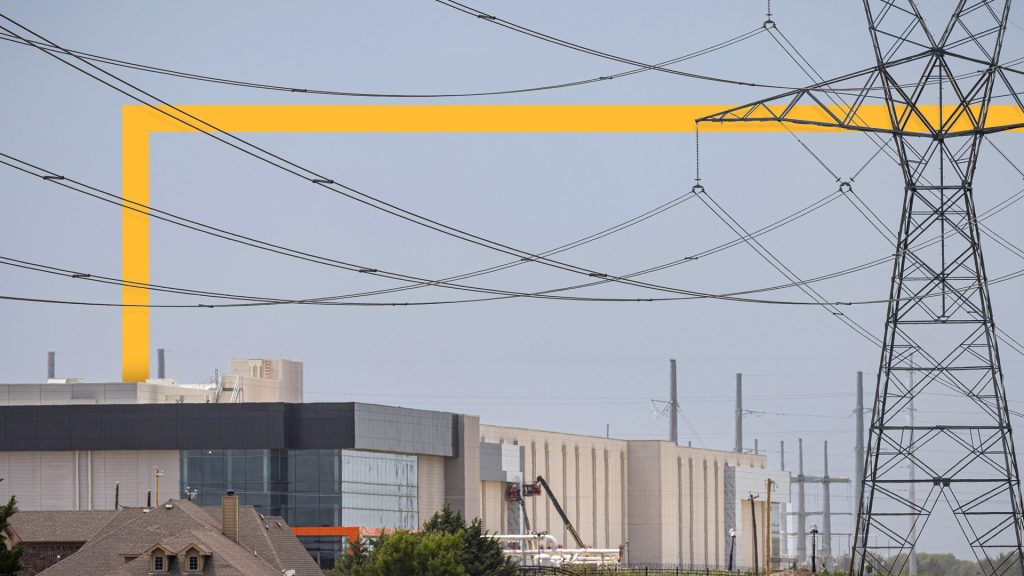
Utility companies have a new message to pitch residents on data centers moving in: The new neighbors will keep electric bills from rising. That’s the opposite of what many opponents to large-scale data center development and some electricity market analysts say.
“As new large-load customers come online, they help spread fixed costs for the grid across a broader customer base,” said Matthew Thompson, a spokesperson for American Electric Power (AEP), one of the largest utilities in the country, in an email to Straight Arrow. “Residential customers will pay a smaller share.”
CenterPoint Energy, the electric transmission provider in the Houston area, described in a statement to Straight Arrow a “once-in-a-generation opportunity” to add 14 gigawatts of data centers — a 65% increase in the amount of power needed across the Houston region. The company said bringing those data centers online would save residential customers $5 billion in charges over a decade.
Electricity prices are rising faster than inflation. From 2024 to 2025, electricity prices increased by 2.6% when adjusted for inflation, according to a July report from the Lawrence Berkeley National Laboratory. The non-adjusted price tag for electricity in 2025 was up 29% compared to 2019. And rising electricity rates coupled with extreme heat are set to make running air conditioning this summer more costly than ever before, with Americans expected to spend an average of $792 on electricity from June to September.
Americans’ concern over increasing costs drove the White House to create a Ratepayer Protection Pledge, a nonbinding commitment for Big Tech to pay for all electricity-related costs of running data centers. The pledge has been signed by the country’s largest electric companies and tech firms.
Many utility companies are going one step further than the pledge by stating that their contracts with data centers will yield cost savings for residential customers that could lower monthly payments. The full picture of data centers’ impact on monthly bills is more complicated.
What are utility companies saying?
AEP said that adding large loads is expected to save existing customers $16 billion in “cost offsets” in a recent earnings report. The savings will flow to customers in vertically integrated states, where the regional AEP utility runs as a regulated monopoly that owns the power plants, power lines and collects customer payments.
“These benefits are the result of agreements and rate structures we have worked with our states to put in place to help drive affordability for residential customers while supporting growth,” Thompson said.
At the state level, most agencies that regulate utilities are requiring specialized contracts that place data centers in a different category from traditional commercial and industrial facilities, with their own electricity rates.
And in many cases, utilities negotiate those contracts, known as large load tariffs, voluntarily. To fulfill the Ratepayer Protection Pledge, the tariffs allocate all new infrastructure costs to the data center developer; often with minimum contract lengths that can last decades, and minimum monthly charges, regardless of how much power the facility consumes. And whenever a new utility customer joins the system, they pay a share of fixed costs to keep the existing network of transmission lines and substations operational.
“Responsibly connecting data centers and large loads to the energy grid creates win-wins in our communities,” said Drew Maloney, president and CEO of the Edison Electric Institute, a trade group representing investor-owned utilities, in an email to Straight Arrow.
Does this mean electric bills will go down?
In Iowa, base electricity rates for customers of the utility Alliant are in the midst of a five-year rate freeze made possible through data center growth, according to the Edison Electric Institute. Nevertheless, the total amount many customers pay has gone up due to other factors, such as regional transmission charges.
Georgia Power has introduced a mechanism to save customers $50 per year, but whether savings can be attributed to data center development is the subject of a pending investigation by the state utility regulator, Georgia Public Broadcasting reported.
Multiple factors, such as maintenance expenses, fuel costs, and regional electricity market design, contribute to the final amount Americans see on their power bill. And experts told Straight Arrow despite some cases where data centers can reduce operational costs for residential customers, as a whole, they create upward pressure on what it costs to generate electricity.
“Anytime you add demand to a market, especially when supply cannot respond rapidly, the price goes up,” said Ed Hirs, an energy economist at the University of Houston.
At three auctions for electricity on America’s largest power grid, PJM, data centers accounted for $21.3 billion, or about 45% of future electric supply contracts, an independent market monitor’s report found. Over the past year, the prices paid for wholesale power in the PJM region have surged to record highs.
“Data centers require so much power from the interstate grid that that competes with everybody else and drives prices up,” Tyson Slocum, director of the energy program at the nonprofit Public Citizen, told Straight Arrow.
Slocum also pointed to how data centers compete with electric utilities’ other needs for equipment like transformers. That’s creating a supply chain problem, according to an April report from energy analytics firm Wood Mackenzie.
“Data centers have essentially become an inflationary component of utility service that is not accounted for in this policy narrative of ‘data centers should pay their fair share,’” Slocum said.
The role of for-profit electric utilities
America’s utility companies do not have immediate control over wholesale electricity prices, and even less so on supply chains for electrical equipment. Vertically integrated utilities also have a legal obligation to serve customers in their territory. On what it can more readily control — the large-load tariffs and agreements with data center developers — the utility industry argues that it’s doing everything it can to lower costs for residential customers.
“America’s electric companies work every day with administration, federal and state officials to protect customers and power innovation,” Maloney told Straight Arrow.
But as local backlash to data centers surges, “the utilities here are not neutral arbiters,” according to Slocum.
“There is an inherent financial relationship between data centers’ push to build,” and a utility company’s profit opportunity through selling more electricity, Slocum said. “That growth can be at odds with the public interest and what household consumers want from their utility.”
Round out your reading
- Why Gen Z is staying home on the weekends.
- Autism research is entering a new era. Here’s what scientists are learning.
- The big reason small cities want data centers. Hint: It’s not permanent jobs.
- High school teacher arrested at city meeting after clapping for anti-data center speech.
- Off Script: Everyone’s watching Michigan. Our reporter explains why the race just changed.
Ella Rae Greene, Editor In Chief