US industrial base is becoming stronger for wartime production, study finds
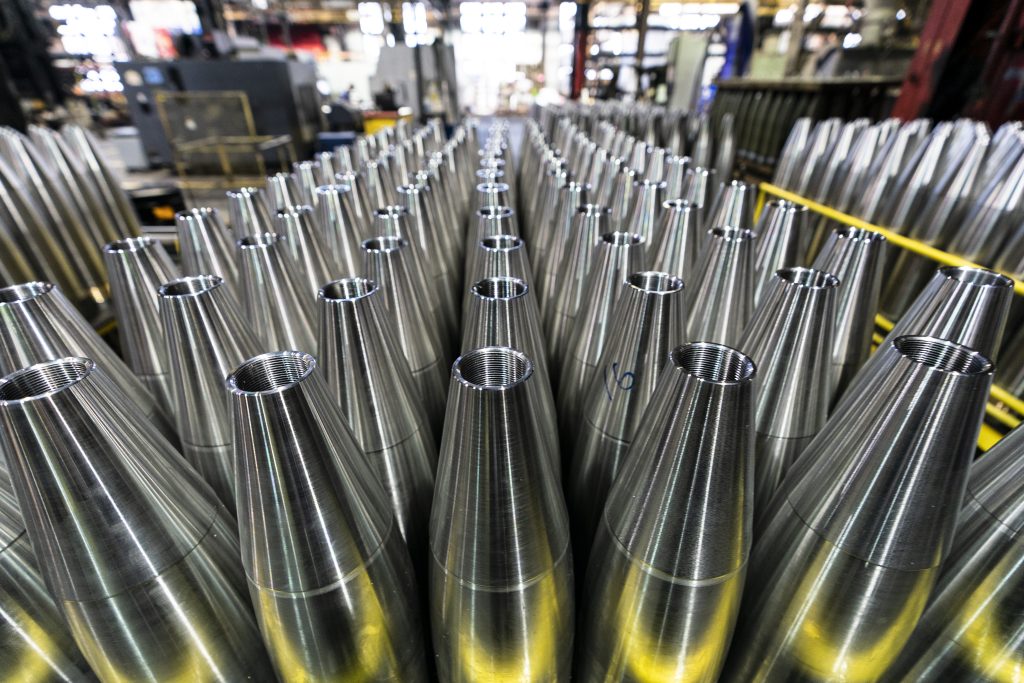
As recent conflicts consume weapons at a ferocious rate, America’s defense industrial base is becoming more prepared to sustain a major war, according to a new report.
“The trends are moving in the right direction,” Jerry McGinn, who co-authored the study for the Center for Strategic and International Analysis think tank, told Defense News.
However, the study — described as a progress report on reforms to the defense manufacturing and acquisition system — still found numerous problems with ramping up and sustaining wartime production.
For example, “according to several measures — manufacturing lead times, critical munitions and materials stockpiles, and supply chain security — the U.S. industrial base has a long way to go to achieve resilience,” warned the analysis by CSIS’s Center for the Industrial Base.
CSIS did find measurable improvements since November 2025, when Secretary of Defense Pete Hegseth vowed to “transform the entire acquisition system to operate on a wartime footing.”
Hegseth also promised to “inspire American industry to become a wartime industrial base that focuses on speed and volume.”
Most striking is the number of new companies in the defense field.
“Roughly 10,000 new firms have entered the market in the past two years and nontraditional companies received over $120 billion in contract obligations in FY 2025, adding competition and innovation to the sector,” CSIS noted. “Munitions contract obligations have risen 330 percent since FY 2010. Spurred by this increased demand and depleted inventories, the Pentagon is signing multiyear agreements with munitions producers and suppliers on a historic scale.”
The military is also responding to depleted stockpiles of expensive guided weapons that have been rapidly consumed by the Iran and Ukraine wars.
The Pentagon’s 2027 budget request for munitions allocated 49% to low-cost munitions — defined as costing less than $600,000 apiece — rising to 70% by 2031.
The U.S. is also strengthening its defense supply chain, such as “multiyear procurement agreements, direct-to-supplier investments, and leaner acquisition pathways,” as well as investing in defense companies such as L3Harris Missile Solutions, according to CSIS.
However, while this signals government commitment to defense production, it “also complicates competitive dynamics within the industry as new entrants and established suppliers alike seek to meet rapidly growing demand for munitions at scale.”
Also notable is federal investment in rare earths, which has seen production soar from 95 tons in 2022, to 8,900 tons in 2025. Nonetheless, “the erosion of domestic rare earth manufacturing capacity and the rise of Chinese control took decades to unfold, however, and it will take several years of enduring effort for the United States and its allies to build, scale, and sustain the production capacity of these key defense inputs.”
Exports of U.S. arms, or cooperative multinational projects such as the F-35 fighter, have also become a pillar of America’s defense industry. Foreign Military Sales, or FMS, have more than tripled, from less than $20 billion in 2015 to more than $80 billion in 2025.
The Trump administration wants to take this further with the “America First Arms Transfer Strategy,” launched in February 2026.
“The United States will use foreign purchases and capital to support domestic reindustrialization, expand production capacity, and improve the resilience of the United States defense industrial base,” the White House executive order declared.
Ultimately, the federal government can control defense production through the products it demands, the prices it is willing to pay, and the incentives it offers.
“It’s a monopsony,” McGinn said. “Government sets the market. Government can regulate the market. So, if the government wants different outcomes, it changes how it buys.”
Ella Rae Greene, Editor In Chief