‘The end of American science as we know it.’ White House funding plan sparks alarm
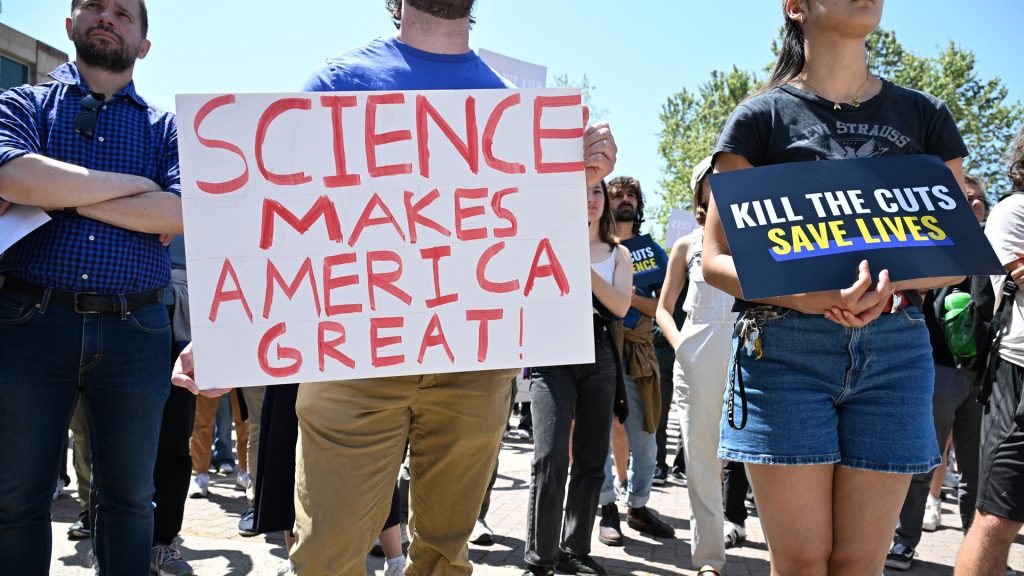
In the early 1970s, federally supported university researchers in California discovered how to combine DNA from different sources and insert it into bacteria. At the time, they were pursuing foundational questions in molecular biology with no clear commercial payoff. Within a few years, scientists used those techniques to manufacture human insulin, launching a new generation of lifesaving diabetes drugs.
Now, scientists say groundbreaking discoveries like that could become far less likely under a sweeping proposal from the White House Office of Management and Budget (OMB).
Research that does not align with the priorities of President Donald Trump and his appointees, including work that lacks an immediate practical application, will not get funded, they warn.
Monday is the final day for the public to comment on the OMB’s 412-page “Regulation for Federal Financial Assistance,” which would overhaul the rules governing federal grants, cooperative agreements and other forms of federal aid.
The proposal rewrites a dense, bureaucratic regulation little known outside contracting and grant-making circles, but one that governs roughly $1.5 trillion in government funding each year. Its reach extends beyond scientific research to funding for healthcare, education and aid to state and local governments.
The Trump administration says that increasing political oversight over discretionary grants would improve transparency and accountability, prevent fraud and waste, and ensure that taxpayer dollars advance the policies of the elected president rather than the priorities of government bureaucrats, universities and researchers. The administration has presented the changes as part of its broader campaign against programs it considers ideological or “woke.”
Critics, including many of the roughly 300,000 people who have submitted public comments, echo what Cole Donovan, a director at the Stand Up for Science Foundation, told Straight Arrow:
“We’re talking about the end of American science as we know it.”
Politicizing science
The budget office’s proposal would fundamentally change how the government has evaluated and supported science for decades.
Political appointees would review all discretionary federal awards, a new layer of scrutiny that would subvert, although not entirely eliminate, the current peer-review process. They would have veto power over projects recommended by independent scientists with expertise in the relevant fields. Federal agencies could also terminate funding before the end of a grant period, abruptly halting studies before scientists reach conclusions.
The proposal would also restrict how grantees can collaborate with researchers and institutions outside the United States, potentially cutting off U.S. science from international partnerships and expertise.
“It’s an invitation to disaster,” said Harold Varmus, who won the Nobel Prize in 1989 for his groundbreaking research identifying cancer-causing genes. He later led the National Institutes of Health, Memorial Sloan Kettering Cancer Center and the National Cancer Institute.
Varmus told Straight Arrow the OMB proposal should be a call to action for all Americans, regardless of their politics. He said it would place responsibility for selecting projects in political appointees whose principal guidance may be “a need to remain consistent with the goals of the administration.”

Varmus acknowledged that government-funded science can never be entirely insulated from politics. Elected officials and political appointees set broad research goals and propose budgets, while Congress determines funding levels.
But he said decisions about how federally supported research is conducted — including the design of the work and the selection of researchers — have traditionally been left to trained scientists whose political affiliations are “considered irrelevant to their tasks.”
Donovan said the proposed changes would make the U.S. a global outlier.
“You’re introducing an incompatibility between the way U.S. scientists are funded and how their European partners are funded,” he said. European research programs, for example, can require gender-equality plans and without them, American grant recipients could be shut out from collaborations.
If the proposed rule is implemented, Donovan said, the American funding system would most resemble China’s, “with ideological requirements attached to academic programs.”
Historian Timothy Snyder said during a recent Stand Up for Science webinar that the administration’s proposed rules remind him of late Stalinism, “where people who know nothing about science are the ones who are making the decisions about what’s going to go forward.”
Snyder and others have pointed to the cautionary tale of agronomist Trofim Lysenko, a political ally of Soviet dictator Joseph Stalin who rejected modern genetics, spread misinformation and helped suppress dissenting scientists. In the 1930s, Lysenko’s agricultural methods contributed to widespread famine that killed millions.
“A similar threat now hangs over U.S. science,” the editors of the New England Journal of Medicine wrote in a recent editorial opposing the OMB proposal.
Downstream effects
Dozens of biotechnology and pharmaceutical executives, whose companies benefit from federally funded research but do not receive grants, have joined the chorus of opposition to the OMB proposal.
“Federal grants frequently support the early scientific discoveries that make future private investment possible,” the advocacy group No Patient Left Behind wrote in a letter signed by dozens of business executives and investors.
The letter warned that the OMB rule would increase uncertainty and stifle research. That would mean “fewer investors funding early-stage innovation, leading to fewer clinical trials, fewer startup companies, fewer high-quality American jobs, and ultimately, fewer life-saving medicines reaching patients.”
Federally supported research is “really the start of the scientific pipeline,” Donovan said.
Grants allow researchers to investigate questions that private companies have no immediate financial incentive to pursue or undertake projects whose scale is beyond the capacity of any business.
Cutting off or politicizing that funding, Donovan said, would have downstream effects on American industries, from pharmaceuticals to semiconductors to communications, and on government functions, such as weather forecasting. The United States could ultimately cede leadership in those fields to other countries, he said.
Moody’s Ratings has warned that the rule change could also put downward pressure on the credit ratings — and potentially raise the borrowing costs — of cities, universities, hospitals and other institutions that rely on federal funding, by making their revenue less predictable.
Shifting research priorities
Supporters of the OMB rule argue that researchers, universities and unelected bureaucrats have not been as politically neutral as they portray themselves and that their left-leaning positions do not reflect the values and priorities of most Americans.
An executive order signed by Trump last year said federal grants had supported projects involving critical race theory, transgender programs and other activities the White House described as ideological or wasteful.
Daniel West, government relations director for Heritage Action, a conservative advocacy group, called the proposal “eminently common sense” and said voters expect the president they elect to influence how federal money is spent.
“When folks are uncomfortable with some of the oversight that is being applied, I’d ask why,” West told Straight Arrow. Among his concerns is whether taxpayer dollars could be used to fund abortion research or hire people living in the country illegally.
West also disputed predictions that the measure would devastate scientific research, calling them “clearly hyperbole.”
Straight Arrow could not identify any congressional Republican who had publicly advocated for the OMB’s proposed rule. But West said Heritage Action has spoken to supportive Republicans on Capitol Hill and expects those members to submit a comment letter before Monday’s 11:59 p.m. deadline. He declined to identify them.
The Republican National Committee defended the OMB proposal when Straight Arrow asked for its position.
“In battleground districts across the country,” said Natalie Baldassarre, the RNC’s national press secretary. “Democrats will have to answer for why they are perfectly content with enabling the waste, fraud, and abuse of taxpayer dollars to fund liberal pet projects and far left nonprofits.”
She added: “President Trump has restored transparency and common sense to the federal government which the American people overwhelmingly support.”
Disfavored research topics
The Trump administration has already made deep cuts to research funding and personnel in its disfavored scientific fields, such as climate science.
Romany Webb, a research scholar at Columbia Law School, told Straight Arrow that the proposed rule threatens to “decimate climate research in the U.S.”
“This will make it easier for the current administration to justify rolling back climate-related regulations,” she said, “and harder for the next administration to reverse course.”
Brittany Janis, executive director of the Open Environmental Data Project, also criticized provisions she said could prevent researchers from documenting disparities among demographic groups and communities.
“You can’t fix a disparity you’re not allowed to measure,” Janis told Straight Arrow. “This rule takes entire lines of scientific inquiry off the table.”
What’s next?
Experts told Straight Arrow that the OMB could finalize the new rule as soon as this fall, before the midterm elections.
After the public comment period closes Monday night, OMB must review the submissions and respond to significant comments before issuing a final rule. The agency has proposed making the regulation effective on Oct. 1.
OMB did not respond to multiple requests for comment from Straight Arrow.
Donovan, of Stand Up for Science, said he does not expect Congress to take action on the rule change, despite claims by some Democrats that it usurps congressional powers. However, he expects a flurry of lawsuits against the agency in the weeks ahead.
Elizabeth Ginexi, a former program official at the National Institutes of Health, said during a recent webinar that the rule would codify practices already underway.
She said scientists at the NIH and National Science Foundation have told her that their grants are being screened again after passing the usual peer and institutional reviews. She said researchers are removing certain words from proposals or reshaping their research to align with administration priorities.
“I would say the rule is supposed to take effect in October,” Ginexi said, “but it’s already taking effect right now.”
Round out your reading
- With more prison space than prisoners, correctional facilities are shutting down.
- ‘Game changer’: New cancer treatment turns major surgery into an outpatient procedure.
- Viewers overwhelmingly support ‘The View’s’ fight against the FCC. Will that matter?
- Why an ICE shooting in Houston isn’t leading to mass protests.
- Milwaukee detective is the latest officer charged with misusing Flock cameras.
Ella Rae Greene, Editor In Chief