Trump says he wants to add wildfire smoke cost to Canada’s tariffs
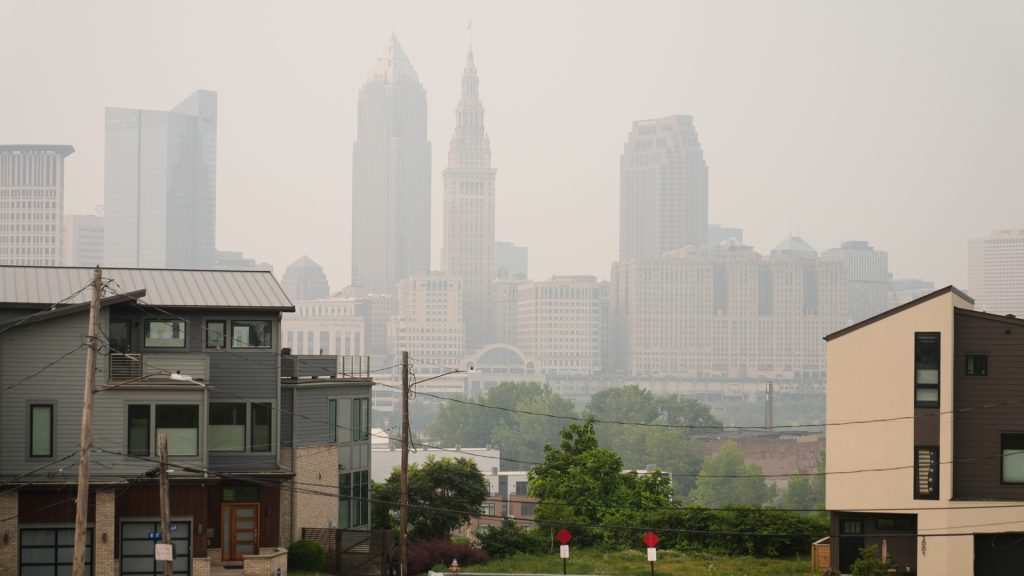
President Donald Trump on Friday threatened to add the cost of air pollution from wildfires to the tariffs Canada is currently paying. Other Republicans have also criticized Canada, citing smoke from the wildfires blowing into the U.S., affecting millions of Americans.
“The cost” of this, Trump said on social media, “is incalculable.”
“The United States is being unnecessarily invaded by filthy, polluted, and unhealthy air, the quality of which is dangerous, and totally unacceptable!” he said.
Four GOP House representatives from Michigan, where air quality earlier this week ranked among the worst in the world, wrote a letter to Canadian Prime Minister Mark Carney, saying that if Canada is not able to do more to stop the fires, “the United States will look elsewhere, and act on our own, to protect our people.”
Sen. Bernie Moreno, R-Ohio, said he plans to introduce a bill sanctioning Canada and its government over the fires.
Asked about the American lawmakers’ criticisms at a news conference Friday, Ontario Premier Doug Ford said “if there’s some politicians out there chirping away, well, maybe what you should do rather than complain is send support, send help, because we have done the exact same thing for our American friends.”
He added that he truly believes the Americans “are good neighbors” and that he spoke with Minnesota Gov. Tim Walz and Massachusetts Gov. Maura Healey.
In Trump’s post, he accused Canada of refusing to “engage in basic Forest Management and Debris Removal, knowing that such refusal would lead to exactly this result.”
A spokesperson for Canada’s embassy in Washington said in a statement to CBC that Ambassador Mark Wiseman has “engaged directly with key administration and Hill officials regarding the wildfire emergency in Canada, our efforts to address it, and the impact of wildfire smoke on Canada and the U.S.”
Canadian Minister of Emergency Management and Community Resilience Eleanor Olszewski put out a statement Friday saying that since 2020, “Canada has invested $12 billion in forest sustainability and fire prevention.”
“Warmer, drier weather is becoming more common, increasing wildfire risk in Canada and around the world,” she said. “Canada is responding to this increasing risk with renewed focus.”
Why is Canada seeing wildfires?
As of Saturday, Canada is seeing 952 active wildfires blazing across the country, according to a government website. Of these, 150 are deemed to be “out of control.”
Daniel Swain, a climate scientist at the California Institute for Water Resources and a research partner at the National Center for Atmospheric Research, said in a video posted to YouTube that fires in eastern Canada and the Midwest are because of North America’s heat wave. These high temperatures have “dried out the forest, and allowed for thunderstorms and lightning strikes.”
Canada hosts nearly a tenth of the global forest area, and much of that is uninhabited.
Climate scientist Andrew Dessler, a professor of atmospheric sciences at Texas A&M College of Arts and Sciences, told Reuters fires in Canada are burning in largely unmanaged forests that were, in the last 100 years, allowed to burn until they died.
The higher temperatures intensifying and prolonging fires in Canada are “because of climate change, that’s the thing that has changed,” Dessler said, adding “nothing else has changed.”
What’s in the forecast for wildfire smoke?
Wildfire smoke spread across the eastern half of the U.S. this week. People from New York City to Chicago experienced unhealthy and even hazardous air quality levels.
Air quality did improve Friday in parts of the upper Midwest, though.
On Saturday, The Weather Channel predicted that smoke would continue impacting major Northeast cities in the morning and early afternoon.
However, showers and thunderstorms in the Ohio Valley and much of the Northeast “should help to temporarily clean the air of smoke particles in some of those areas.”
But residents of those areas aren’t necessarily in the clear yet: another round of smoke going southward into the western Great Lakes Saturday, then into the Ohio Valley, could affect “at least parts of the Northeast and mid-Atlantic on Sunday,” The Weather Channel reported.
A third round of smoke could either “nosedive” through the upper Midwest starting on Tuesday, before going into the Northeast around Wednesday, according to The Weather Channel. It could also go into parts of the South on Wednesday and Thursday.
Round out your reading
- With more prison space than prisoners, correctional facilities are shutting down.
- ‘Game changer’: New cancer treatment turns major surgery into an outpatient procedure.
- Viewers overwhelmingly support ‘The View’s’ fight against the FCC. Will that matter?
- Why an ICE shooting in Houston isn’t leading to mass protests.
- Milwaukee detective is the latest officer charged with misusing Flock cameras.
Ella Rae Greene, Editor In Chief