States trying to change presidential elections just got closer, but is it legal?
The movement to transform how states elect a presidential candidate inched closer to reality after a state legislature passed a bill to join the compact. The campaign faces several challenges as it’s not a priority for many Americans and an opposition group says it would undermine voters.
The National Popular Vote Interstate Compact looks to add another state to its list of supporters as Virginia lawmakers sent a bill to Gov. Abigail Spanberger’s desk for her consideration. If the Democrat signs it, the compact would be at 222 electoral votes, 48 short of the requirement to take effect.
California, Colorado, Connecticut, District of Columbia, Delaware, Hawaii, Illinois, Massachusetts, Maryland, Maine, Minnesota, New Jersey, New Mexico, New York, Oregon, Rhode Island, Vermont and Washington state have all enacted legislation on converting the presidential selection process into a national popular vote, according to National Popular Vote. All states, with the exception of N.Y., had a Democrat trifecta when they joined the compact.
Elsewhere, lawmakers have introduced legislation in Arizona, Florida, Kansas, Pennsylvania, South Carolina and Texas to join the compact. None have advanced as of yet.
National Popular Vote chair John Koza said in a statement that the movement would ensure each vote counts and presidential elections reflect the nation. Koza is a registered Democrat and has donated to Democratic campaigns across the nation since at least 1978, according to the Federal Election Commission. The campaign would not eliminate the Electoral College, but instead award the national popular vote winner all 535 electoral votes.
Removing the Electoral College requires an act of Congress. The Constitution, however, doesn’t require states to adhere to any election format.
“It’s likely to be challenged legally, probably to go all the way to the Supreme Court,” Michael Traugott, research professor at the University of Michigan, told Straight Arrow News. “But in the meanwhile, a bunch of states, especially but not entirely, the states on the East Coast have agreed to do this.”
He added that a constitutional convention could be called to change presidential elections, but politicians are likely to debate several issues.
Apart from possible legal challenges, the National Popular Vote Compact faces opposition from Save Our States, a right-wing group whose aim is to keep the Electoral College intact. Trent England, executive director of Save Our States, told Straight Arrow News the Electoral College preserves political stability and representation in the U.S. He noted the compact combines votes across state lines, which would create conflicts should results get contested or go to a run-off.
“The electoral college was created at the beginning of our country where people lived in cities, rural areas, small towns and states,” England said. “You need some kind of a balancing mechanism to where you don’t end up with a group that has a central voice.”
Reforming electoral college a low priority, but has high support
National Popular Vote has said the effort is needed as it would force presidential candidates to expand their campaigning and enforce the ideal of “one-person-one-vote.” But the plan doesn’t award a president for securing the popular vote in a state, instead it does for the nation.
A presidential candidate doesn’t always win the popular vote. The contentious 2000 election was decided by a U.S. Supreme Court decision. George W. Bush won 271 Electoral College votes, and Vice President Al Gore had about 500,000 more votes, according to 270 To Win.
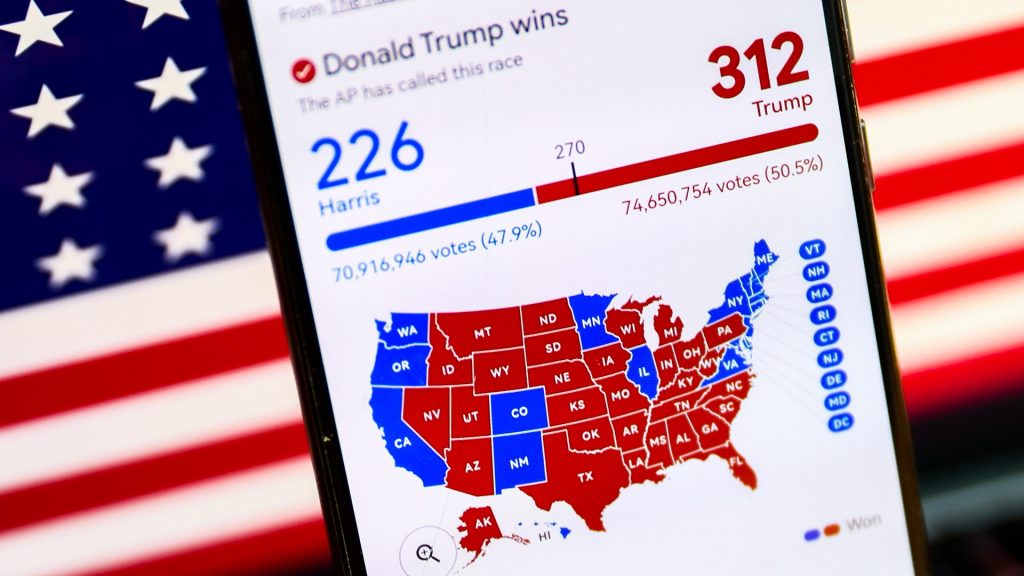
A wider margin of popular votes happened in the 2016 election, where now-President Donald Trump won 304 electoral votes, but then-Secretary of State Hillary Clinton won 3 million more votes.
Which party wins the presidency will sway voters’ opinions on the Electoral College. Hannah Hartig, a senior researcher at Pew Research, told Straight Arrow News that, generally, most Democratic voters have supported switching to a popular vote, while Republican voters’ opinions fluctuate.
“People do see the stakes of something like this,” she said. “It’s this idea that someone might be baking in an advantage or baking in some kind of disadvantage to them.”
She added that reforming the presidential process isn’t as high a priority for many Americans as issues like congressional term limits and age limits.
Despite that, a Pew Research survey from September 2024 showed that 63% of American adults supported the president being the person who wins the most votes nationally. The center surveyed 9,720 Americans for the poll. In contrast, 35% of respondents favor retaining the Electoral College.
Legal challenges ahead
Traugott suspected Republican-led states or lawyers for those politicians would file lawsuits to prevent the change, as it could be perceived as a workaround to the Electoral College. He noted the specificity in it being on a national scale, not state-by-state outcomes that would require a Constitutional amendment.
“The states are essentially pledging to cast their electoral votes for the winner of the national vote,” he said.
John Martin, assistant professor of law at Quinnipiac University, told Straight Arrow News that one argument could be the agreement runs afoul of Article 1, Section 10, Clause 3 of the Constitution, which says no state shall — without consent of Congress — enter into any agreement or compact with another state.
However, Martin added that the Supreme Court has already reviewed compact clauses of the Constitution and decided it only applies to agreements that would intrude upon the federal government’s power. That’s not immediately clear in the National Popular Vote Interstate Compact, he said, because states decide how they appoint their electors, not the federal government.
“So the states that sign on to this compact can simply point to the elector’s clause of the Constitution and say, ‘Hey now. This is our wheelhouse. This is our power,’” Martin said.
Switching to a national popular vote or reforming the Electoral College has come up throughout history, Traugott said.
“It’s a combination of the, the growing imbalance of the votes, the distribution of votes in the electoral college,” Traugott said. “And the fact that we’ve had Democrats in recent elections win the majority of the vote, but not enough electoral votes as a result.”
Ella Rae Greene, Editor In Chief