
Security guards have prevented deadly attacks. Religious leaders petition Congress to fund them
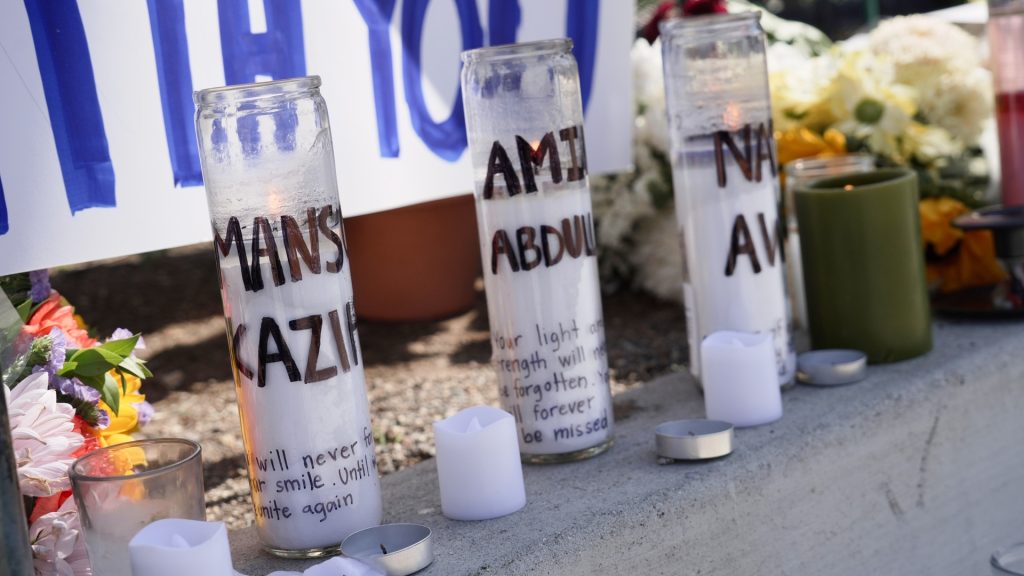
Attacks on places of worship in the past year have resulted in 11 deaths and dozens of injuries. Leaders have lobbied lawmakers for more protections, warning that the status quo will lead to more incidents, affecting their congregants’ sense of security.
Amin Abdullah, 51, an armed security guard at the Islamic Center of San Diego, was credited with putting his life on the line and protecting the Monday mosque shooting from becoming a high-casualty incident. Guards like him are expensive to come by, but a need for religious organizations as gun violence continues in the nation, religious leaders told Straight Arrow.
It’s become so severe that religious leaders are pleading with Congress to boost the Nonprofit Security Grant Program’s funding from $274.5 million to $1 billion. The Federal Emergency Management Agency manages and disperses grant awards.
“Every day that passes, that American citizens don’t have access to this money, puts us at risk,” Jen Lader, a rabbi at Temple Israel in West Bloomfield, Mich., told Straight Arrow.
She joined several Jewish leaders in Washington, D.C. after the attack on her synagogue, which she said has also motivated senators to cosponsor legislation U.S. Sen. Jacky Rosen, D-Nev., introduced for security upgrades. Lawmakers sent the bill to the Senate Committee on Homeland Security and Governmental Affairs on Tuesday.
“It allows houses of worship and other nonprofit institutions to apply to the federal government for funding for security needs,” Lader said.
Since 2020, there have been at least seven attacks on houses of worship. In terms of mass shootings where more than one person was injured or killed, the Rockefeller Institute of Government has found that 22 shootings have happened at houses of worship since 1966. It does not yet include the Islamic Institute of San Diego shooting.
The Council on American-Islamic Relations sent a request Wednesday to U.S. Department of Homeland Security Secretary Markwayne Mullin to restore Muslim organizations’ access to the grant.
The White House Religious Liberty Commission, which is tasked to address threats to religious freedom and enhance protections for faith-based organizations, has not commented on the legislation, nor has it commented on the mosque or Michigan synagogue attacks.
Texas Lt. Gov. Dan Patrick, who chairs the White House’s Religious Liberty Commission and is seeking reelection, didn’t immediately respond to Straight Arrow’s request for comment.
“It’s not something that we can fight on our own,” Lader said. “It’s something that we need our government’s support and help in managing this. Not just to protect our own kids, but to protect all of our children in America who deserve to go to school safely without being afraid.”

Security guards saved lives
Law enforcement and religious leaders credited armed security guards at Temple Israel and the Islamic Center of San Diego for preventing massacres.
Lader noted that after the Tree of Life mass shooting in Pittsburgh, synagogues across the nation hired armed security guards. For the temple, she said they spend $800,000 a year just on the security team. Congregants support it through their membership, but she said that money could be used elsewhere if they secured federal assistance.
“The fact that we have to do this — and I believe every house of worship should be doing it — is really indicative of why we need our government to step up to fight this scourge,” she said.
She feared that if the guard didn’t stop the attack, it would have become deadly quickly, as the attacker had explosives with the intent of committing mass murder. Lader added that the synagogue is equipped with an automatic weapon fire system, which cuts power to the hallways and releases thick, black smoke. Teachers also helped in physically shielding students.
“Having security personnel is non-negotiable,” Lader said.
Cory Saylor, research and advocacy director at CAIR, told Straight Arrow the silence from the White House’s religious commission is deafening as the civil rights organization has tracked an all-time high of Islamophobia, sometimes parroted by elected officials, in 2025. He believes 2026 may see worse numbers.
He’s seen Islamophobia play out in many ways in his time at CAIR, and said it makes sense why more mosques and other institutions are hiring armed guards. But Saylor doesn’t want just any armed guard.
“I like people to be well-trained and understand how to use a firearm and not be an amateur who is afraid and acting in a moment of adrenaline,” Saylor said.
But the leaders know the request can be costly, especially as they’re tax-exempt organizations. Still, they don’t see a reason why the government shouldn’t help them, as religious institutions have often helped local communities with social services or mental health help, Tuqa Nusairat, executive director at the Institute for Social Policy and Understanding, told Straight Arrow. The institute is a Muslim-focused research organization.
“It’s very hard to find a mosque, a church or temple that is not also providing free food through food banks,” Nusairat said. ”My local mosque provides free food. They provide schooling and social services and mental health services.”
Feeling safe where they preach
Straight Arrow reached out to seven religious institutions that experienced violence or a mass shooting since 2020 and found that congregants at one said they feel safe enough to return, while another has closed down due to the damage.
Lader recalled hearing from Jewish families after the March attack about how safe they felt at the synagogue. They said the security protocols staff followed, the systems at the temple, and the security guard’s actions made them feel secure.
“Our parents are overwhelmed with gratitude for our security team and our teachers, and they don’t want to be anywhere else,” she said.
Nusairat and Saylor haven’t heard that. Instead, mosque leaders said in a survey they’re concerned about safety and security whenever their community gathers.
Nusairat noted the Trump administration’s policy change affecting which religious organizations can secure nonprofit security grants, and said it doesn’t meet the White House’s messaging in protecting religious freedom.
She said it’s important for the White House and other politicians to condemn any hateful rhetoric they see to protect Americans.
“Seeing this increase in mass violence against houses of worship is a symptom of the disease overall, and the disease is hate and extremism and access in a way that they don’t have in other countries,” Lader said.
Round out your reading
- They built an Epstein files library, but realized they couldn’t let everyone read them.
- The doctor who claims functional medicine reversed her MS.
- For many Americans, ‘one more round’ no longer serves their lifestyle or budget.
- Trump claimed economic data is ‘rigged.’ Former officials pledge to ‘watch like hawks’ for political manipulation.
- We’re building a new Straight Arrow. Help us shape our future by taking our survey.
Ella Rae Greene, Editor In Chief