Pump.fun says people can ‘pay anyone to do anything.’ Is it legal?
What would you do for money? What’s doing it worth? A new site offering bounty-type tasks in exchange for digital currency is banking on finding out.
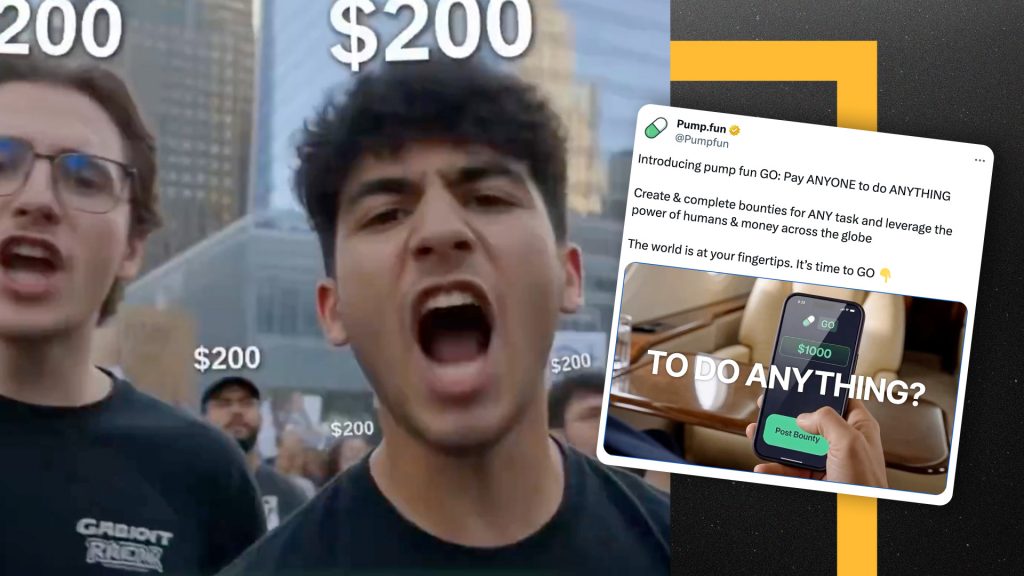
Pump.fun has unveiled a new service that lets people complete user-generated tasks in exchange for meme coins. The venture received criticism for being a “dystopian nightmare” and encouraging insider trading, one scholar told Straight Arrow.
A post advertising a new feature on Pump.fun has some users on X wondering if a popular television show is becoming a reality. The tasks ranged from getting certain tattoos to donating hair to a cancer foundation to dying by suicide. The last task has since been removed.
There were 818 live submissions as of Tuesday and $45,000 in payouts. But the money isn’t exactly real. All of the rewards are in meme coins, a cryptocurrency that Craig Holman, government affairs lobbyist with Public Citizen, said fluctuates based on the social environment. In essence, people can decide how much a coin is valued.
That’s the case for custom currency like $DOGE, which Coinbase said is worth $0.085 as of Monday. The coin’s value has dropped 57% since last June.
Many of the bounty hunters on Pump.fun are paid in $SOL, a cryptocurrency for the Solana network. It’s currently valued at $65.15, but has dropped 61% since last June.
“When it comes to cryptocurrency, it’s pretty easy to do insider trading since crypto doesn’t really have a set value,” Holman said.
The website has advertised several coins on its X, encouraging more support for bounties.
Pump.fun allows anyone to create coins and set valuations however they see fit. The company’s operator, U.K-based Baton Corporation, didn’t immediately respond to Straight Arrow’s request for comment.
“Create & complete bounties for ANY task and leverage the power of humans & money across the globe,” Pump.fun said on X Thursday. “The world is at your fingertips. It’s time to GO.”
The post caught New York Gov. Kathy Hochul’s attention, who joked on X that she’s offering a bounty to “ban this dystopian nightmare.”
Platform quickly attracts controversy
The actual platform has existed since 2024 as a website for creating and trading custom meme coins. Holman told Straight Arrow in an email that the website encourages insider trading as coin insiders, also called snipers, would play the “Greatest Fool Theory” to drive up valuations.
“Snipers frequently learn about a pending project and buy the memecoins invested in that project, and then post the memecoins for sale on the Pump.Fun platform,” he wrote. “The game is to then sell those memecoins to a ‘greater fool’ willing to pay a higher price.”
The site is facing two lawsuits, each accusing the platform of violating federal securities laws.
In one, Diego Aguilar accused the platform and its owners of offering and/or selling tokens not registered with the U.S. Securities and Exchange Commission via racketeering. The lawsuit, filed in January 2025, seeks class action status.
In another, Kendall Carnahan wrote that he purchased a PNUT Token, which wasn’t registered with the SEC. He alleged Pump.fun promoted unregistered securities and operated in Ponzi and pump-and-dump schemes. U.S. District Court for the Southern District of New York Judge College McMahon consolidated the two cases in June 2025.
Baton’s lawyers have sought to get both lawsuits dismissed.
Bounties, exposure drives coins’ value
The U.S. Securities and Exchange Commission acknowledged meme coins in a February 2025 statement, noting that the crypto assets are more akin to collectibles than they are to other forms of currency. Due to the commission’s view, it has settled on the belief that anyone who offers or sells meme coins doesn’t need to register their transactions under the Securities Act.
“A meme coin does not constitute any of the common financial instruments specifically enumerated in the definition of “security” because, among other things, it does not generate a yield or convey rights to future income, profits, or assets of a business,” according to the statement. “In other words, a meme coin is not itself a security.”
It is similar to the value a person places on a baseball signed by an MLB player. If the player rose in popularity and has become a generational figure for a team, a baseball signed by them would be worth more than one signed by a lesser-known MLB player.
Despite its view of meme coins, the SEC held that they are still subject to enforcement or prosecution under other state and local laws. It could change how insider trading is viewed on Pump.fun, as Holman said it involves profiting off of private information before it becomes public.
“It’s very much influenced by however much someone says it’s worth,” he said. “It’s sort of like the predictive market industry where you can actually gamble on anything.”
Holman didn’t explicitly address some of the bounties being pushed, but said it’s akin to bets people have placed on political campaigns and other political events like former Venezuelan President Nicolas Maduro’s capture.
“People come from all different types of the world, and they can cash in on whatever private information they have,” Holman said.
Round out your reading
- People are overdosing on GLP-1 injections. What does that look like?
- Researchers put chatbots in a simulation. Grok ended the world in 4 days.
- Fearing more e-bike injuries, Illinois looks to become 10th state to mandate registration, insurance.
- Why are young professionals facing such a tough job market? Hint: It’s not just AI.
- We’re building a new Straight Arrow. Help us shape our future by taking our survey.
Ella Rae Greene, Editor In Chief