When AI reports the news, facts don’t always get in the way of a good story
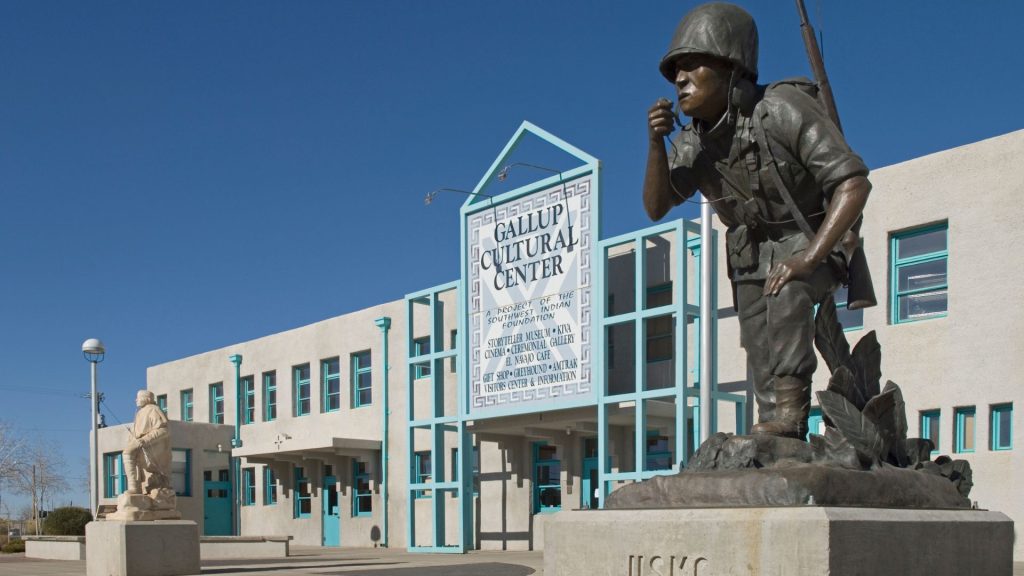
New Mexico is dealing with the aftermath of historic monsoon rains that left many areas flooded and damaged. One of those areas was Gallup, a small city near the Arizona border.
Residents were already on edge because of the flooding, and their anxieties only grew after reading that the rains had claimed the life of a neighbor.
But this wasn’t true.
The death, it turns out, happened a different year. And the person who died was the victim of a different flood.
The claims originated from Prism News, a news site that says it’s filling a void left by mainstream media as more local news outlets leave smaller communities because expenses are exceeding revenues.
But the outlet says all its stories are written and published using artificial intelligence without human input. Its parent company, however, says its operations as a whole are supervised by humans.
The Prism’s error — reported by another outlet, Source New Mexico — illustrates the dilemma facing so-called news deserts, the large swaths of America where local news produced by real reporters and editors can be hard to come by. AI news sites can highlight important stories, but sometimes they get them very wrong.
In February, the Gallup Independent closed after more than a century covering the area, Source NM reported. But that didn’t leave residents there completely without a local news source. The Gallup Sun, a weekly newspaper, and the Gallup Journey, a monthly community magazine, still report for the area.
Where has local news gone?
The Gallup Independent, which once published Monday through Saturday before retreating to a four-day-a-week publishing schedule, shut down altogether in February. That left the community with The Gallup Sun, a weekly newspaper, and the Gallup Journey, a monthly magazine.
The Independent’s closure reflects a nationwide trend. According to the 2025 State of Local News report by Northwestern University’s Medill School of Journalism, 213 counties in the U.S. are full news deserts, with no locally produced professional news outlets. But 1,524 counties have only one remaining local news source, usually a weekly newspaper.
Since 2005, nearly 3,500 newspapers have closed nationwide, including 136 in the last year alone. Researchers point to several causes, including the collapse of the print advertising model that once sustained newspapers, as ad revenue shifted to digital platforms, and consolidation, as weakened papers became acquisition targets for large corporations that further cut newsrooms.
But Gallup is a little different, according to Zachary Metzger, director of Northwestern’s State of Local News Project and one of the report’s researchers. He said he wouldn’t consider Gallup and McKinley County a news desert, since residents still have local news options despite the Independent’s closure earlier this year.
“It is true that the Gallup Independent closed earlier this year, but there are still a few other news sources,” Metzger told Straight Arrow. “There’s a weekly, the Gallup Sun … and then there are two public broadcasting stations in the area, both of which have been around for some time, and I think are some of the earliest Native American-owned and operated stations in the country.”
Those stations are KSHI, in Zuni Pueblo, New Mexico, and KTDB, in Pine Hill, New Mexico — both of which are now on shakier ground. Congress last year clawed back $1.1 billion in funding from the Corporation for Public Broadcasting, which helps fund NPR, PBS and about 1,500 local stations nationwide.
KSHI relied on federal funding more than all but two other public radio stations in the country, according to federal data from 2023. An analysis by newsletter writer Alex Curley, a former NPR product manager, found that the station drew 95% of its revenue from federal funding.
What’s going on with Prism News?
Gallup’s thinning but not totally empty news landscape is precisely the kind of space Prism News has targeted. Metzger noted that among the 84 counties Prism says it covers, several had a newspaper close relatively recently, which he suspects may have “galvanized” the company to move in.
But Prism’s local reporting has led many local officials to openly criticize the company. Following Prism’s story on the flooding death, Gallup’s tourism and marketing manager Matt Robinson said the stories are causing more misinformation to spread.
“They’re taking things that happened years ago that are negative, bringing them to light, scaring people, and sharing false information,” Robinson told Source NM. “It’s really not a good thing.”
That wasn’t the only instance of misinformation. On July 18, according to Source NM, Prism News reported that two women were robbed and beaten at a Walmart. But the robbery actually happened in 2020. Gallup Police Chief Erin Toadlena-Pablo told Source NM that she had no idea where Prism News got that information.
The article quickly took off on Facebook, with about 250 shares and dozens of comments. The post prompted the police department to issue its own Facebook post reminding people to use “verified sources and/or official government channels to obtain the most dependable information.”
Metzger said this pattern is a predictable consequence of AI models operating in sparsely covered news markets.
“If there’s only so much for them to draw from, they’re going to end up pulling things from a year ago or several years ago … it doesn’t have the knowledge to know that that’s from two years ago,” Metzger told Straight Arrow. “I think you’re going to keep seeing those kinds of problems if there aren’t other sources of news to draw from.”
Still, in May, Prism News published a story on a data center proposed for the Gallup Tradeport, drawing on federal data. But the story got a basic fact wrong. It reported the Gallup City Council deferred action on the project April 29. The Gallup Sun, the weekly outlet that broke the story, reported that the vote took place a day earlier.
Prism’s flood coverage has also included a story about itself, without appearing to know it. On Tuesday, the outlet published an article titled “Gallup officials warn AI news is spreading flood misinformation,” citing Source NM’s reporting. It also referred to the Gallup Sun’s own warning about AI misinformation. Nowhere does the story identify Prism as the outlet officials are describing.
Prism didn’t respond to Straight Arrow’s request for comment on this story.
Where does this leave local news?
Prism’s patterns in Gallup raise a broader question: can AI actually fill the gap left by the disappearance of local news, or does it just create a different kind of gap?
Metzger believes that AI can be beneficial to local journalism if it’s used correctly, such as for initial research or for processing large data sets. But he’s skeptical about the ways companies like Prism are using it.
While he doesn’t see a “one-solution-fits-all” answer, he pointed to philanthropy as one underused option, noting it hasn’t reached rural areas the way it has cities.
“We’ve seen a lot of philanthropic efforts to support local news over the past couple of years, but a lot of that is very heavily concentrated to organizations within urban areas and within relatively affluent areas,” Metzger said. “We’re not seeing as much of that money move to more rural communities. I hesitate to think that AI journalism is going to be able to do that.”
Round out your reading
- What does low water at the Hoover Dam mean for power in the American West?
- Could GLP-1 drugs become the first longevity medications? Scientists think it’s possible.
- ChatGPT told him he wouldn’t face charges. Then came the arrest warrant.
- How one small city built a second act as a bio hub inside empty cigarette factories.
- If permanent Daylight Saving Time is so popular, why is it dead in the Senate?
Ella Rae Greene, Editor In Chief