New study blames iPhones for a significant drop in US fertility rates through the recession
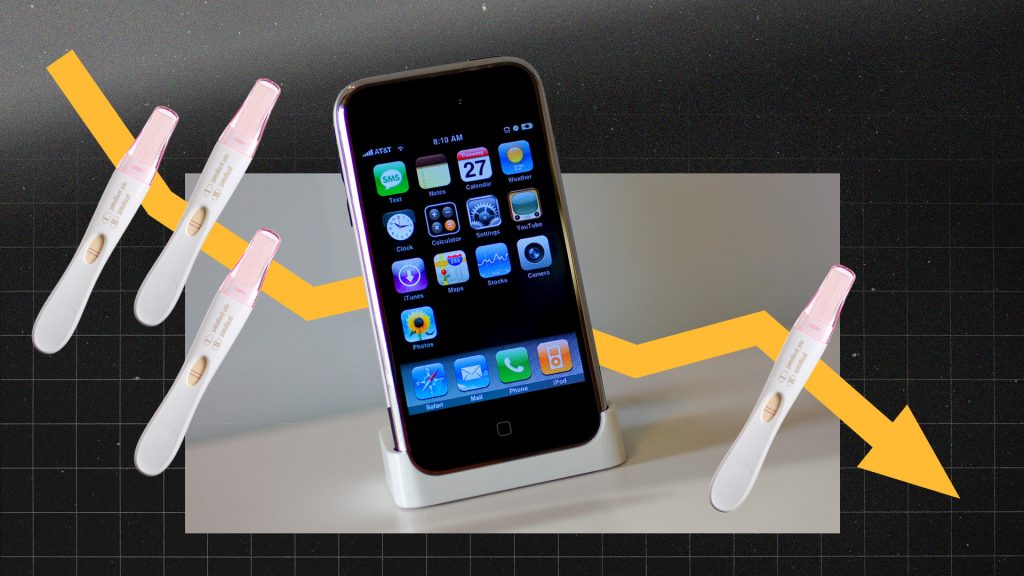
A new study suggests the global launch of the iPhone, seen in 2007 as a revolutionary device, contributed to falling fertility rates. However, the researchers contend the phone isn’t the sole cause of the declining rate, as it launched when the nation’s economy was crumbling.
Researchers Caitlin Myers and Ezekiel Hopper of Middlebury College in Vermont released a white paper showing the nation’s fertility rate dropped at least 33% when Apple launched the iPhone. The phone changed how people used the devices and quickly amassed 1 million sales in under 90 days, according to Apple.
The excitement over the phone and how it transformed smartphones, Myers and Hopper wrote, accelerated the nation’s fertility rate decline from 2007 to 2011. They say the iPhone caused in-person interactions to decline, while also giving people access to information on abortions and contraceptives, and essentially putting pornography in people’s pockets.
“The first and third channels reduce sex; the second raises contraception conditional on sex; all three reduce the unprotected sex that produces unintended pregnancies,” they wrote.
The research hasn’t yet been independently reviewed.
Issues lie in the conclusion, as 2007 was the start of the Great Recession, which saw the fall of the real estate market and the automotive industry. It also forced many people out of their jobs. The Bureau of Labor Statistics reported unemployment peaking at 10% — or at least 15 million people unemployed — in October 2009. It didn’t rebound until January 2012.
“During and immediately after the recession, the unemployment rate increased markedly for people in all age, gender, race, ethnicity, and education groups,” according to the BLS.
AT&T data revealed declining rates
The Middlebury University researchers used data from AT&T to develop areas to compare fertility rates. They used AT&T since it was the sole provider of iPhones until 2011, when Apple opened the iPhone to all providers.
The data came from the carrier’s broadband coverage, which at the time wasn’t in all 48 contiguous states, and how many people resided in the coverage area. They then compared the fertility rates with the distribution of AT&T’s network coverage at the time.
The final analysis compared areas with an increase of AT&T subscribers versus areas where other carriers rose in popularity. Myers and Hopper also added that results from the American Time Use Survey revealed women were spending less time with people outside of their home and thus had lower rates of sexual intercourse.
Myers and Hopper concluded that iPhones contributed to a 6.2-birth decline per 1,000 women, representing a 33% to 52% decline from 2007 to 2011.
“Our results point to one possible answer,” they wrote. “The fertility drop is concentrated among young populations and largely operates through declines in unintended births, suggesting the operative margin may be less about the cost of raising a child and more about whether the relationships and sexual activity that produce children are forming at all.”
The Vermont researchers aren’t the only ones to assert that phones contributed to a declining fertility rate. University of Cincinnati Department of Economics professors Nathan Hudson and Hernan Moscoso Boedo said in April that teens shifted to using their phones as their main point of contact with friends rather than in-person interactions.
“The model predicts that the shift towards the phone-mediated equilibrium affects multiple aspects of teen behavior,” they wrote. “The same instrument that produces a collapse in teen fertility produces a surge in teen suicides.”
Correlation doesn’t imply causation
Researchers were confident the data showed the iPhone played a major role in dwindling the birth rate from 2007 to 2011. But they contended the iPhone isn’t the sole cause.
“We do not claim that the iPhone is the sole cause of the post-2007 decline, nor that no policy lever can move the trajectory,” the Vermont researcher wrote. “But over the 2008–2011 window that our design identifies, our estimates imply that the introduction of the modern smartphone played a sizable role in the decline in U.S. births.”
Myers and Hopper made the conclusion cautiously as they couldn’t pinpoint the primary driver for low birth rates. They instead explained that the phone played a major role. That is carefully done, as people will sometimes mistake a comparison of data as demonstrating causation. The Middlebury University researcher found a drop in fertility rates, but mentions that outside factors like the Great Recession and other economic woes were at play.
The white paper discounts the effects of the Great Recession, as the researchers said fertility rates were expected to rebound with recovery, but didn’t.
“Nearly two decades on, that rebound has not come: the decline continued through the long economic expansion of 2010–2019, through the COVID dip and its aftermath, with declines visible across the same subgroups,” they wrote.
Still, the country’s recovery from the economic crisis wasn’t substantial. According to Federal Reserve History, growth increased at about a 2% rate from 2009 until 2012, and long-term unemployment remained at historic highs. Libertarian think tank Cato Institute instead asserted that a drop in the fertility rate isn’t inherently negative and is demonstrative of how teen pregnancies were viewed and women becoming more economically independent.
“In line with the idea that a significant piece of the recent decline in fertility is due to a decline in teenage births, another paper finds that 35 percent of the decline in fertility in the years between 2007 and 2016 is due to a reduction in unintended births, or births that were either undesired or occurred earlier than the mother would like,” according to Cato.
Round out your reading
- People are overdosing on GLP-1 injections. What does that look like?
- Researchers put chatbots in a simulation. Grok ended the world in 4 days.
- Fearing more e-bike injuries, Illinois looks to become 10th state to mandate registration, insurance.
- Why are young professionals facing such a tough job market? Hint: It’s not just AI.
- We’re building a new Straight Arrow. Help us shape our future by taking our survey.
Ella Rae Greene, Editor In Chief