New Eaton Fire video renews questions about criminal liability for SoCal Edison
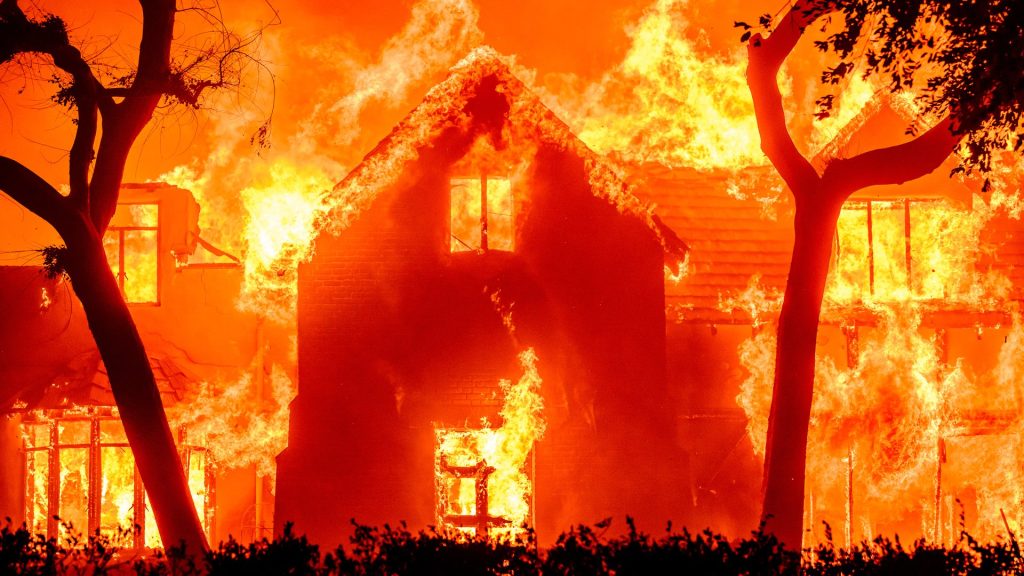
What happens when a corporation causes a fire that leaves nearly two dozen people dead? That’s a question that we could soon get an answer to in Southern California.
New video appears to show lines from power company SoCal Edison caused the Eaton Fire in Los Angeles.
That fire killed 19 people and destroyed nearly 10,000 structures.
New video
New surveillance video shows an old SoCal Edison electrical line ignited a fire around the time the wildfire started.
The footage came from a closed-circuit TV from a nearby swim and tennis club in Pasadena.
In the video, you can see two flashes of light just after 6 p.m. on Jan. 7, 2025. That’s according to new court filings.
Those flashes happened at the same time the utility recorded two faults on another transmission line more than five miles away.
Shortly after that, people nearby reported a fire burning at the base of one of the utility’s towers.
That grew into the Eaton fire, which devastated parts of Altadena and Pasadena.
Utility liability
“The Eaton Fire could not have occurred if SCE had simply disassembled and removed Structure M16T1,” the lawyers wrote in the filing, according to the Los Angeles Times.
Those lawyers represent property insurers that paid out tens of millions of dollars to residents who lost their homes.
They aim to make SoCal Edison liable for the fire.
A legal doctrine in California’s state constitution requires utilities like Edison to pay for any property they destroy, even if they’re not found negligent.
“Most frequently it’s the familiar mechanism of tort law, where civil lawsuits are brought by those who have been injured by a fire,” Lawrence Rosenthal, law professor at Chapman University, told Straight Arrow.
SCE faces numerous other lawsuits.
That includes a wrongful death lawsuit, a suit from LA County and even a suit from the Trump administration.
So far, these are all civil lawsuits.
Despite killing nearly two dozen people, no criminal charges have been filed. The Los Angeles County District Attorney is considering that.
“If the negligence is sufficiently aggravated to satisfy the definition of criminal negligence in California law, then there could, theoretically be an involuntary manslaughter charge,” Rosenthal said.
Companies clearly can’t go to prison, but there have been cases where corporate executives have gone to prison for negligence.
The former CEO of Massey Energy spent a year behind bars for a deadly mining accident, while a former peanut executive received a 28-year-sentence for a nationwide salmonella outbreak.
“When it comes to executives, they would be in the same position as any other criminal defendant,” Rosenthal said. “The prosecutor would have to prove beyond a reasonable doubt that a particular executive exhibited criminal negligence, and that criminal negligence proximately caused the death of one or more human beings.”
SoCal Edison has not taken responsibility for the fire.
Impact on consumers
SCE dominates the electricity space in Los Angeles. They serve some 11 million people over roughly 50-thousand square miles.
Companies like that can’t just go out of business despite apparently causing a massive fire.
“A regulated utility really can’t go out of business, precisely because it’s the only way that a lot of people can get their electricity in Southern California,” Rosenthal said.
However, the company may have to pay tens of millions of dollars in fines.
That money has to come from somewhere. Often, it falls on the consumers.
“The perverse effect of corporate criminal liability in a regulated utility like this is that the most likely effect is to raise the cost to ratepayers,” Rosenthal said.
Because they have to pay the fines and because going out of business is not an option, that could force regulators to allow SCE to raise those rates.
That’s already happening.
SCE, along with Pacific Gas & Electric and San Diego Gas and Electric, have been authorized to raise rates due to wildfires. That includes paying off fines, replacing equipment, and paying out damages.
Some people’s utility bills are 20% higher due to the fallout from wildfires.
“The lawsuits in these contexts don’t really punish the utility so much as they punish the ratepayers,” Rosenthal said. “So, you get into a vicious cycle where the greater the liability the utility faces, the higher the price of electricity.”
Round out your reading
- People are overdosing on GLP-1 injections. What does that look like?
- Researchers put chatbots in a simulation. Grok ended the world in 4 days.
- Fearing more e-bike injuries, Illinois looks to become 10th state to mandate registration, insurance.
- Why are young professionals facing such a tough job market? Hint: It’s not just AI.
- We’re building a new Straight Arrow. Help us shape our future by taking our survey.
Ella Rae Greene, Editor In Chief