Louisiana Senators debate new congressional maps before protest-packed gallery
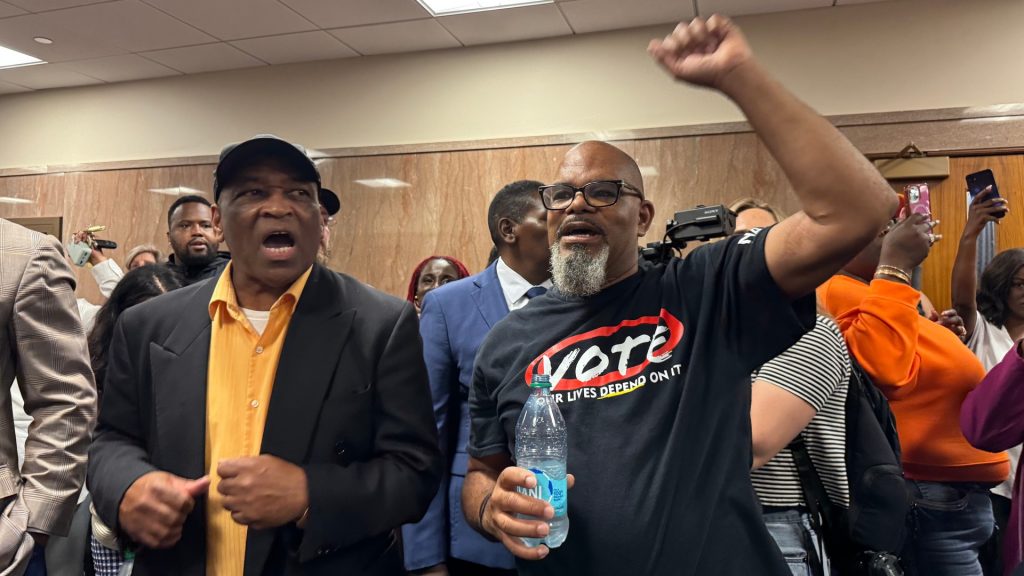
Hundreds of people traveled down to Louisiana’s capital for a marathon of testimony on proposed congressional maps they said would negatively affect the state’s Black population. The hearing comes on the heels of a U.S. Supreme Court opinion that threw the state’s primary into disarray.
People packed the Louisiana State Capitol on Friday evening as legislators mulled over four proposed congressional maps, each having varying boundaries for the Pelican state. The public hearing is the first after the U.S. Supreme Court struck down a previous map for creating a second Black-majority district.
State Sen. Ed Price, D-Gonzales, submitted a map with two possible Democratic districts. State Sen. Jay Morris, R-West Monroe, submitted three maps that had either one Democratic leaning district or none.
“We know one thing for sure: The current maps did not survive a challenge,” Morris said. “They have been declared unconstitutional, and we are here to pass what we hope will be a constitutional map in accordance with the law.”
Louisiana Gov. Jeff Landry suspended the state’s congressional primary on April 30, just two days before absentee voting began. It effectively halted the U.S. House primary, with the U.S. Senate being a statewide race.
Debates over the maps became heated at times during the hearing, reflecting what’s happening across the nation in Alabama, Florida and Tennessee. In those states, legislators either erupted in screaming matches or led chants decrying redistricting attempts.
Several civil rights groups put out requests the day before for people to “pack” the hearing room to convince lawmakers to pass a map with two Democratic seats in Louisiana.
Senate and Government Affairs Committee chair Caleb Kleinpeter, R-Grosse Tete, often reminded speakers about decorum to prevent shouting matches seen in other legislatures.
“The people of Louisiana have elected us to do a job, not to do the bidding of a party, not to do the bidding of an individual, but to do the bidding of the people,” U.S. Rep. Troy Carter, D-New Orleans, said during the hearings. He’s the state’s fourth Black U.S. representative since 1877.
Senators propose maps to outlast legal challenges
The maps pulled out emotional testimonies from several faith leaders and people who lived during segregation, warning Morris’ maps would reverse the clock in Louisiana. Morris opined that his maps were fair and, by chance, had Republican majorities.
Morris said he filed the three bills before the U.S. Supreme Court ruling.
Each of Morris’s three maps — introduced as Senate bills 116, 121 and 130 — evenly split the six districts, population-wise. The first map has no potential Democratic majorities in the second district, with about 49% of the vote share registered Democrats, while the others were firm Republican majorities. He noted the map was coined the “6-0” map for eliminating Democratic seats.
“I asked the demographer to work with me, don’t make race or party a consideration, consider the traditional boundaries, and this is what we came up with,” Morris said.
His second map compacted Democratic voters — and Black voters — more intensely into the second district at 61% and 60%, respectively. It was used in the 2022 elections, he noted.
Morris’ third map shifted the Democratic majority to the 6th District, with 60% of registered voters being Democrats, and Republicans having a slight majority in the remaining five districts. This map also concentrated Black voters in the 6th District, with 60% of the district’s population being Black.
“I believe this map would probably pass Constitution muster inasmuch as it is very similar to the bill, the map reflected in Senate Bill 121,” Morris said of Senate Bill 130.
Price’s map — introduced as Senate Bill 407 — splits all six districts roughly equally, by population, giving future representatives about 776,292 constituents. It still retains the party’s advantages, but shifts Democrats’ advantage to the 5th District.
Districts were generally split among parish lines, with deviations in Lafayette, Orleans, Ouachita and Vernon parishes, to name a few.
All four Black US representatives at hearing
The meeting hit a historic moment when the state’s first Black U.S. representative, former Rep. William Jefferson, 79, spoke at the meeting about redistricting as he was flanked by the state’s other Black U.S. representatives.
They are current Reps. Carter and Cleo Fields, both Democrats, and former Reps. Jefferson and Cedric Richmond. Carter, Jefferson and Richmond each represented the state’s 2nd Congressional District, which encompasses New Orleans. Fields represents the district the U.S. Supreme Court nullified, which included Shreveport, Baton Rouge and Lafayette.
Fields spoke in favor of Price’s map, but said a better map would have an equal Democrat-to-Republican split based on population counts.
“It is unfortunate that we find ourselves where we are in the state of Louisiana today,” State Sen. Sam Jenkins, D-Shreveport, said. “The Callais decision was dropped at a time that has created nothing but chaos and confusion.”
Ella Rae Greene, Editor In Chief