Is longing for ‘the day it happens’ a threat to Trump? Comey case tests free speech protections
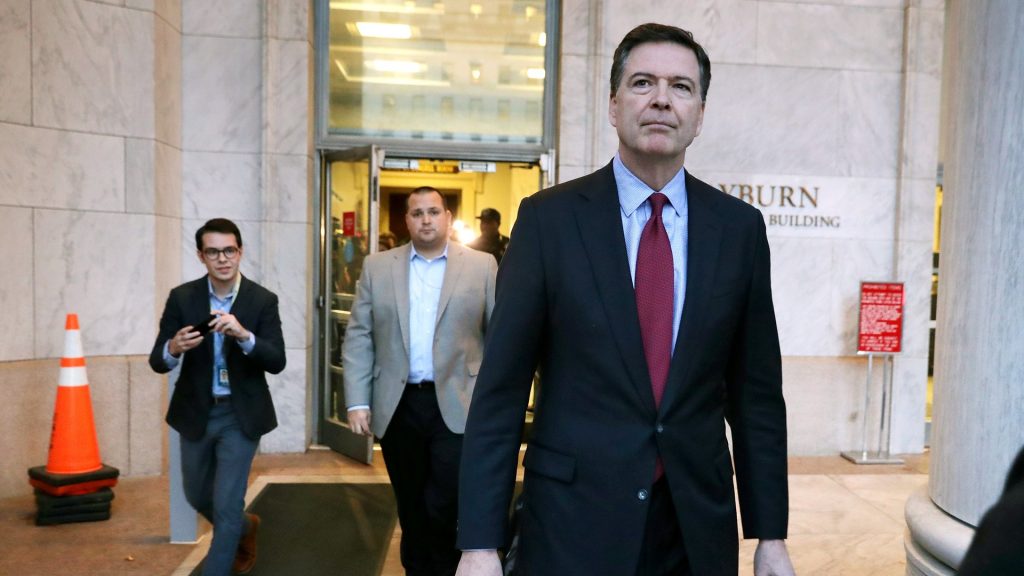
The Justice Department says former FBI Director James Comey threatened the life of President Donald Trump when he posted a picture of seashells on social media.
The shells were arranged to spell out “86 47,” interpreted to mean “get rid of” Trump, the nation’s 47th (and 45th) president. Trump and Comey are longtime nemeses.
Such displays are “the same kind of conduct that we will never tolerate and that we will always investigate and regularly prosecute,” acting Attorney General Todd Blanche said Tuesday as he announced an indictment that could result in a 10-year prison sentence for Comey.
But across the nation, countless Trump critics have expressed similar sentiments to Comey. In yard signs and on social media, they look forward to “the day it happens” — the day Trump dies.
They say they don’t mean it as a threat, but rather as an expression of hope for a new administration — and a recognition that a nearly 80-year-old man who regularly dines on fast food and does not exercise cannot be long for the world.
Are they subject to prosecution, too? Is wishing for nature to take its course to eliminate a political enemy the same as plotting violence against him?
Ultimately, the question becomes: Where is the line between free speech and criminal behavior?
A ‘serious’ threat?
Comey, whom Trump fired as FBI director when he wouldn’t pledge his loyalty to the president, maintains he committed no crime.
“I’m still innocent,” Comey said in a Substack video released Tuesday, “I’m still not afraid, and I still believe in the independent federal judiciary, so let’s go.”
It is Comey’s second indictment since Trump publicly pressured Blanche’s predecessor, former Attorney General Pam Bondi, to bring criminal charges against the former FBI director and several other political enemies. A judge dismissed the first indictment — which accused Comey of lying to Congress five years earlier — over the improper appointment of the federal prosecutor who handled the case.
Comey made his first court appearance in the new case Wednesday in North Carolina, where the seashell photo was staged and where a grand jury charged him in a bare-bones indictment that barely spilled over onto a third page.
The indictment says that on May 15, 2025, Comey “did knowingly and willfully make a threat to take the life of, and to inflict bodily harm upon, the President of the United States.”
He did so, the indictment says, by posting the “86 47” message on social media, “which a reasonable recipient who is familiar with the circumstances would interpret as a serious expression of an intent to do harm”’ to Trump.
“While this case is unique and this indictment stands out because of the name of the defendant,” Blanche said at Tuesday’s news conference, “his alleged conduct is the same kind of conduct that we will never tolerate and that we will always investigate and regularly prosecute.”
‘Is he dead yet?’
Messages similar to Comey’s appear on all corners of the internet and in neighborhoods across America.
On Etsy, the online marketplace, sellers offer a variety of merchandise that is tied to Trump’s eventual death.
Items include wine bottle labels with messages such as “Open bottle when IT happens,” “America just became a little greater” and “Pairs well with one big, beautiful obituary!”
A yard flag reading “Cheers! To the big beautiful day” sells for $16.99. The online description makes clear the meaning by asking, “Is he dead yet?”
TikTok is abuzz with “day it happens” videos. A brewery owner in Wisconsin is offering free beer for the day Trump dies. There’s even a Spotify playlist featuring songs such as “No One Mourns the Wicked,” from the soundtrack of “Wicked,” “Celebration” by Kool & The Gang, “Beautiful Day” by U2 and Miley Cyrus’ “Party in the U.S.A.”
Crossing the line?
Despite Comey’s indictment, it remains unclear whether expressions of glee about the prospect of Trump’s death are subject to federal prosecution.
Legal experts say that depends. While the First Amendment protects political speech, it does not cover statements that represent a “true threat” to the life of the president.
Still, many experts have questioned whether the case against Comey is valid.
“This case is going to fail, and the reason for that is the First Amendment,” Elie Honig, a former federal prosecutor, said on CNN. “You and I and members of the public have a very broad right to criticize our public officials, especially the president. It is OK to post things that are stupid, that are irresponsible, that are scary, that are silly, that are insulting. The only line that the criminal law draws, and the criminal law gives a very wide berth to the First Amendment, is you cannot make a statement that is intended to make a specific threat of death or physical injury to the president, or to another public official.”
But that’s exactly what Comey did, the Justice Department says.

“You are not allowed to threaten the President of the United States of America,” Blanche, who represented Trump in a criminal trial in 2024, said Tuesday. “That’s not my decision. That’s Congress’s decision, and a statute that they passed that we charge multiple times a year.”
Round out your reading
- Scientists unearth new evidence on how the Grand Canyon was shaped.
- Why the Army is adding a second fitness test for combat.
- Illegal midwives, growing demand: The fight over home birth in America.
- 40 years after Chernobyl, the U.S. pushes nuclear power once again.
- We’re building a new Straight Arrow. Help us shape our future by taking our survey.
Ella Rae Greene, Editor In Chief