Iranian embassies declare meme war against Trump
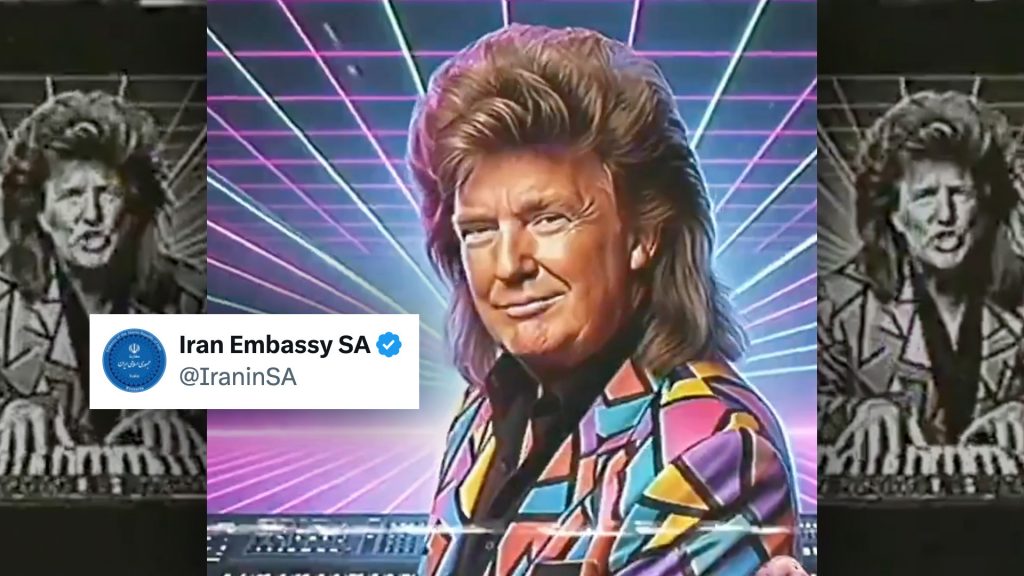
Iran’s embassies and consulates have waged a digital war against President Donald Trump, using artificial intelligence and comedic posts to sway public opinion of the war. The jokes play out online as the two countries, and Israel, debate how to formally end the conflict that has left thousands dead.
The embassies have lobbed jabs at rising gas prices, an AI-generated video of Jesus Christ tossing Trump into a firepit, and an AI video of Trump singing a song about the Strait of Hormuz blockade. The posts use humor to express Iranian officials’ views of the U.S. military’s actions in the war, and are tools of propaganda in swaying the public’s opinion of the war.
And the accounts are all real. The Iranian Ministry of Foreign Affairs lists all 130 of its embassies and consulates online, with links to their X accounts.
The U.S. isn’t the embassies’ only target. Each office has shared posts comparing Israeli Prime Minister Benjamin Netanyahu to Adolf Hitler and accusing Trump of being influenced by the Israeli prime minister.
The trolling reached Trump himself.
“The Iranians are better at handling the Fake News Media, and ‘Public Relations,’ than they are at fighting,” Trump wrote on TruthSocial on April 10, two days after the U.S. and Iran reached a supposed ceasefire. Reuters reported that 3,636 people have been killed since the war started.
Iran-controlled accounts aren’t the only ones using propaganda during the war. The White House posted a March 12 video on X that mimicked Nintendo Wii’s games, declaring victory during Operation Epic Fury. Days earlier, the White House stitched scenes from several blockbuster films, cabinet officials and strikes on Iran to claim it’s delivering “justice the American way.”
The posts are made while an estimated 93 million Iranians are in a state-sanctioned internet blackout, according to The Washington Institute for Near East Policy’s forum on Iran’s digital blackout. The institute is a center-right think tank focused on U.S.-Middle East relations.
“The Islamic Republic has spent years building its propaganda apparatuses, controlling the media, trying to infect the social media space,” Mahsa Alimardani, associate director at human rights advocacy organization Witness, said during the forum.
Embassy accounts publish more than just jokes
Joke posts aren’t the only things the embassies push out.
OSINT Analyst Tal Hagin has tracked hundreds of misinformation and disinformation posts on the Iran war. One in particular came from the Iranian embassy in Athens, Greece, which claimed on March 29 that mass protests were happening in the U.S. against the war.
The protests on March 29 were for No Kings Day. The video shared was also taken from an October No Kings protest.
Another round of posts from the accounts commented on the 2028 Presidential Election, where the embassies cast doubt on Republicans’ chances of securing the presidency again.
One group — Explosive Media — took credit for the AI LEGO videos on the accounts and said they are an “independent” team, but told the BBC that the Iranian government is its customer. They aren’t alone, as Iranian filmmaker Syed Kumayl created a video about slain President Ali Khamenei saying America is his worst enemy. The Iranian Embassy in South Africa shared the video on April 14 with the caption, “Who is your worst enemy.”
Contracting out propaganda isn’t new for Iran, which has waged an information war against its citizens for several years.
“Iran makes less use of obvious falsehood,” according to The Atlantic Council’s 2020 review of Iran’s online propaganda. “Instead, Iran advances a distorted truth: one that exaggerates Iran’s moral authority while minimizing Iran’s repression of its citizens and the steep human cost of its own imperial adventures in the wider Middle East.”
Alimardani said that whether propaganda comes from the U.S. or Iran, civilians are the ones put in harm’s way when AI-generated media becomes the leading narrative of the war.
“There have been stories of people who ended up being victims in this war who had this kind of false knowledge that they could never be in danger,” she said.
Ella Rae Greene, Editor In Chief