In the modern surveillance state, someone’s always watching

As the United States marks its 250th birthday, Straight Arrow is taking a fresh look at the institutions, systems and social contracts that shaped modern America — and the pressures now testing them.
The Watergate scandal of the 1970s began with a botched surveillance attempt. Five men working for President Richard Nixon’s re-election campaign were caught burglarizing and planting listening devices in the Democratic National Committee headquarters in Washington. The episode led to Nixon’s resignation and to legislation that reined in both the power of the federal government and its domestic surveillance apparatus.
More than 50 years later, the legal firewalls put into place during that era — including the 1974 Privacy Act, intended to silo and restrict the sharing of Americans’ data across agencies — have either completely eroded or begun to unravel.
Those reforms failed to anticipate a digital era in which private companies, not the government, would become the primary consumer of private data — and what would happen when the data from the public and private sectors was combined.
Now, with the rise of data brokers and the proliferation of artificial intelligence, governments can easily bypass the Fourth Amendment’s prohibition on unreasonable search and seizure. They can purchase, aggregate and analyze billions of pieces of information in real-time, without citizens ever knowing.
The result: As the nation marks the 250th anniversary of its founding, an act intended to free its citizens from an oppressive monarchy, it is operating the most far-reaching and powerful surveillance machine in the world’s history.
“We are at a critical moment when it comes to government surveillance,” said Jeramie D. Scott, senior counsel at the Electronic Privacy Information Center and director of its surveillance oversight program.
“The public is beginning to understand the dangers of an indiscriminate, mass surveillance infrastructure made possible by insufficient and poorly enforced laws,” Scott told Straight Arrow. “The result is the rampant collection of personal information by data brokers; the dragnet surveillance of our location, our social media and our faces by surveillance companies; and the unlawful aggregation of federal databases by the government.”

Watching immigrants — and protesters
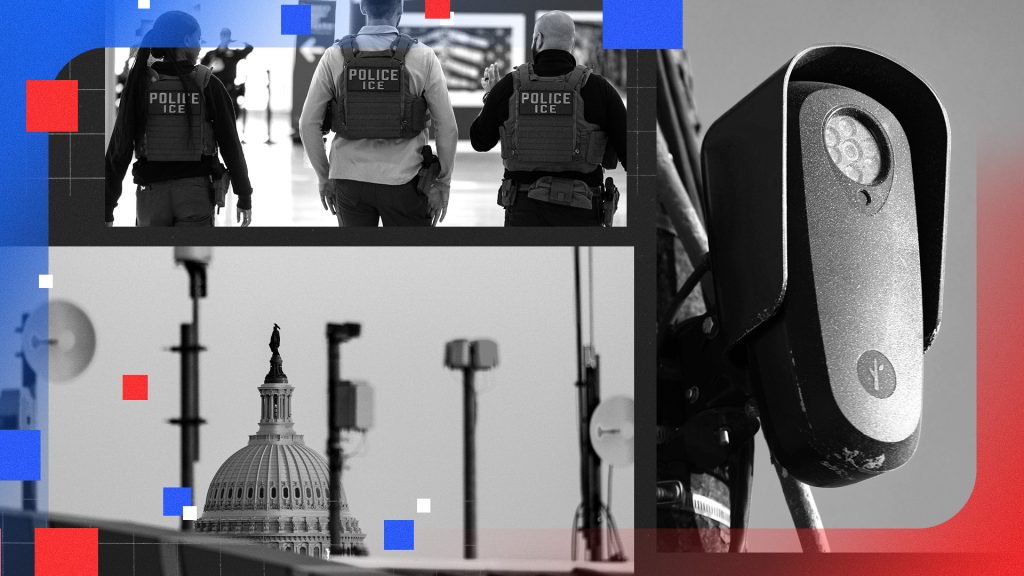
No government entity epitomizes the modern surveillance state more than the Department of Homeland Security — particularly its immigration enforcement branches.
Immigration and Customs Enforcement (ICE) and Customs and Border Protection (CBP) are using portions of a $165 billion windfall from President Donald Trump’s One Big Beautiful Bill Act of 2025 to build new systems that allow unprecedented surveillance of unauthorized immigrants — and of U.S. citizens protesting the administration’s attempt to carry out mass deportations.
The funding “has granted ICE a multibillion-dollar slush fund toward invasive spyware, including real-time facial recognition, iris scanning, social media monitoring and other alarming tools to target immigrant communities, protesters and observers,” said Will Owens, communications director of the Surveillance Technology Oversight Project (STOP).
ICE has been accused of not only flaunting its new surveillance powers but openly using them as a tool for intimidation.
An ICE officer in Maine told a woman in January that she would be entered into a domestic terrorist database for recording him with her phone.
In Minneapolis, a woman who spoke with Straight Arrow after immigration agents killed two protesters said that Greg Bovino, then the commander-at-large for the Border Patrol, addressed her by her full name even though they had never before met.
ICE’s expanded surveillance capabilities became apparent when tools such as Mobile Fortify began popping up in the hands of agents across the country. The smartphone app allows officers to identify people through facial recognition software. The app also identifies people through photographs of their fingerprints.
DHS isn’t stopping there. Just months after the public became widely aware of the Mobile Fortify tool, the department began working to develop facial recognition smart glasses to allow agents to collect images of even more faces, likely without the targets’ knowledge.
A $25 million no-bid contract awarded in late May to a company that builds tools for iris scanning will supercharge ICE’s current ability to identify individuals based on photos of their eyes.
ICE is also spending millions on AI-powered social media monitoring tools from the company Cobwebs, a firm founded by former members of Israel’s intelligence agencies and the Israeli Defense Forces. The company was one of several that Meta banned from using its Facebook platform in 2021 after it was found to be spying on journalists, human rights activists, politicians and others in more than 100 countries.
Many of ICE’s tools and tactics are shrouded in secrecy, including its use of cell-site simulators. Commonly referred to as IMSI-catchers or Stingrays, these fake cell phone towers can be used to locate specific mobile devices or determine how many devices are in a designated area. Analysis by Straight Arrow of cellular signals outside two DHS facilities found evidence that indicated cell-site simulators may have been in use.
“This infrastructure of surveillance undermines our First Amendment rights and weakens the Fourth Amendment,” EPIC’s Scott said. “The diminishing checks on surveillance has and will continue to lead to the government’s abuse of power.”
Perhaps most surprising is ICE’s use of Paragon, a spyware tool capable of remotely hacking and accessing private data of cell phones.
Spyware of this caliber, once reserved for powerful and secretive intelligence agencies, is trickling down into the hands of federal law enforcement officers.
Not having direct access to certain surveillance tools hasn’t stopped ICE and other agencies from obtaining the data they collect.
Flock Safety, the company that has more than 80,000 AI-powered license plate reader cameras across the country, does not have a formal contract with ICE. Still, numerous police departments and other agencies, such as Florida’s Fish and Wildlife Conservation Commission, perform searches for the agency.
Those searches, according to public records, are not always related to immigration enforcement. Customs and Border Protection officers have asked police agencies to search for information on people who attended protests against the government’s deportation policies.
“With automated license plate readers, the administration has deputized local police to assist in immigration enforcement and target abortion and gender-affirming healthcare seekers, creating a sweeping surveillance dragnet across the country,” STOP’s Owen said.
License plate scanners can record a vehicle’s make, color and other attributes. They are seen as so invaluable that the FBI is currently seeking out companies that can provide nationwide access to such data. This would allow the FBI to track individuals across state lines without the need for a warrant.
Sharing data for surveillance
Palantir, founded by the technology executives Peter Thiel, Alex Karp and others, has been instrumental in expanding the government’s surveillance capabilities.
The company supplies ICE with ELITE, a tool that lets the agency populate a map with the location of people targeted for deportation. Relying on data from the Department of Health and Human Services and other agencies, it gives officers dossiers on targets and even a “confidence score” on their addresses to assist ICE on raids.
In 2025, the Trump administration began installing another Palantir product, Foundry, at federal agencies after the president issued an executive order calling for data sharing among departments. The effort would seem to undermine the 1974 Privacy Act by potentially merging, for instance, a person’s health data from Medicare with tax data from the Internal Revenue Service.
Palantir is building a system that will allow a wide swath of government agencies to access IRS data. It also is building a system for the IRS’ criminal investigation unit that, according to 404 Media, will “bring together traditionally disparate systems into a single overarching one to investigate all sorts of financial crime.”
Palantir, particularly through Thiel, is close to Trump, who promoted the company’s stock in April, an unprecedented act for a U.S. president.

The increased cross-sharing of previously segregated government information can be attributed in large part to the Department of Government Efficiency (DOGE), the Elon Musk-led initiative that asserted it would reduce waste, fraud and abuse within the federal government.
“With DOGE, the Trump administration has pooled together vast troves of our highly sensitive federal data, including from the Social Security Administration, Centers for Medicare and Medicaid Services and other agencies,” STOP’s Owen said.
DOGE’s claims of reducing federal spending by billions have been challenged, however, and whistleblowers have reported that DOGE employees collected and illegally shared sensitive financial data on hundreds of millions of Americans that was kept confidentially by various agencies, including the Social Security Administration.
A critical eye on surveillance
America’s surveillance juggernaut has become so expansive that it is being used against the government itself.
As first reported by Reuters in May, U.S. military personnel are being targeted due to commercially available location data. Smartphone apps that collect users’ location data and in turn sell it to data brokers allow government officials to be tracked just as easily as citizens.
Such problems have been persistent for years. In 2018, the locations of secret U.S. military bases were even exposed because soldiers were wearing fitness tracking wearables.
Less sinister pushback against this widespread surveillance has been substantial.
Cities across the country have taken down or disabled license plate reader cameras to satisfy demands by citizens. Communities have stood up to their local governments to demand that data centers, arguably the backbone of the surveillance grid, not be built in their backyards.

Others have taken it a step further. A Straight Arrow analysis of Flock audit logs in February showed numerous cases of vandalism against license plate reader cameras. After the city of Dayton, Ohio, ended its contract with Flock and began placing plastic garbage bags over its cameras until they could be taken down, activists did the same to cameras in states such as New York, where contracts with Flock remain in place.
The opposition has become so substantial that the FBI has now created a domestic terrorism category for “anti-tech extremism.”
Privacy advocates say that restricting the government’s ability to watch its citizens is essential to the nation’s survival.
“This indiscriminate mass surveillance does not make us safer, and it does not improve our lives,” Scott said. “It is a tool ripe for abuse that is undermining our democracy.”
Round out your reading
- America at 250: Straight Arrow’s week-long look at the pressures testing modern America.
- Ketamine is booming in America. The reasons go beyond drugs.
- Cluster of AI news sites suddenly goes dark after human reporter starts asking questions.
- A 79-year-old, obese, well-connected man gained exclusive access to a new weight loss drug. Is it Trump?
- Newsom pushes national wealth tax after opposing California billionaire tax.
Ella Rae Greene, Editor In Chief