How the crushing weight of love strains city bridges across the US
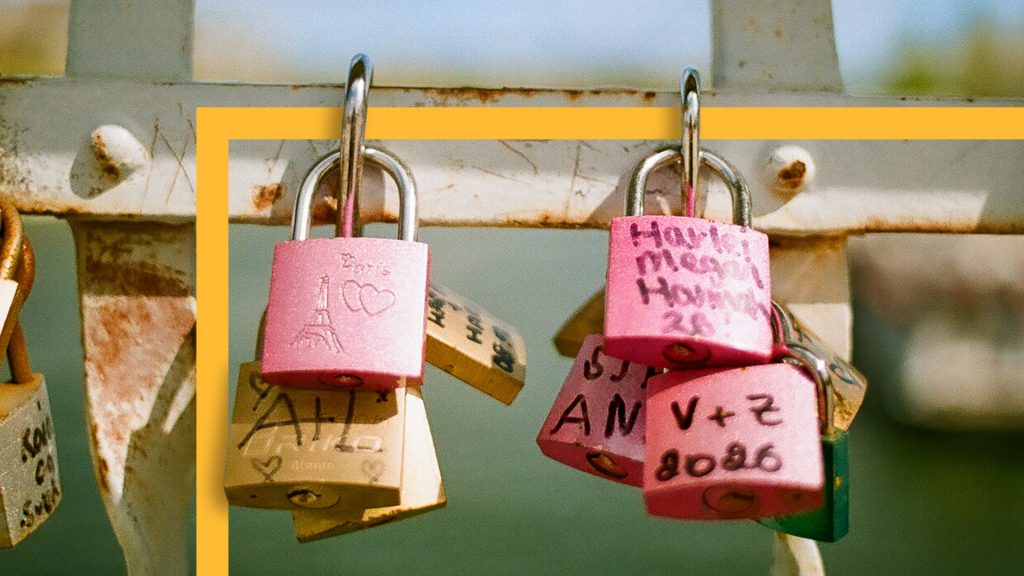
On a Wednesday evening in the summer of 2018, Stacy Skiavo and her roommates hiked up to the Shenley Bridge above Flagstaff Hill, overlooking Pittsburgh’s quintessential smokestacks and Carnegie Mellon University’s campus.
They passed around a Sharpie and scribbled their initials onto a padlock before fastening the brass symbol of their friendship onto the bridge’s mesh railing. For six years they had attended the city’s summer movie series on Wednesday nights, right below the bridge.
But one of Skiavo’s roommates was moving back to Rochester, New York, for graduate school. Somehow, those fresh-from-college twenty-somethings were now almost 30.
“Before we all started to part ways into our next stage in life I wanted us to commemorate that chapter,” Skiavo told Straight Arrow.

Not everyone is so keen on preserving love by lock.
In recent years, municipalities from Pennsylvania to Washington state have removed tens of thousands of pounds worth of locks to ensure the public’s safety.
A spokesperson for the Allegheny County Public Works Department, which oversees bridge maintenance in Pittsburgh, said he wishes residents would find another way to express their devotion.
“It comes from a good place, particularly love and caring for someone else,” said Brent Wasko. “But it does damage the bridges and cost us money, whether it’s our maintenance crews or a contractor.”
During the county’s restoration of the Robert Clemente Bridge from 2022 through 2024, workers had to remove 11,000 pounds of locks — the average weight of an adult, male elephant — in order to repair and repaint the railing, Wasko explained.
“It’s not the best use of taxpayer money,” he added.
Public works employees across the country told Straight Arrow the weight of the padlocks does not pose a threat to a bridge’s structural integrity, but can corrode a bridge’s railing and the mesh fencing that prevents pedestrians and cyclists from falling off.

Total eclipse of the lock
When Gig Harbor, Washington, began removing love locks from its one-lane bridge with a view toward Mount Rainier in March, you better believe Jeff Langhelm started receiving calls.
“It was just the end of the world,” said Langhelm, the city’s public works director. “People called us begging to go to the operations center and dig through dozens of 5- and 10-gallon buckets to find their one lock.”
Langhelm said the city was forced to take action after an annual inspection report from Pierce County officials cited damage to a fastener that attached the railing to the bridge. The culprit: Love locks.
“The place where the lock was attached was not meant to handle (400) or 500 pounds worth of locks put on them,” he said.
Back east in Pittsburgh, Wasko said engineers in the Allegheny County Public Works Department are certain love locks could never collapse a 440-foot bridge like the Roberto Clemente. However, they remain concerned that these vestiges of the heart can corrode railings and create an opportunity for someone — or some part of the bridge —to careen into the river below.
Padlocks can weigh up to half a pound each, and that adds up over time. Plus, Wasko said, their damage is expensive. Removing the locks from the Roberto Clemente Bridge cost the city $8,500.
Langhelm said some residents in his city — about an hour outside Seattle — were thrilled the locks were finally gone.
“It’s surprising how polarizing this issue is to people,” he said. “Some said, ‘Thank goodness!’ because it looked so trashy.”
Yet on the day the Clemente bridge reopened, five locks instantly popped up on its railing, Wasko said.
“We try to discourage folks from doing it,” he said. “But it is what it is and we’ll continue to deal with it.”

Kansas City: ‘Heart of America’
Love locks became a worldwide phenomenon in the early aughts, after Parisian couples began adorning the Pont des Arts bridge with padlocks and tossing the key into the Seine.
The tradition has roots in a lovelorn, World War I-era Serbian town called Vrnjačka Banja, where a young soldier left his former love to die of a broken heart. In turn, local women began placing padlocks on the bridge where the couple had often met, in hopes it would bind them to their own partners forever.
Deep in the Midwest, in the “Heart of America” as Kansas City is so aptly nicknamed, the tradition carries on — albeit with less heartache.
“When it became time to repurpose the Old Red Bridge we kind of came up with the idea: ‘Hey if people are going to put locks, and we know they’re going to do it anyways, let’s provide them something that’s going to be safe,’” said Toni Zibert, spokesperson for Kansas City’s parks and recreation department.
In contrast with her municipal colleagues in Gig Harbor and Pittsburgh, Zibert said Kansas City encourages residents to pronounce their “unbreakable and everlasting love” by affixing a lock to the bridge.
The Old Red Bridge, an old-school, one-lane steel thoroughfare, was turned into a footbridge inside Minor Park in 2013 for residents to enjoy, safely attach a lock and dispose of any key inside a city-provided recycling box.
Zibert said the bridge has not had any issues with the locks corroding railings or damaging parts of Old Red’s infrastructure.
“I think we have a really nice mix of passionate residents who like to lock in the love, but we’re not too big of a city where our bridge is overrun with locks,” she said, adding that Old Red is bucket list-must for Kansas Citians planning a wedding, attending prom or just trying to make Valentine’s Day sweeter.
The last time the department counted, Zibert said, there were at least 6,000 locks on Old Red Bridge.
“It serves as a really, great public art installation,” she said.

Don’t dream it’s over
In cities where bridge railings were not meant to bear the weight of love locks, how can leaders convince zealous romantics to commemorate their love in another, creative way?
Langhelm said Gig Harbor has a few ideas: Allow residents to attach locks to an art installation inside a nearby park or place a retrofitted panel on the bridge that is designed to hold locks.
That could likely cost a city somewhere in the ballpark of $20,000 to $30,000, though.
“I think the artwork would be the best solution,” he said. “One of the other concerns we have with people putting love locks on bridges is that they throw the keys into the water … I’m an engineer not a biologist, but just on the surface somebody’s polluting and it’s adding things to the water that’s not natural.”
When officials in Pittsburgh removed their elephant-sized load of locks from the Roberto Clemente Bridge, they donated them to a local nonprofit, the Industrial Arts Workshop. There, Wasko said, welding students reused them in public art installations.
For Skiavo, who is now 35, the lock she placed on the Shenley Bridge with her former roommates remains a testament to their friendship and the fleeting period of young adulthood they shared.
“It’s such a cool thing,” Skiavo said. “I think there’s so many ways to express that you care about friends and family through words, but this is a way to do that through actions.”
It’s for that very reason, Wasko said, love locks remain an uphill battle for public works employees.
“We understand why they do it,” he added. “And, despite our best efforts, it’s likely to continue.”
Round out your reading
- Scientists are now eyeing a possible ‘Mega El Niño’.
- Critics mocked Mamdani’s AC request. Republicans made the same ask.
- Social Security was supposed to be a safety net. To young Americans, it’s a broken promise.
- What happens when the water dries up? Much of the American West is close to finding out.
- Political insiders are targeting the two-party system’s grip on America.
Ella Rae Greene, Editor In Chief