Geography determines tax liability as more states move to tax the rich
On this Tax Day, how much Americans have to pay depends more than ever on where they live.
Across much of the country, states have been cutting income-tax rates or moving toward flatter tax systems to attract and retain residents and businesses. But a handful of other states, led mostly by Democrats, are aggressively moving in the opposite direction: advancing proposals to tax the wealthy to fund housing, education and social programs or plug budget gaps.
The result is a widening divide between blue- and red-state tax systems just as the federal One Big Beautiful Bill Act, the sweeping tax and spending package signed into law by President Donald Trump on July 4, 2025, reshapes the federal tax landscape.
Supporters cast the new federal law as a middle-class tax cut and pro-growth package broadly aligned with Republican-led state policies.
Critics, however, say it gives millionaires and billionaires a huge windfall. They say it’s now up to the states to tax the wealthy and sharpen the fight over who pays for the government in America — and who doesn’t.
State tax policies are moving further apart
Today, eight states — Alaska, Florida, Nevada, New Hampshire, South Dakota, Tennessee, Texas and Wyoming — have no state income tax.
Among the 42 states that levy individual income taxes, the top marginal rates vary widely, from 2.5% in Arizona to 13.3% percent in California.
“There has never been more divergence in state income laws,” said Jared Walczak, senior fellow at the Tax Foundation, a center-right tax policy research group. “At least not in the modern history of the income tax.”
“You have a cluster of high-tax states, and you have a much larger set of low-tax states, and that middle has really been hollowed out,” Walczak told Straight Arrow News.
Like America’s political split, the country’s tax divide is dramatically widening.
A Tax Foundation analysis found that 26 states have reduced individual income tax rates since 2021, including 23 states that cut their top marginal rate for high earners.
Over the same period, six states — California, New York, Massachusetts, Maryland, Washington, and New Mexico — and Washington D.C., increased the nominal tax rate on high earnings.
Some of those Democratic-led states are now pushing for new or higher taxes on the wealthy.
What are the competing arguments over higher taxes on the rich?
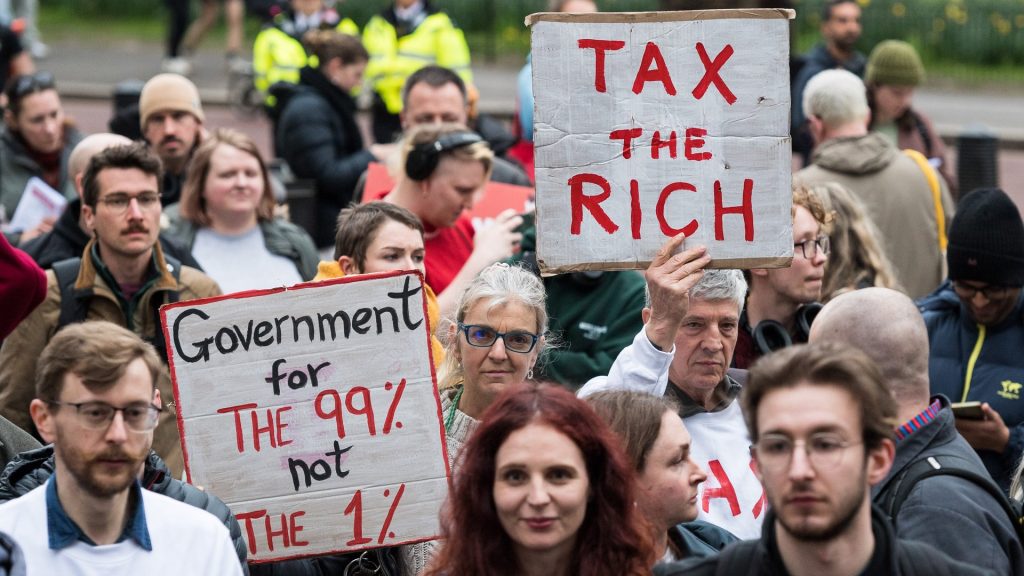
Even some wealthy Americans embrace the slogan “Tax the Rich.”
Morris Pearl is the chair of the advocacy group Patriotic Millionaires, a collection of roughly 200 wealthy Americans who call for higher taxes on millionaires and billionaires.
Pearl told SAN the current system is unfair because much of the wealth of very rich Americans is held in investments that rise in value without being taxed unless they’re sold.
As a retired asset manager living in New York, he said he pays a lower tax rate than many average earners who “work for a living.”
The gap has increased during Trump’s second term, some experts say.
“Wealthy Americans are getting enormous tax breaks” in many states and from Trump’s One Big, Beautiful Bill Act, said Amy Hanauer, the executive director of the left-leaning Institute on Taxation and Economic Policy.
“If you raise rates on the very top, especially at a time of spiking inequality, you raise more revenue for the things your communities need,” Hanauer told SAN.
But others, like Walczak, disagree. He argued that aggressive state efforts to tax the rich would drive affluent households and companies away and impede investment and economic growth, particularly for small businesses.
He criticized what he sees as the “punitive nature” of blue-state tax hikes: “In some states you see antagonism toward high earners and high net worth individuals. They’re seen as a problem to be solved, instead of a solution.”
Why is Washington state’s historic “millionaire’s tax” under legal attack?
When Washington Gov. Bob Ferguson signed a bill widely known as the “millionaire’s tax” into law on March 30, 2026, he made history.
Washington has not had a traditional personal income tax in more than 90 years, since the state Supreme Court ruled in 1933 that income is property and cannot be taxed nonuniformly under the state constitution.
The new law takes effect on Jan. 1, 2028, and imposes a 9.9% tax on annual household incomes above $1 million.
Washington currently relies heavily on sales and business taxes instead of personal income taxes, making it one of the most regressive tax systems in the country.
“Less than one half of one percent of Washingtonians will pay the tax, but it will make life more affordable for millions,” Ferguson said when he signed the bill.
The governor’s office said the revenue would support tax credits for working families, tax relief for some households and businesses and funding for public services.

Within weeks of passage, a group of small business owners with household incomes above $1 million, along with several trade groups, filed a lawsuit in Klickitat County, Washington, along the Oregon border, claiming the new tax violates the state constitution.
Ben Petter, a home and office builder, and his wife, Lauren Petter, are among the plaintiffs.
“We love this state and have built our lives and businesses here, this is why it matters to us,” the Petters wrote in a statement to SAN.
“Through our work,” they wrote, “we’re already seeing investment slow and projects pause as uncertainty increases, which has real implications for jobs and long-term growth.”
Jackson Maynard, a lawyer for the couple, told SAN that lawmakers were playing a dishonest game of semantics.
“Calling an income tax a ‘millionaire’s tax” doesn’t make it constitutional,” he said.
In their complaint, the couple also argued that Washington voters have repeatedly rejected statewide income tax proposals.
The legal battle over Washington’s tax law could serve as a test case for similar efforts nationwide.
Other Democratic-run states are moving to raise taxes on the wealthy
Washington joins other Democratic-run states in moving toward higher taxes on the affluent.
In California, proponents are pushing for a ballot initiative for the November 2026 election that would impose a one-time 5% wealth tax on Californians with a net worth of at least $1 billion who resided in the state on Jan. 1, 2026.
Even if it makes it on the ballot and passes, the measure would almost certainly face major legal challenges.
California, home to an estimated 200 billionaires, already has the nation’s top state income tax rate at 13.3%, according to the Tax Foundation.
A handful of prominent billionaires — including Google co-founders Larry Page and Sergey Brin and former Uber CEO Travis Kalanick — already have established residency outside the state to avoid this potential tax, according to Fortune.
In New York, the Democratic-led state Senate advanced a proposal for a surcharge on top tax brackets and higher taxes on income over $5 million a year.
Meanwhile, New York City Mayor Zohran Mamdani, a self-described Democratic socialist, has proposed raising the personal income tax rate by 2 percentage points for New Yorkers earning more than $1 million a year, along with higher corporate taxes.
But those measures would require state approval and would likely face resistance from legislators.
Do high state taxes drive out the wealthy?
Despite some high-profile examples, experts are divided over whether higher state taxes drive away wealthy residents.
Walczak, of the Tax Foundation, said taxpayers seeking lower-tax states now have far more options than they once did, as more states offer tax cuts, top rates below 5% or no state income tax at all.
“The motivation to move is stronger when that is contrasted with rates pushing double digits,” he said.
Patriotic Millionaires’ Pearl, by contrast, does not believe the ultra-rich would move away over taxes.
“Most people who are extraordinarily wealthy live wherever they want to live,” he said. “That’s the whole point of being rich.”
Ella Rae Greene, Editor In Chief