Cruise ship stranded at sea as hantavirus outbreak sparks docking dispute
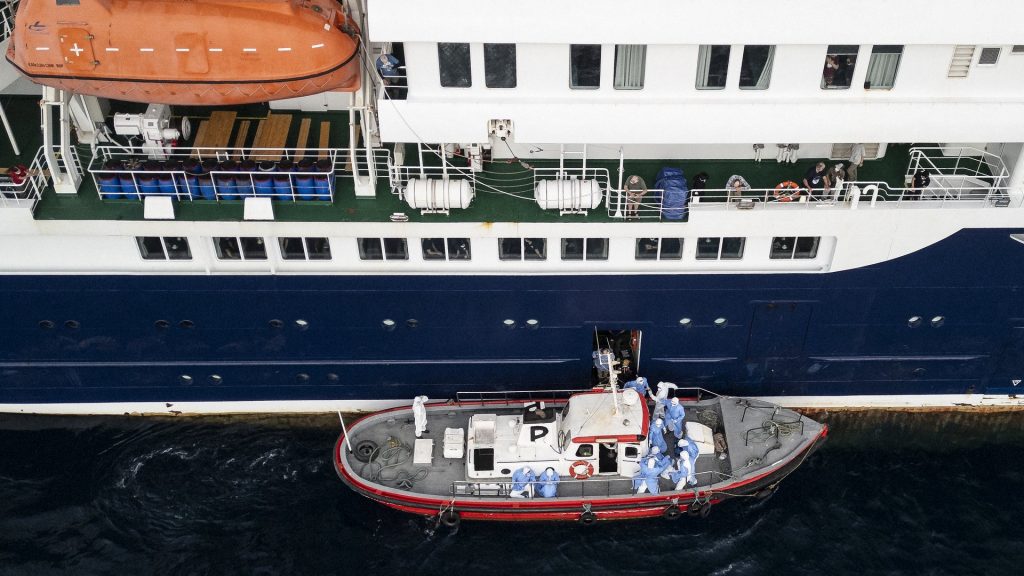
The fate of the cruise ship MV Hondius, where several passengers and crew members have contracted hantavirus, remained unclear Wednesday morning.
Spain and Canary Islands leaders at odds
Spanish officials and the World Health Organization have been working on a plan for the ship, carrying about 150 passengers and crew, to dock in the Canary Islands for inspection and a full health investigation.
But that plan appeared to hit a snag after the president of the Canary Islands publicly objected to the move.
Fernando Clavijo wrote on X: “Today I have requested a meeting with President Sánchez due to the lack of coordination and information regarding the cruise ship affected by a Hantavirus outbreak. Canarias always acts with responsibility, but it cannot accept decisions taken behind the backs of the Canary Islands institutions and without sufficient information to the population.”
The post referred to Spanish Prime Minister Pedro Sánchez.
The ship has been stranded in the Atlantic Ocean off the coast of West Africa for days after Cape Verde officials refused to allow it to dock amid the outbreak.
Health officials have identified at least seven confirmed cases so far, including three deaths.
CBS News reported three additional people suspected of having the virus have been evacuated and flown to the Netherlands for treatment. However, the outlet also reported that a planned medical evacuation flight for the ship’s doctor, who is reportedly ill, was later canceled.

Background on the outbreak
The MV Hondius departed Argentina in early April for a weeks-long Atlantic voyage when passengers reportedly began falling ill.
Health officials believe the virus may have originated during excursions earlier in the trip, possibly through exposure to infected rodents.

South African authorities confirmed Wednesday that two former passengers tested positive for the Andes strain of hantavirus, a strain commonly found in parts of Argentina and Chile.
Swiss officials also confirmed a former passenger who returned home has tested positive for the same strain.
WHO expert warns more cases could emerge
Straight Arrow spoke with Professor Lawrence Gostin, director of the World Health Organization Center on Global Health Law, who warned the illness can be severe and potentially deadly.
“There are two forms of Hantavirus disease, both very, very serious and potentially lethal,” Gostin said. “One is a pulmonary form that basically affects your breathing and your lungs, and the other one is a hemorrhagic fever, which primarily affects your kidneys. Both of them are very dangerous, and unless you get very intensive care, can lead to death.”
Unbiased. Straight Facts.TM
The most recent data from the CDC show that the U.S. has reported 890 hantavirus cases between 1993 and 2023.

Gostin said authorities will need to conduct a full epidemiological investigation once they gain access to the ship to determine where exposure occurred and how widely the virus may have spread. He also warned the incubation period can range from two to eight weeks, meaning additional cases could still emerge.
He expects more passengers to become ill as the MV Hondius remains at sea.
“It’s very unlikely that being in close quarters that you’ll contract the virus from another person,” he said. “What’s much more likely is that many of them have already been exposed to these contaminated rat or mice droppings, and they’re going to get very, very sick.”
Unlike illnesses such as COVID-19 or influenza, there are currently no antiviral treatments available for hantavirus.
Gostin also warned the ship likely lacks the medical capability to treat severe cases onboard, making it increasingly urgent for the vessel to dock so critically ill passengers can receive advanced care.
Read Gostin’s full interview with Straight Arrow below:
CRAIG NIGRELLI: A pretty alarming situation is unfolding at sea with that cruise ship, with three people dead and others sickened by the hantavirus. First of all, can I get your reaction as a medical professional and expert on what you’re hearing and seeing from that cruise ship?
LAWRENCE GOSTIN: Well, what we know right now is that there is one confirmed case of hantavirus and three suspected cases. One person is in intensive care, and three people have died. And there are probably going to be more people on the ship who come down very ill, because hantavirus is a very serious and dangerous disease.
NIGRELLI: Are we looking at person-to-person transfer of this virus?
GOSTIN: It’s very unlikely there is one strain of Hantavirus that’s found in southern South America, in this far southern tip of South America, that is person-to-person transmitted, but it’s rare that ship did cruise in that area, but it’s an unlikely possibility. The more likely possibility is that it’s a rodent-borne disease — mice or rat droppings, urine. Sometimes it aerosolizes in the air, and you can breathe it in. And there are two forms of Hantavirus disease, both very, very serious and potentially lethal. One is a pulmonary form that basically affects your breathing and your lungs, and the other one is a hemorrhagic fever, which primarily affects your kidneys, and both of them are very dangerous, and unless you get very intensive care, can lead to death because there is no known treatment for either form of the disease.
NIGRELLI: Might it have originated in Argentina, where the ship set out, or do you think it might have been picked up along the way, so to speak?
GOSTIN: Well, we don’t know. We need an epidemiological investigation, not only to determine the origin but also to identify which parts of the ship were affected, because people in those areas are at risk. The incubation period is quite long, from four to six weeks, and it could be up to eight weeks or as little as one or two weeks, so there will be a long period of vigilance that we’ll need. Most likely, it would have required the ship to be in dock where they were boarded, or they might have boarded on cargo. But we know the cause is rodents.
NIGRELLI: Is there a risk for those 140 or so passengers who are still on board?
GOSTIN: Well, they’re a considerable risk, but not for that reason. It’s very unlikely that, in close quarters, you’ll contract the virus from another person. What’s much more likely is that many of them have already been exposed to contaminated rat or mouse droppings, and they’re going to get very, very sick. Before they get very sick, they’re going to need strong, supportive care and, ultimately, intensive care. And the ship medics don’t have the capacity to do that, so these individuals who are exposed need to be in a place where they can get good, supportive medical care, including intensive care. The ship itself can only provide basic medical care.
NIGRELLI: So what I’m hearing you say, in some senses, is you expect there to be many more cases?
GOSTIN: Potentially, I wouldn’t say expect, but I would be concerned and quite vigilant about more cases.
NIGRELLI: You mentioned that there is no known cure for hantavirus, but there is a treatment. What might that treatment be for anyone who contracts it and then survives the virus?
GOSTIN: There isn’t really a treatment in the sense that this is not an antiviral like Paxlovid for COVID, for example, or Tamiflu for the flu. So the flu virus and the coronavirus do have antivirals. There is no known treatment for this. What it calls for is intensive care and support, so, for example, if you’ve got pulmonary problems, try to unblock your airways and give you oxygen; if you’ve got renal failure, provide kidney support functions, and, of course, pain relief.
NIGRELLI: As we sit here today, we know that ship is not docked yet. What do you think, professor, would be the best course of action to limit the spread and nip this thing in the bud before it gets worse?
GOSTIN: Well, if the place where they’re docked won’t let them come in, or if they’re anchored and won’t let them come in, first of all, I think that’s a violation of international law, including the International Health Regulations and the Law of the Sea. Countries that have the capacity to take them in are required to do so, but if they’re refusing and don’t have the capacity, then I would go to the nearest sophisticated medical port, which would be the Canary Islands, which are under Spanish jurisdiction and have obviously very good medical care.
NIGRELLI: Anything else you’d like to add, professor, that I didn’t ask about and that you think is pertinent and important for our viewers to see, whether it be about the hantavirus, the ship in particular or the sufferers?
GOSTIN: I would only say that after COVID-19, many of your listeners may remember that cruise ships with coronavirus on board were not allowed to dock in Japan and other places. Because of that, we amended the World Health Organization’s International Health Regulations to place requirements on states that have the capacity to let people in and to treat them, and, if they don’t have the capacity, to direct them to the nearest port that does. But the problem is, you’ve got these international legal standards, but they’re not being complied with, and there’s no enforcement mechanism.
NIGRELLI: Yeah, I know it’s shades of this with the hantavirus dating back to COVID-19, because, if you recall, there were cruise ships out at sea with passengers on board who were quarantined, calling the news network saying they wanted to get off. Things were getting worse, that sort of thing. Is there a parallel here?
GOSTIN: Absolutely, this is pretty much the same situation. The only difference is that, at the time, COVID-19 was person-to-person transmissible. If a port were to let people in, which they should have done, they should have done it in safe quarantine facilities. Here, the island says it doesn’t want to let people in because it’s afraid of the risk to its local population, but there is very little risk to its population because this isn’t a person-to-person disease.
Ella Rae Greene, Editor In Chief