Google’s new AI converts news stories to TikTok videos. How well does it work?
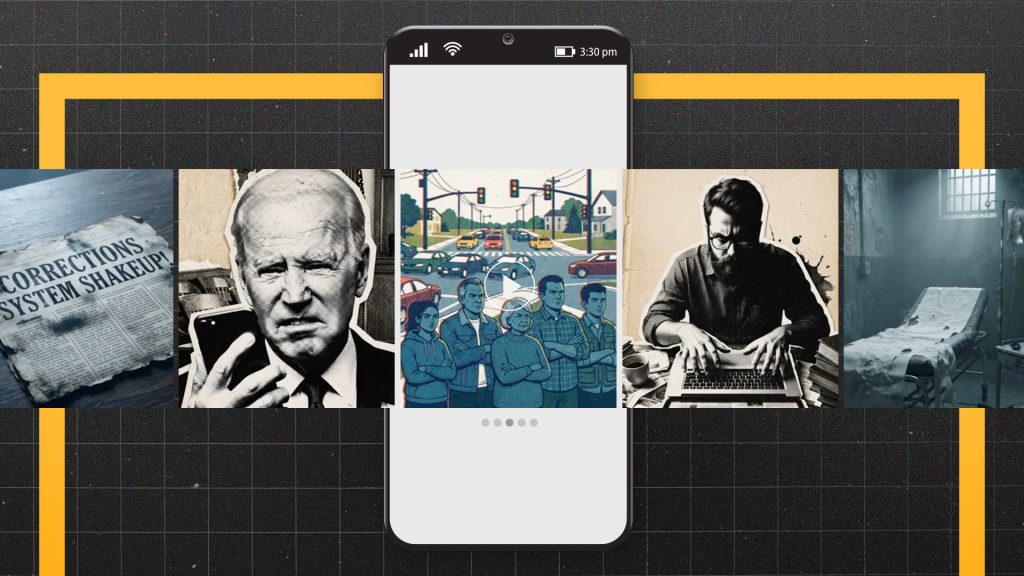
An ominous stack of papers is followed by a gray hallway leading to a barred window. Thirty seconds later, a dingy room with warning signs on the walls and a hospital bed covered by a tattered sheet comes into view.
This is how a new short-form video generator chose to illustrate a news story about New York’s treatment of incarcerated people, published by the nonprofit newsroom, The City Reporter. The vibe, according to the story’s lead reporter Kennedy Sessions, is a little “spooky, and kind of scary.”
Late last month, Google’s “AI-powered research partner” Notebook LM, rolled out a new 60-second short-form explainer format — the video generator can take any source and spit out a TikTok-style video.
The product is aimed at condensing important information into more digestible formats. Notebook LM, as a research assistant, doesn’t search the web. Rather, it summarizes specific pieces of information or writing.
Some responses on X were enthusiastic.
“No more brainrot, education maxxing,” one social media user posted.
“I’ve wanted something like this for a long time! Hyper-personalized educational tiktok,” wrote another.
But not everyone was a fan.
“The amount of AI slop is going to come on tiktok and insta reels in the name of education,” one user lamented.
So which is it?
Notebook LM has created the first shortform video generator explicitly for education, according to Jordan Wilson, host of the podcast Everyday AI.
“This is the first time that I’ve seen an AI product that is focused on education come out with something that is vertical video,” he told Straight Arrow. “Because, you know, normally those two things don’t align, right?
“It is interesting because, you know, a lot of times AI video has been closely associated with brain rot,” Wilson added.
The product could be very useful for businesses, he said. One example: Generating onboarding videos for new employees who are more used to consuming content in a video format.
“A lot of people learn better that way when they can watch something that’s interactive or multimedia in terms of text, video and audio narration,” he said.
But the videos’ accuracy would depend on experience and effort, Wilson said. Knowing which prompts to give the model might be a question of understanding what’s actually important in the source documents.
“You do need a little bit of practice,” he told Straight Arrow.
Is this useful for understanding the news?
Straight Arrow used the tool to create several videos from articles published by newsrooms across the nation — including ours. The reporters behind the original work largely said they found the videos broadly informative and often accurate, but that they also often missed the nuance of the original stories.
In each case, Straight Arrow provided Notebook LM with the link to the original reporting and asked it to create a video without providing any guidance about the content of the video. This reflected how a learner might use the tool if they had not yet read the story.
Here’s how it went:
To watch the generated videos, view this story in a web browser at san.com.
The Price of Prison Abuse: $25.7 Million in New York Settlements
Outlet: The City Reporter
Reporter: Kennedy Sessions
The video has both pros and cons, Sessions told Straight Arrow. Sessions liked that “it gives people a short summary” of the story, but noted that the information did not accurately mirror what was in the original reporting.
“It scared me a little bit,” Sessions told Straight Arrow. “Because it sounded, I don’t know why, but it sounded and it felt different from when you’re reading an article and it’s like an automated voice reading the article to you.”
And, she said, some of the facts in the video were wrong. The video described one of the people in the story as 20 years old, when in fact, he had been 20 years old at the beginning of his incarceration.
Sessions sees journalism as providing a key educational role — teaching people that they deserve accountability from their governments and institutions. She thinks this kind of video creates an educational soundbite, but manages to remove any discussion of responsibility for the harms experienced by incarcerated people.
Sessions is a data reporter, and she had created charts for the original piece, which didn’t get included in the story. She also felt the video didn’t make it clear that the story was based in real news — and, she said, it left out a lot of key voices.
“It feels too robotic in a way,” Sessions said. “Like I think a part of specific investigative work is that human connection and human piece.”
This is especially important in journalism and storytelling. “You can’t, like, quantify that in a Google video.”
Trump admin cutting solar spending. Some Delaware farmers are celebrating
Outlet: Spotlight Delaware
Reporter: Olivia Marble
The 72-second video version of Olivia Marble’s story for the nonprofit newsroom Spotlight Delaware missed the mark on her reporting, Marble told Straight Arrow. The written story, about the government ending a federal solar loan program, included several perspectives that were notably absent in the AI video version.
“It really was honestly a little bit disheartening to see that video,” she said, because the video turned one of the several perspectives she had included, into the dominant narrative.
“This absolutely did not show the subtleties of what I was trying to convey,” Marble told Straight Arrow.
As a reporter, Marble works to include all sides of any debate. While she said the AI did a good job of explaining one side of the argument, she felt it narrowed in on it to the exclusion of the other angles.
“It completely did not include anything about the counter arguments that I put in there,” she said.
And, she said, the video missed the “news peg” altogether. “It didn’t mention anything about the Trump administration taking away the loans,” she said.
Ultimately, she said, the platform turned her journalism into an opinion piece — or “edutainment”. She doesn’t expect everyone to always read a full article — they’re busy, she said, so might only read a headline in passing. But this kind of video summary wouldn’t provide the full picture.
“My fear is that someone might watch that and get the false impression that they are understanding every part of what I wrote,” Marble said.
Dover panhandling debate resurfaces as flashpoint for various city issues
Outlet: Spotlight Delaware
Reporter: Maggie Reynolds
Maggie Reynolds, also of Spotlight Delaware, reported on the experiences of a local community debating a proposed ordinance on panhandling. She found that this video over-generalized her reporting, and made linguistic choices that exaggerated her sources’ experiences.
Reynolds strives for accuracy in her work. So when she watched the Notebook LM video, she was disappointed that some of its analysis video was inconsistent with the information she had included in her story.
“I know it’s like a 60-second video, so it’s shorter than a full length story, but it was a lot of general statements,” she told Straight Arrow.
Another tick against accuracy: The video chose words that she hadn’t used to describe the sources’ actions, describing residents as “aggressively” and “desperately” pushing for a new ordinance.
“It’s important in reporting to be really precise with word choice,” she told Straight Arrow. “If you’re going to use a strong word like that, make sure it’s one that is accurate to the details and the evidence in the story.”
In this case, she said, it was not.
Like her colleague, Marble, Reynolds noted that her story included a wide range of voices. Yet the video focused on only one person.
“We make one-minute-long scripts that we write for social media,” Reynolds said, “and I know it’s hard to include a lot of depth in that.”
If she were making a version of this video, she said, she would provide more context about the specific debate flashpoints and incorporate more on-the-ground voices.
These ranchers heal the land. The power company drew a line through it
Outlet: Straight Arrow
Reporter: Keaton Peters
Keaton Peters spent two months reporting about Texas ranchers who are concerned about how a newly proposed transmission line could come through the land via eminent domain, affecting their ability to use electric fencing to move cattle.
The video did a really good job of explaining one part of a complex story, said Peters.
“I was like, a little impressed that AI is understanding that part of it,” he said. “But there were some important things that were lost when that was made the sole focus.”
The first is attribution. While the video did well unpacking one of the technical questions at the center of the story’s conflict, “that was not the point of the story,” he said. The video didn’t make any indication that the perspective was disputed by the electrical company involved, nor did it point out why the electrical grid was being developed in the first place.
“It was not including that nuance of who’s saying this, which made it appear as if it was like a universal truth, instead of the experience of people at one ranch,” Peters said.
Not only does this make the video inaccurate, Peters said it obscures the full picture: “It lost the balance that comes with making sure that you show the perspective of all the parties who are involved.”
Boiling down a story that took two months to report into a one-minute take would be hard for a human as well, Peters said. But missing the central point — that it was about land rights, rather than the electrical grid — was a critical error.
A blogger sent a lawmaker a photo of Shrek’s penis. Now he faces 6 months in jail
Outlet: Straight Arrow
Reporter: Mark Keierleber
This was a simpler story for Keierleber, covering the First Amendment implications of a blogger who had texted a state senator a lewd photo of the animated character Shrek.
The video was a good representation of the story, said Keierleber. But he had some issues with it hallucinating new elements, and misrepresenting the facts of the story.
“What’s really interesting is that the narrative crafted by the AI says that ’the politician didn’t just block the blogger, he filed a formal complaint,’” said Keierleber, who never mentioned “blocking” in his story.
This is a classic example of an LLM using the “it’s not X, it’s Y” rhetoric that they are known for. In this case, that introduced a hallucination that a viewer could interpret to mean something different from what actually happened, said Keierleber.
His main issue with the video is that the Supreme Court has a three-pronged standard for whether something is protected by the First Amendment.
“The video actually only highlighted the first of the three prongs, so, to some degree, it actually oversimplified a pretty important and bureaucratic legal standard,” he said. Viewers risk losing the full understanding of the law by relying solely on the video.
Then there are the images, including fabricated shots of state troopers, which Keierleber said “could be misleading to viewers because none of those images are real.”
The images’ tone also seemed off.
“This stark, black-and-white footage — that really kind of read like a hard-hitting story,” said Keierleber. “Whereas in this case, we’re not talking about something that’s particularly a hard-hitting story, though it certainly is about an important issue, the First Amendment.”
The video also mentions that two law enforcement officers arrested the blogger. That’s new.
“I actually never cited in my story that it was two people who arrested him,” said Keierleber. “It raises the question of whether or not that was a hallucination, or if the video generator is actually pulling content from other sourcing that exists on the internet.”
What can we learn from these videos?
“This is newer technology,” said Wilson. “Google is pushing the boundaries of what is available.”
But, whether AI-generated vertical video will be a useful synthesizing tool for education remains up for debate. The reporters agreed: Notebook LM videos capture parts of their source material, but seem to miss the nuances or purpose of the reporting.
“If we’re trying to reach more people with a more digestible video form, I would much rather have us put the resources into making videos like this from our work, instead of something AI-generated,” Reynolds, from Spotlight Delaware, told Straight Arrow.
Round out your reading
- Scientists are now eyeing a possible ‘Mega El Niño’.
- Critics mocked Mamdani’s AC request. Republicans made the same ask.
- Social Security was supposed to be a safety net. To young Americans, it’s a broken promise.
- What happens when the water dries up? Much of the American West is close to finding out.
- Political insiders are targeting the two-party system’s grip on America.
Ella Rae Greene, Editor In Chief