‘Game changer’: New cancer treatment turns major surgery into an outpatient procedure
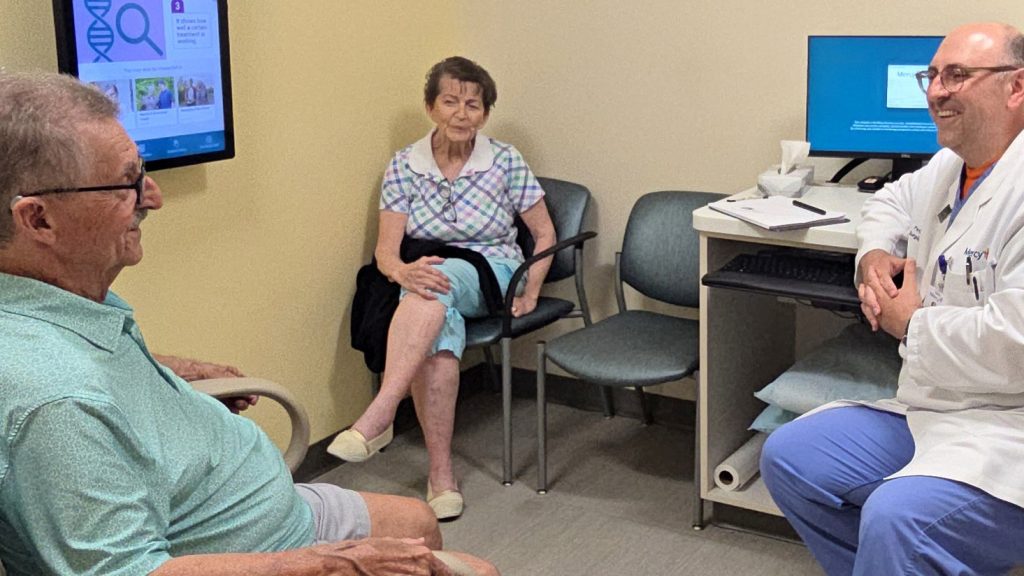
When Mike Wess underwent surgery to remove a liver tumor several years ago, the operation lasted five to six hours. Recovery took weeks. He spent days in the hospital and faced a long rehabilitation.
So, when doctors discovered another cancerous tumor on his liver at age 82, Wess assumed another major surgery was his only option.
Instead, he became one of the first patients at Mercy Hospital in St. Louis to receive a groundbreaking treatment called histotripsy, a noninvasive procedure that uses focused sound waves to destroy tumors without a single incision.
“I was amazed,” Wess said. “With my age, I didn’t think there was much chance they’d pick me. I was thrilled, but a little apprehensive because I wasn’t sure what to expect.”
The treatment lasted about 35 minutes. The only thing Wess remembers is being wheeled into the operating room and seeing the machine.
“The next thing I knew,” he said, “I was in recovery.”
‘This can’t be real’
For Wess’ wife, Lillian, the difference between the two experiences was striking.
The first liver surgery required weeks of caregiving and monitoring. Wess struggled with pain, limited mobility and eating. As an active person who had already undergone spinal surgery, knee replacements and skin cancer procedures, recovery was especially challenging.
“With this, there was nothing,” Lillian Wess said. “He was fine right after.”
The couple said they were stunned when doctors told them Mike Wess could return to normal activities almost immediately.
“After this,” his wife recalled the surgeon saying, “if you want to play golf, go play golf. If you do gardening, go gardening.”
When the procedure was finished, Wess didn’t head straight home to bed. Instead, he visited family and ran errands.
“Our son kept looking at him,” Lillian Wess said. “He was like, ‘This can’t be real.’”
The technology behind outcomes like Wess’ is drawing attention from cancer specialists nationwide.
Dr. Peter DiPasco, a surgical oncologist at Mercy and one of the physicians leading the program, said he was initially skeptical about histotripsy.
“It sounds too good to be true,” DiPasco recalled saying.
Histotripsy uses focused ultrasound waves delivered through a water-filled device positioned above the patient. The sound waves converge at a precise target inside the body, creating microscopic bubbles that rapidly expand and collapse millions of times per second.
Those collapsing bubbles mechanically destroy tumor tissue, effectively liquefying it while leaving critical structures such as blood vessels and bile ducts intact.
“The tumor is turned into liquid and melted away,” DiPasco said. “The important stuff is left behind.”
Over time, the body absorbs and removes the cellular debris.
“If you compare MRI images before treatment and six to nine months afterward, it’s almost like somebody took an eraser and erased the tumor out of the liver,” DiPasco said.
The technology received federal approval for treating liver tumors and is being adopted at a growing number of medical centers. DiPasco said Mercy has already treated several patients and expects the technology to expand to other organs, including the kidney, pancreas and prostate, as research and regulatory approvals continue.
For older patients or those with serious medical conditions, the benefits can be especially significant.
“Patients who couldn’t tolerate a major operation now have another option,” DiPasco said. “The fact that it’s an outpatient procedure and patients can walk out of the hospital the same day has been a major game changer.”
Round out your reading
- Scientists are now eyeing a possible ‘Mega El Niño’.
- Critics mocked Mamdani’s AC request. Republicans made the same ask.
- Social Security was supposed to be a safety net. To young Americans, it’s a broken promise.
- What happens when the water dries up? Much of the American West is close to finding out.
- Political insiders are targeting the two-party system’s grip on America.
Ella Rae Greene, Editor In Chief