Americans are earning more than ever. So why does the middle class feel stuck?
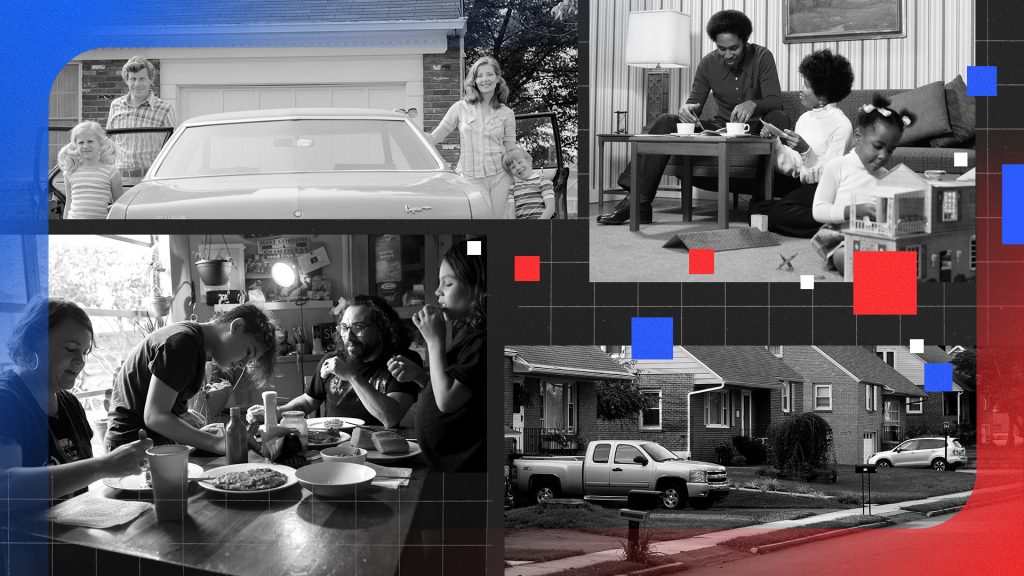

As the United States marks its 250th birthday, Straight Arrow is taking a fresh look at the institutions, systems and social contracts that shaped modern America — and the pressures now testing them.
Jennifer Bringle sits almost exactly in the middle of America’s vast middle class.
Bringle, a 47-year-old freelance writer, and her husband, a 49-year-old wheelchair-services worker, live in Greensboro, North Carolina, with their 11-year-old son.
Their combined annual income has averaged about $110,000 in recent years, Bringle told Straight Arrow. In their best year, they earned $160,000.
And yet, Bringle said, “it’s frustrating because I feel like at this point in our lives, with the money we make, we should be in a different position.”
“If I’m not living paycheck to paycheck, I feel like I’m almost there,” she said. “And we’re like one catastrophic event away from being in a really terrible state financially.”
Her status – and her fears – reflect the challenges facing middle-income Americans as the nation marks the 250th anniversary of its founding. For many who consider themselves middle class, the American dream is slipping away.
Fifty years ago, at the nation’s bicentennial, many middle-class families could buy a home, raise children and build savings on a single paycheck.
Today, the typical American family earns more than its counterparts did then, even adjusting for inflation. They also can afford technologies and conveniences that seemed unimaginable to even the wealthy a half-century ago.
But housing, health care, childcare and higher education have become dramatically more expensive since 1976, requiring many households to devote more work, if they can get it, to maintaining a middle-class lifestyle.
The result is one of the central economic paradoxes of modern America: Government statistics show rising prosperity, while many families experience growing financial strain.
The middle
In recent years, Bringle and her husband together earned slightly more than the U.S. median income for a family ($108,600) — but less than the median income for a married couple ($128,700).

Yet in many ways, she said, they are doing better than most middle-class Americans.
They bought their home 15 years ago for $123,000, and it is now worth about $270,000, Bringle said.
She is a college graduate, although her husband is not, and she paid off her student loans after receiving an unexpected legal settlement.
Also, her retired mother-in-law watches their son while they work, saving them thousands of dollars a year in childcare expenses.
Still, as a breast cancer survivor, Bringle worries that if her cancer returns or the family faces another health crisis, medical bills and lost work could wipe them out.
“Getting something like cancer, which can happen to any of us, is just so astronomically expensive,” she said. “Some people are getting their whole lives devastated, health-wise and financially, from something like this.”

Rising median incomes
“The typical American family is modestly better off financially today than 50 years ago,” said Mark Zandi, chief economist at Moody’s Analytics.
The primary reason is that median household income rose from about $70,000 in 1976 to roughly $84,000 in 2024, adjusted for inflation, according to Census data. Net worth has also increased, Zandi said.
Still, he told Straight Arrow, median earners have fallen well behind wealthy Americans over those decades.
Michael Tanner, an economist formerly with the Cato Institute, a libertarian think tank, acknowledged that inequality has surged. But he maintains that the American middle class still enjoys a better quality of life today than in the 1970s. The rising tide has lifted all ships, he said.
Scott Winship, a senior fellow at the conservative-leaning American Enterprise Institute, made a similar case.
Real median wages are “more or less at all-time highs,” Winship told Straight Arrow, and have risen faster than inflation for food, clothing, home furnishings, cars and entertainment over the past several decades.
Tanner also said that the goods and services available today — from computers and smart phones to safer, more technologically advanced cars — far exceed what was accessible to the middle class decades ago.
“Many of the things we now consider standard would have been considered luxuries,” he told Straight Arrow. For example, Tanner said, “think about Gordon Gekko” — the villain of the 1987 film “Wall Street” — “and that brick-like phone he carried.”
Even homes are larger and more lavish, he said, which is partly why their prices have dramatically outpaced wage growth.
Surging housing costs helped fuel today’s middle-class affordability crisis, but Tanner said that is partly because “we’re not building starter homes anymore.”
Earlier this month, Congress passed the 21st Century ROAD to Housing Act, a sweeping bipartisan legislative package aimed at making it easier to build new homes. It includes measures to speed up federal reviews, remove restrictions on manufactured homes and reward communities that increase housing production.
More work to earn a middle-class lifestyle
Bringle remains unconvinced that rising inflation-adjusted income tells the complete story. Many leading economists share her skepticism.
Household income figures, they argue, mask a fundamental shift in how families achieve middle-class status.
In 1972, 51% of married couples relied on a single earner, almost always the husband. By 2022, that share had plunged to 29%, according to the Pew Research Center.
Most of the increase in household income over the past several decades has come from women’s earnings and more hours worked, not from hourly wage growth, said Enrique Lopezlira, director of the Labor Center at the University of California, Berkeley.
His team’s research reveals that lower- and middle-income Americans increasingly juggle multiple jobs and longer hours. And the lifestyle that one breadwinner could sustain in 1976, he said, typically requires two full-time workers in today’s economy.
That dual income keeps Bringle’s family afloat.
“If either one of us were unable to work the way that we are now,” she said, “it would be a big struggle for us.”
When essentials become luxuries
Despite modest income growth, America’s middle class is increasingly squeezed by the exploding costs of big-ticket essentials like housing, healthcare, education and childcare.
Consider housing: Today’s median existing-home price of $434,300 is a dramatic increase from 1976’s median of $228,306 in current dollars, according to data from the National Association of Realtors (NAR).
This surge helps explain why first-time homebuyers now average 40 years old, compared with 29 years old in 1981, according to NAR survey data.
Bringle’s family story illustrates this shift.
Her parents — her father was a factory worker and her mother a church secretary in 1980s Salisbury, North Carolina — were lower-middle class and not college-educated, she said. But they owned a home remarkably similar to hers today.
“Same number of bedrooms, roughly the same square footage,” she told Straight Arrow.

Though Bringle and her husband earn more than her parents ever did, adjusted for inflation, she believes their incomes “would have gone a lot farther back then.”
The data support that belief, especially when it comes to major expenses.
Childcare costs alone averaged $13,184 nationally in 2025, reaching $25,000 or more in major metropolitan areas, according to data from Child Care Aware of America, an advocacy group. That was not even a necessary expense for many single-breadwinner families in the 1970s.
Meanwhile, healthcare costs have nearly doubled since 1970, with out-of-pocket spending rising from roughly $703 per person to more than $1,500 in 2023, inflation-adjusted, according to KFF. And that excludes insurance premiums.
Additionally, in-state tuition at public four-year colleges has more than doubled just since the mid-1990s, saddling graduates with unprecedented debt, according to the College Board.
A precarious middle class
These rising costs, along with eroding job stability, have made today’s middle class more vulnerable, said Chuck Collins, director of the Program on Inequality and the Common Good at the progressive Institute for Policy Studies.
“Middle-income households are more precarious, have fewer financial reserves and diminished retirement security, and a lower sense of economic well-being and security” than in the past, Collins told Straight Arrow. Young Americans today, he said, face significantly higher barriers to financial independence than the postwar baby boomers.
Lopezlira drew a key distinction: While consumer goods have become more affordable, the assets that provide lasting security — homes, retirement savings, investments and higher education — have moved further from reach.
Median-income Americans, he added, grapple with increasing anxiety about job security, the impact of artificial intelligence, the future of Social Security and broader economic instability.
The fading American dream
Perhaps no metric captures middle-class aspirations better than economic mobility — the likelihood that children will outpace their parents’ financial success.
Harvard economist Raj Chetty‘s groundbreaking research reveals a stunning reversal. While 90% of Americans born in 1940 eventually out-earned their parents, fewer than half of those born in the mid-1980s have achieved that milestone.
“By tracking what happens to families over time,” Chetty told Straight Arrow, “we can see whether economic growth is translating into broadly shared gains.”
Upward mobility, he said, “is one of the clearest ways to understand how the middle class is really faring.”
And by that measure, today’s middle class is falling behind their parents’ and grandparents’ generations.
A widening income divide
Median income has risen since the 1970s, but not at the explosive rate of incomes at the top.
The U.S. median household income grew roughly 60% from 1970 to 2022, adjusted for inflation, while upper-income households saw their income grow about 78% during that same period, according to Pew.
But in those years, Pew found, the share of total household income for middle-class Americans fell from 62% to 43% — a dramatic erosion of middle-class economic power.
That trend has recently accelerated.
While income growth at the top has surged, “spending power in middle- and lower-income households has not increased meaningfully going back to before the pandemic,” said Benjamin Shoesmith, a senior economist at KPMG.
“In some cases,” he told Straight Arrow, “it has diminished.”
An even starker wealth divide
America’s wealth gap has widened even more dramatically than the income gap since the 1970s.
In 1989, the wealthiest 1% of Americans held about 23% of the nation’s wealth. By 2025, that share had climbed to nearly one-third, according to Federal Reserve data.
And that was before Elon Musk became the world’s first trillionaire through the record-setting initial public offering of his company SpaceX.

Collins, who writes books about inequality, has a unique perspective on wealth concentration.
As the great-grandson of Oscar Mayer, founder of the food company that bears his name, he said he had “an intimate front-row seat to the compounding advantage of the ultra-wealthy.”
Even from that vantage point, he feels that “the current level of excessive wealth, and the trappings of sumptuous consumption and power, is positively medieval.”
“We’ve gone from the other side of the tracks,” he said, “to the wealthy taking off on a rocket launcher, living in a parallel universe.”
The political disconnect
Bringle is concerned about the growing power of wealthy Americans and their ability to shape economic policies in the years ahead.
“I feel like politicians on both sides love to talk about the middle class,” she said, “but I don’t really feel seen.”
As America celebrates its 250th birthday, Bringle said she still believes in the country’s promise.
But she worries that promise is increasingly out of reach for many.
Round out your reading
- America at 250: Straight Arrow’s week-long look at the pressures testing modern America.
- Ketamine is booming in America. The reasons go beyond drugs.
- Cluster of AI news sites suddenly goes dark after human reporter starts asking questions.
- A 79-year-old, obese, well-connected man gained exclusive access to a new weight loss drug. Is it Trump?
- Newsom pushes national wealth tax after opposing California billionaire tax.
Ella Rae Greene, Editor In Chief