
How states and schools are racing to solve the small-town vet shortage
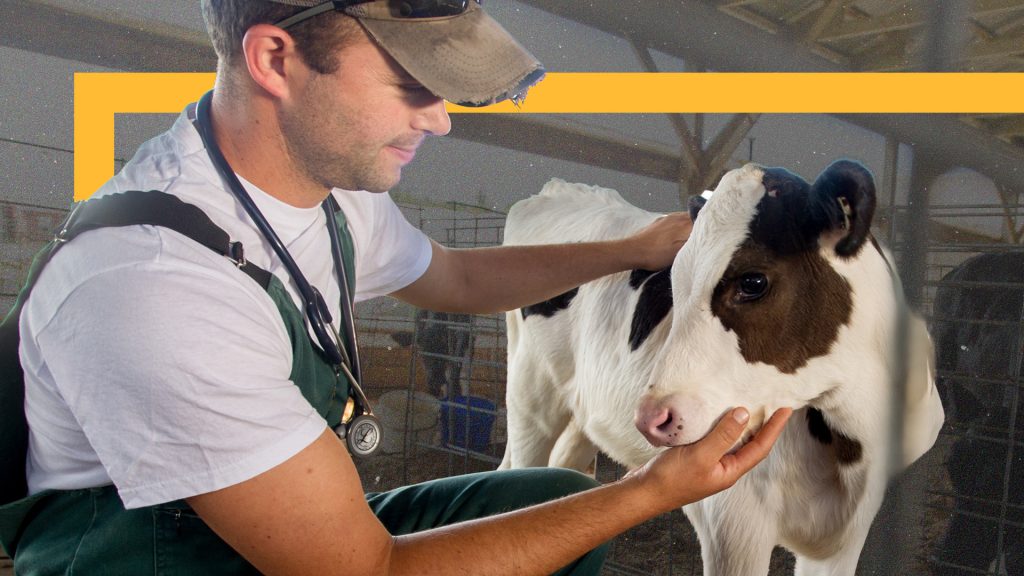
Cattle farmer Jeff Sherfield needs to know his bulls are fertile before selling them. That requires a semen check at a veterinarian’s office.
And this spring, that became a problem.
“The vet I typically use couldn’t see the bulls until the end of May,” he told Straight Arrow in late April.
The closest veterinarian who could fit them in sooner was an hour drive from his Spencer, Indiana farm, requiring gas money and precious time away from his farm.
“I have to haul them 60 miles to get a pretty simple procedure done,” he said. And even then, he had to wait an extra week.
Hundreds of counties nationwide are short on veterinarians, USDA figures show, putting farmers like Sherfield in a tight spot when animals need routine care, and creating desperate circumstances in emergencies.

The shortage is especially acute in heavily rural states like Indiana, where the USDA considers the entire southern section of the state a “must-serve” location, meaning there aren’t enough vets for the region. Seventeen counties and municipalities in other parts of Indiana are also considered “must serve.”
“The veterinary shortage is a signature issue,” said Denise Derrer Spears, communications director for the Indiana Center for Animal Policy. “We hear regularly from farmers about needing assistance locating vet services.”
READ MORE: How high corn production hides the financial strain of US farms
All but three states — Rhode Island, Massachusetts and Connecticut — have at least one “must-serve” location. Some have dozens. One such location is Meigs County, Ohio, with a population of just over 22,000 people spread over 433 square miles.
The problem is mutli-faceted, veterinary experts tell Straight Arrow. Veterinary schools don’t produce enough students and graduates shy away from rural communities where they stand to make less money.
Several states, including Ohio, Texas, Colorado and Mississippi, have in recent years moved to address the shortage by training more vets, finding scholarship money and recruiting more in-state applicants.
How well those measures will work remains to be seen.
Why is there a shortage?
Vets need clients, said Brad Garrison, who runs a veterinary clinic in New Pittsburg, Ohio. And in the underserved areas, “the livestock and number of farms is insufficient to support a practice,” he said. “There has to be a volume of work to generate the income a vet needs.”
The landscape surrounding New Pittsburg alternates between rolling hills, patches of trees and vast fields of corn and soybeans with the occasional barn and farmhouse sprinkled in between plots of row crops.
In a place where the distance between homes can be measured in miles, Garrison said his practice must ask many farmers to come to them.
The financial toll on veterinarians is especially stark for those who must pay their own way through veterinary school, experts say. Servicing financially strapped cattle and poultry farmers is a tall order when someone is saddled with student loan debt.

But other factors are at play. When Minnesota Veterinary Medical Association President Jessica Fox informally polled veterinarians about their willingness to work in rural areas, she was surprised that the financial toll was not the top issue.
“The biggest issue is on-call expectations,” she told Straight Arrow.
Young vets have difficulty taking vacations or even having weekends off if farmers need them to be available for emergencies, she said. Urban and suburban vets, by contrast, mostly serve smaller, household pets and can work regular hours.
“Nobody goes into veterinary medicine to make a lot of money,” Fox added.
Veterinarians are often married, and must think of their families, Purdue College of Veterinary Medicine Dean Bret Marsh told Straight Arrow.
The college collaborated with the Farm Journal Foundation to research the shortage, and found that veterinary graduates worry about career opportunities for their spouses and educational opportunities for their children. They find few of both in farming communities, Marsh said.
“The previous supposition was that a veterinary grad couldn’t go into a rural area because they couldn’t pay their student debt,” he said. “But we’re finding it’s more broad than that.”
Purdue is considering a number of measures to address the problem, including expanding class sizes at its veterinary school, Marsh said.
Why is this a problem?
The thought of something going wrong when a cow gives birth keeps Sherfield up at night. With no veterinarians willing to drive to his farm, a birthing emergency means loading an already-stressed cow into a trailer and driving nearly 40 miles to a vet who might not be able to see them, he said.
“They might only be able to save the cow or the calf, not both,” he said. “With what a cow is worth these days, that’s a big financial hit.”
When older veterinarians retire, it’s not always clear whether someone will replace them, a problem that Wisconsin organic farmer Harriet Behar recently learned.

“My local vet is retiring and nobody wants to buy his practice,” said Behar, who grows vegetables and raises chickens in southwest Wisconsin. Her chickens’ medical problems could be a death sentence if she can’t find a replacement.
“If you have a sick chicken, you have a dead chicken,” Behar said.
What are states doing about it?
Ohio State’s veterinary school plans to increase class sizes from 165 to 200 over the next three years and recruit more in-state students who might be more willing to work outside of big cities.
School officials are also seeking scholarship grants from the USDA and hiring more staff to support the expanded enrollment.
READ MORE: Most US farmers can’t afford the fertilizer they need
States such as Wyoming and Mississippi have offered more scholarships to ease the burden of vet school, which can cost hundreds of thousands of dollars. The total price of attending Ohio State’s veterinary college, for example, is nearly $275,000.
More veterinary schools have also opened in recent years. Texas Tech’s veterinary school graduated its first class a year ago.
“Well over 80% of that class went into mixed or rural settings,” said Texas Veterinary Medical Association Executive Director Lori Teller.
Texas A&M’s veterinary school, she added, “has a campus in West Texas and the focus for those students is also rural and large-animal medicine. They are increasing the number of clinical rotations to give students even more experience and exposure to rural and large animal practices.”
Colorado tried a different tactic. Voters there approved a 2024 ballot measure creating a mid-level position called a veterinary professional associate, who can diagnose animals, order medical procedures and perform routine surgeries.

These VPAs will require two additional years of schooling after earning a bachelor’s degree. That puts them between the requirements for vets — who must complete four years of schooling after their bachelor’s — and veterinary technicians, who only require two years of schooling post-high school.
But not everyone thinks it’s a good idea.
“The concern is veterinarians are already going through four years of [veterinary] schooling and not feeling equipped to practice,” said David Emery, an assistant professor of primary care medicine at Michigan State University’s College of Veterinary Medicine. “You’re asking a lot of them to go through two years and then do surgery.”
Will those measures work?
Some states only started expanding veterinary classes in the past two years, meaning rural communities won’t see the fruits of those efforts until those students graduate. Ohio State’s first enlarged class will be ready to hit the workforce in 2030.
And whether those graduates will work in rural areas is unclear.
Some experts note that simply increasing class sizes and seeking scholarship money won’t increase family opportunities in rural areas or change on-call expectations.
“This is such a multi-faceted problem,” Spears said. “There isn’t just one solution.”
Round out your reading
- They built an Epstein files library, but realized they couldn’t let everyone read them.
- The doctor who claims functional medicine reversed her MS.
- For many Americans, ‘one more round’ no longer serves their lifestyle or budget.
- Trump claimed economic data is ‘rigged.’ Former officials pledge to ‘watch like hawks’ for political manipulation.
- We’re building a new Straight Arrow. Help us shape our future by taking our survey.
Ella Rae Greene, Editor In Chief