What a bomb would do: Website visualizes nuclear attacks
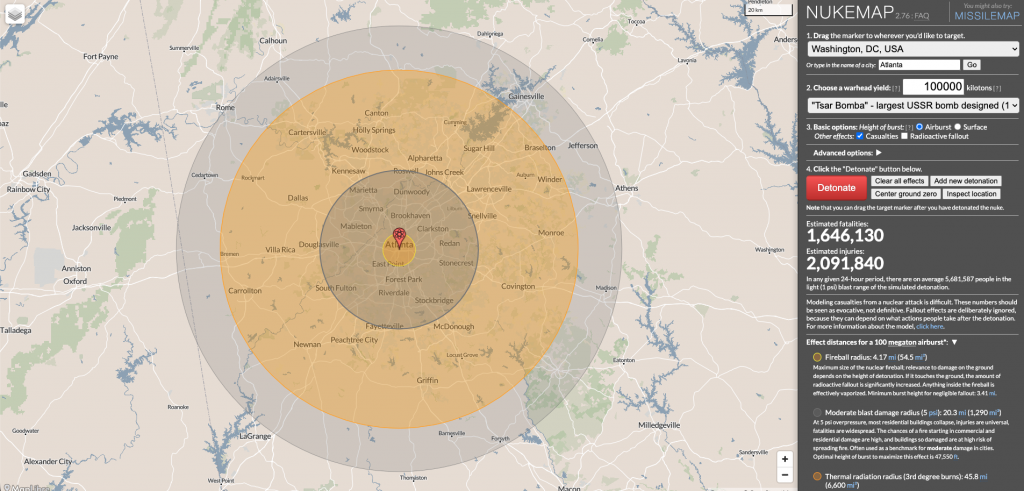
If the largest nuclear bomb ever designed by the Soviet Union were dropped on downtown Atlanta, everything and everybody within a nearly five-mile radius would be “effectively vaporized.”
Within 20 miles of the detonation site, “most residential buildings collapse, injuries are universal, fatalities are widespread.”
And even within a 45.8-mile radius, people would receive third-degree burns that “extend throughout the layers of skin. … They can cause severe scarring or disablement, and can require amputation.”
These are the grim assessments of an increasingly popular website that simulates the effects of nuclear attacks. The site, known as NUKEMAP, allows users to see how cities across the globe would fare from a direct nuclear hit. After selecting a location, users can detonate an assortment of nuclear bombs to see a range of statistics such as estimated fatalities and injuries.
Usage has surged since the United States and Israel attacked Iran, in part to eliminate the Islamic Republic’s potential development of nuclear weapons. President Donald Trump said Iran was developing weapons capable of striking the U.S., although military analysts have generally disputed his claim.
Goal is to educate public
The site was created by Alex Wellerstein, an associate professor of science and technology studies at the Stevens Institute of Technology in New Jersey. He has written two books on the history of atomic warfare, including 2025’s “The Most Awful Responsibility: Truman and the Secret Struggle for Control of the Atomic Age.”
He says he launched NUKEMAP in 2012 with the goal of educating the public.
“The NUKEMAP is aimed at helping people visualize nuclear weapons in terms they can make sense of — helping them to get a sense of the scale of the bombs,” Wellerstein says on the website. “By allowing people to use arbitrarily picked geographical locations, I hope that people will come to understand what a nuclear weapon would do to places they are familiar with, and how the different sizes of nuclear weapons change the results.”
A detonation in Washington, D.C., for example, of the same nuclear weapon used by the U.S. against Nagasaki, Japan, in 1945 would cause an estimated 129,560 casualties. NUKEMAP’s statistics are based on declassified government data on the effects of nuclear detonations.

Even the smallest nuclear bomb produced by the U.S. would cause thousands of deaths if it were detonated near the World Trade Center in New York — far more than the terrorist attack of Sept. 11, 2001.
‘Elevated’ usage
NUKEMAP, according to its website, has been used to conduct 391.4 million simulated detonations. In a post to Bluesky on Monday, Wellerstein highlighted what he described as “elevated” usage since the beginning of the Iran war.
Statistics shared by Wellerstein indicate that 404,000 new users came to NUKEMAP between Feb. 10 and March 9. The attack on Iran began Feb. 28.
A snapshot on Monday showed 872 active users, 505 of whom originated from the U.S.
Wellerstein added that while the surge in users is notable, it has thus far failed to surpass the numbers seen in 2022 after Russia invaded Ukraine. Between January and April 2022, Wellsterin says, NUKEMAP was visited more than 7 million times.
Nevertheless, the uptick in users, especially in the U.S., highlights the public’s growing anxiety over the current conflict.
Ella Rae Greene, Editor In Chief