Spain denies US bases after Iran strikes as Trump feud with Prime Minister intensifies
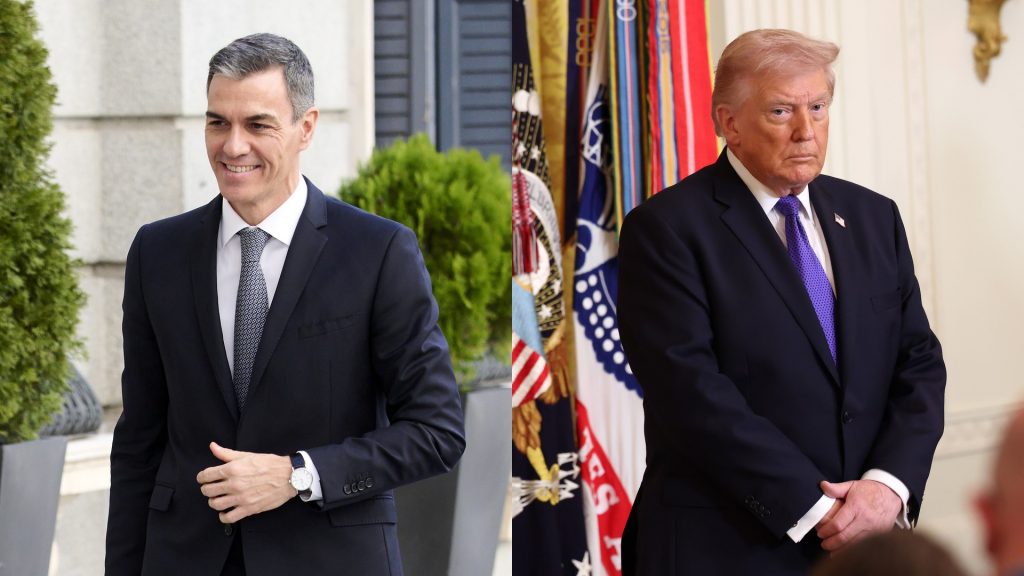
Tensions between Spain and the United States have been building for months, but they escalated this week after the U.S. struck Iran over the weekend.
Spanish Prime Minister Pedro Sánchez escalated his criticism, condemning the Iranian regime but also criticizing the United States’ response, saying it’s contributing “to a more uncertain and hostile international order.”
“In short, the position of the government of Spain can be summarized in four words,” Sánchez said. “No to the war.”
Spanish bases and trade threats
Sánchez also refused to allow U.S. military personnel to use Spanish bases – unlike some of his E.U. counterparts — saying his government wouldn’t “be complicit in something that is bad for the world.”
The decision drew a threat from President Donald Trump on Tuesday, who said he would cut off trade with Spain.
“We don’t want anything to do with Spain,” Trump told reporters, saying “we’re going to cut off all trade.”
Sánchez quickly pushed back, saying Spain would not be pressured into changing its position.
“We’re not going to be complicit in something that’s bad for the world nor contrary to our values and interests simply to avoid reprisals from someone,” Sánchez said.
By Wednesday, White House press secretary Karoline Leavitt said Spain had agreed to cooperate with the U.S. military.
“It’s my understanding over the past several hours, they’ve [Spain] agreed to cooperate with the U.S. military,” she told reporters. “The U.S. military is coordinating with their counterparts in Spain.”
However, Spanish Foreign Minister José Manuel Albares denied the claim, saying Spain had not changed its position.
Other EU members get involved
While Spain continues to deny the U.S. its bases, other European leaders have taken different approaches.
British Prime Minister Keir Starmer reversed an earlier decision and is allowing the U.S. to use British bases to destroy Iranian missile capabilities.
In France, President Emmanuel Macron ordered French military reinforcements to the Middle East, pledging to help protect Cyprus and Persian Gulf nations that are experiencing Iran’s retaliation.
Macron blamed Iran for the conflict but said France could not approve of the U.S.-Israeli attack, saying it fell “outside of international law.”
Germany has taken a different stance. Chancellor Friedrick Merz voiced his full support to the U.S., saying now is “not the time to lecture our partners and allies” about international law.
History between Trump and Sánchez
This week’s clash is not the first time Sánchez and Trump have found themselves at odds.
In June 2025, after the U.S. bombed Iran’s nuclear facilities, Sánchez warned that “the world is on the edge of a dark abyss.”
“We are normalizing a scenario where certain powers bomb each other, their leaders trade nuclear threats, and civilians bear the consequences,” he added.
Sánchez has also criticized Trump’s immigration agenda in a New York Times op-ed, writing that some leaders have chosen “to hunt them down and deport them through operations that are both unlawful and cruel.”
The Spanish leader has also rejected Trump’s call for increased defense spending through the United Nations, and the two notably failed to greet each other at a recent summit.
Could Trump cut off trade?
If the feud escalates, Trump has several potential tools to target trade with Spain.
Because Spain is part of the European Union, imposing tariffs specifically on Spain would be complicated.
The E.U. negotiates tariffs as a bloc. That means the administration would likely have to pursue other measures — such as retaliatory tariffs, anti-dumping tariffs, or financial sanctions — according to reporting by The Washington Post.
Ella Rae Greene, Editor In Chief