Navy: China’s subs could strike more of US from defended waters
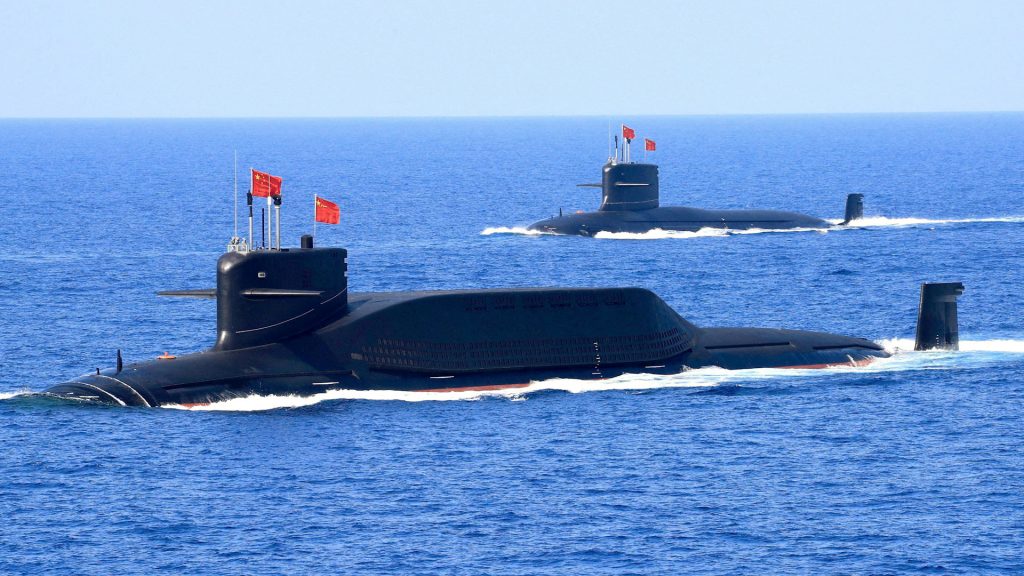
The U.S. Navy’s decades-long undersea advantage in the Pacific is facing its sharpest test in years.
For generations, the “silent service” has been one of Washington’s strongest cards in the Indo-Pacific. But testimony prepared for the U.S.-China Economic and Security Review Commission warns that China is accelerating submarine production and developing next-generation nuclear-powered boats that could narrow the U.S. edge.
The aim, Navy leaders say, is a force that can hold large portions of the U.S. at risk while operating from protected waters closer to China’s coast.
Vice Adm. Richard Seif, commander of U.S. Navy submarine forces, said U.S. undersea capabilities remain a key advantage in the Indo-Pacific because submarines can stay concealed and operate for long periods in highly contested waters. He warned that China is trying to reduce that edge by modernizing its submarine force, expanding anti-submarine warfare and investing in seabed sensing and networked surveillance.
Seif said open reporting sometimes uses the phrase “Underwater Great Wall” to describe parts of China’s effort to combine fixed and mobile sensing, unmanned systems and data processing to improve detection and tracking in strategically valuable areas. He said the likely impact is a narrower U.S. stealth margin in certain approaches and chokepoints, rather than making the undersea environment fully “transparent.”
What US Navy leaders say China is building
Rear Adm. Mike Brookes, director of the U.S. Navy’s intelligence office, wrote in testimony that China’s next-generation submarines include the Type 095 and Type 096, which he said are expected to enter service in the late 2020s through the 2030s.
“These submarines will incorporate substantial advancements in nuclear reactor design, sensor performance, weapons integration, and noise quieting technologies,” Brookes wrote in his testimony.
The Type 096 SSBN is expected to be equipped with JL-4 submarine-launched ballistic missiles and could threaten large portions of the U.S. from waters China can defend near its coast.
China currently fields the JL-3 submarine-launched ballistic missile, the predecessor to the JL-4 system that U.S. Navy leaders say could arm the future Type 096. The National Interest reports the JL-3 has an operational range exceeding 5,600 miles, with some estimates topping 6,200 miles.
In contrast, the U.S. Navy’s Trident II D5 submarine-launched ballistic missile has a listed maximum range of about 7,456 miles, according to CSIS’ Missile Threat database.
The Wall Street Journal, citing Brookes’s submission, said he described the Type 096 as a step beyond China’s current ballistic-missile submarines, which he said can target portions of the United States from within the “first island chain” linking Japan, Taiwan and the Philippines.
Unbiased. Straight Facts.TM
China fields the Shang III SSGN as its most capable operational attack submarine and has launched at least six of the eight expected boats since 2022.

A growing fleet
Brookes wrote that China has “dramatically increased” domestic submarine production capacity through major shipyard investments, pushing nuclear-sub output above the previous pace of less than one per year.
Brookes projected China’s submarine force could reach roughly 70 submarines by 2027 and said it includes more than 50 diesel-electric boats while evolving through “successive generational improvements,” including Yuan-class submarines, which incorporate propulsion technology to extend submerged endurance.
Seif, in separate testimony, described China’s modern nuclear-powered submarines, including the Shang III and follow-on Type 095 guided-missile submarines, as increasingly capable and said they increase demands on U.S. and allied anti-submarine forces and complicate conflict scenarios in contested waters.
Beijing’s undersea push
U.S. Navy leaders said the competition is not limited to submarines. The Journal reported Seif and Brookes pointed to Chinese investments in seabed sensors, undersea cables and unmanned systems designed to improve situational awareness and make U.S. operations in parts of the western Pacific more difficult.
Brookes wrote that by 2040, routine submarine deployments to the Indian Ocean, Arctic approaches, and possibly the Atlantic are likely.
Bloomberg reported that Brookes contrasted China’s expansion with U.S. shipbuilding constraints, citing challenges in hiring and retaining workers and in maintaining delivery schedules for Virginia-class attack submarines and the Columbia-class ballistic-missile submarine program. Randall Schriver, chair of the commission, warned that the United States will lose its underwater advantages if it fails to sustain them.
Retired Rear Adm. Mike Studeman, testifying separately, urged policymakers to view China as a broader maritime power and warned Chinese underwater operations could extend farther afield over time, including toward U.S. home waters. He also highlighted risks to undersea infrastructure and raised counterintelligence concerns tied to maritime technology.
What US commanders say they need next
Seif said the U.S. will need more ready submarines, better undersea sensing and counter-sensing, faster deployment of unmanned undersea systems, deeper munitions and payload capacity and closer operational integration with Indo-Pacific allies and partners.
Brookes projected next-generation submarine introductions in the late 2020s through the 2030s and force-size growth through 2035. He also projected China’s routine submarine deployments could push farther from its shores by 2040, the Journal reported.
Ella Rae Greene, Editor In Chief