Vance downplays long war risk as Trump reviews Iran strike options
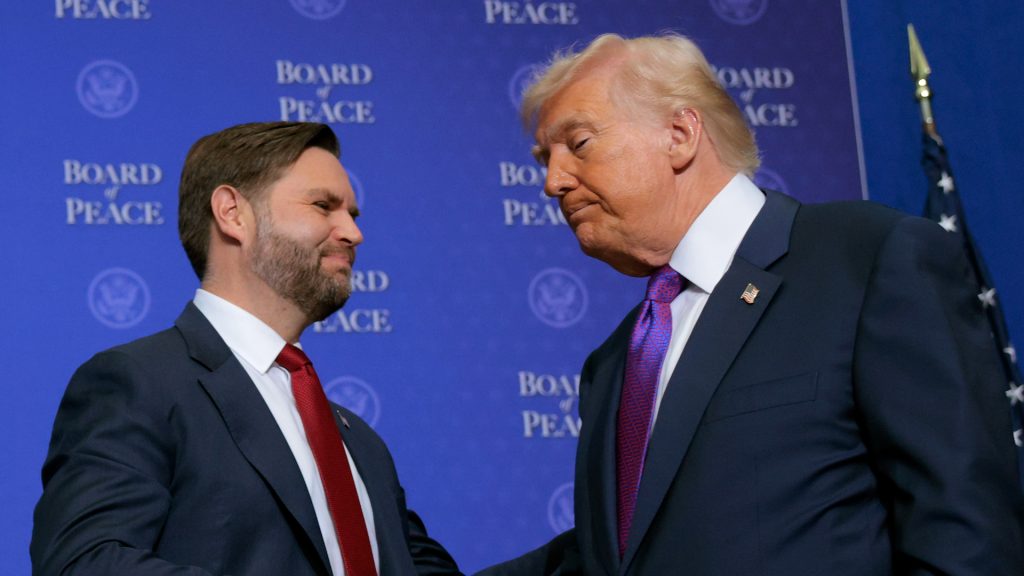
Vice President JD Vance is publicly dismissing the risk of another prolonged Middle East war — even as the United States amasses significant naval and air power around Iran.
In a Thursday interview with The Washington Post, Vance said President Donald Trump is actively weighing military options against Iran. He pushed back on warnings that a strike could spiral, saying there is “no chance” the United States would end up in a years-long conflict with no clear end.
Behind the scenes, those options are being refined. ABC News reported that Trump met Thursday with senior Pentagon leaders, including Joint Chiefs Chairman Gen. Dan Caine and U.S. Central Command chief Adm. Brad Cooper, to review possible strike scenarios. Those range from limited attacks on ballistic missile launchers and nuclear facilities to a broader air campaign targeting multiple sites over time.
Some Republican allies and Trump officials privately urged the president to let Israel strike first, with the possibility of a joint follow-on operation. Analysts cited by ABC News cautioned that a large-scale campaign could last weeks, carry major risks and still fail to produce a more cooperative government in Tehran.
The State Department said Friday that Secretary of State Marco Rubio will travel to Israel March 2–3, where he plans to talk about Iran.
Geneva diplomacy yields mixed results
Military planning is unfolding alongside indirect nuclear talks in Geneva.
Omani mediators and Iranian Foreign Minister Abbas Araghchi described the latest round as serious and productive, but far from resolved. According to The New York Times, U.S. negotiators are demanding Iran permanently shut down the three nuclear facilities at Fordo, Natanz and Isfahan and accept a permanent ban on uranium enrichment on Iranian soil. In return, Washington is offering phased sanctions relief.

Iran maintains it has the right to peaceful nuclear work under the Nuclear Non-Proliferation Treaty. Iranian officials have floated pausing most enrichment for several years, keep only small-scale “token” enrichment for medical research and diluting a stockpile of highly enriched uranium rather than exporting it, The Times reported.

Technical teams are scheduled to meet at the International Atomic Energy Agency in Vienna on Monday, with broader talks expected to resume next week. Even so, analysts told CBS News the chances of a mutually acceptable deal remain slim, and some described a U.S. strike as “a matter of days,” not months.
Rising pressure and regional instability
Timing may also factor into the decision-making. Ali Vaez of the International Crisis Group told The Times that this weekend could offer a window for Trump to act before Congress votes next week on a resolution aimed at limiting presidential war powers without legislative approval.
Retired Lt. Gen. H.R. McMaster told CBS News that if strikes occur, the opening phase would likely be “extensive,” not symbolic, and argued that Iran would face limited options for effective retaliation against U.S. defenses.
Signals of rising risk are already visible across the region. On Friday, the State Department authorized non-emergency U.S. personnel and their families to leave Israel, citing unspecified “safety risks.” The department noted that commercial flights in and out of the region are often suspended when military action appears imminent and advised Americans to consider departing while routes remain open. Earlier in the week, the U.S. Embassy in Beirut ordered a similar drawdown.
Pakistan-Afghanistan strikes
At the same time, instability is spreading elsewhere in the region. The Washington Post reports Pakistan and Afghanistan exchanged strikes over the past two days after months of rising tension. Pakistan’s defense minister declared on social media that his country is in “open war” with Afghanistan and accused the Taliban government of harboring militants.
Officials in Islamabad and Kabul issued conflicting casualty counts that could not be independently verified. A UN special rapporteur urged both sides to de-escalate.
Ella Rae Greene, Editor In Chief