Would the SAVE Act combat election fraud — or disenfranchise voters?
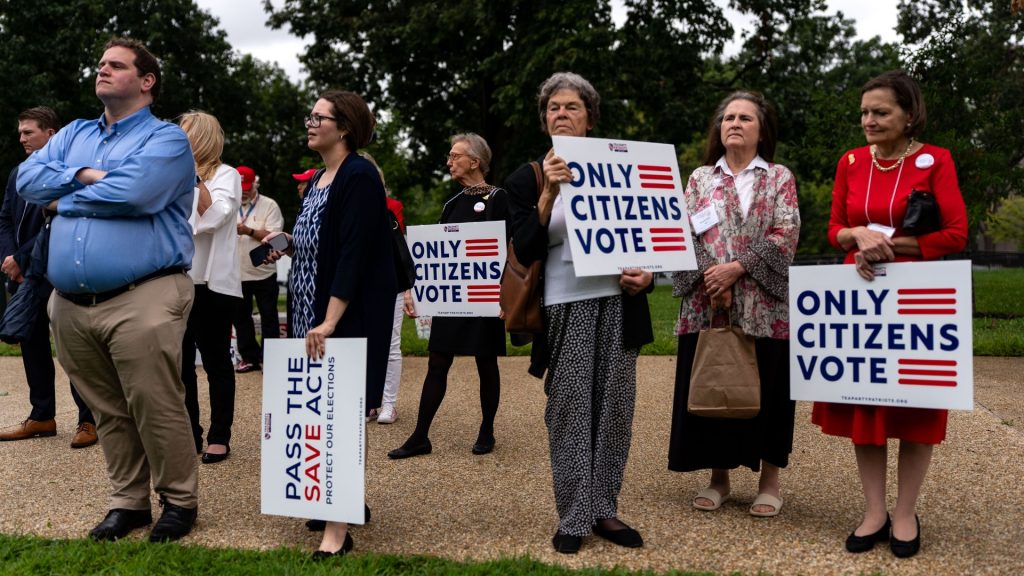
Congress is debating a bill that could dramatically change how Americans register to vote. Supporters say the Safeguard American Voter Eligibility Act, or SAVE Act, would prevent election fraud. Critics, however, say it could disenfranchise millions of potential voters, especially poor Americans.
The SAVE Act would require Americans to show proof of citizenship to register to vote. Currently, when people register, they confirm their citizenship under penalty of perjury.
Supporters, mostly Republican lawmakers, say the bill would further protect U.S. elections and formalize a national standard to help prevent voting irregularities. However, critics say that studies and investigations have repeatedly shown voting by non-citizens is extremely rare and U.S. elections have seen little proven fraud.
What does the SAVE Act do?
The bill requires native-born American citizens to show a passport, birth certificate or consular report of birth abroad to register to vote. For naturalized citizens, a certificate of naturalization or certificate of citizenship is required. Some REAL-ID or enhanced driver’s licenses are eligible if the ID explicitly indicates citizenship.
Critics said the bill does not say how people would submit documentary proof online for registration. They said this leaves election officials confused about how they can properly approve voter registration.
Some have also raised concerns about mailing important documents, which some states prohibit. Additionally, if those documents were stolen, they could be used to commit identity theft.
Under the legislation, those registered to vote would need to show a valid driver’s license, a state-issued non-driver ID, a passport or a military ID when casting a ballot. Thirty-six states already require voters to show some form of identification at the polls.
While the act would still allow mail-in ballots, registration would have to be done at an elections office. Critics say this nullifies the benefits of mail-in registration.
State voting officials would also have to share voter data with the federal government, including the Department of Homeland Security. Election officials could face criminal charges if a non-citizen registers to vote.
Groups opposed to the bill say it would place an undue burden on election officials, who are already facing burnout and high turnover.
Who would this impact?
The Bipartisan Policy Center, a political think tank, stated that many eligible voters lack the required documents under the SAVE Act. About 52% of registered voters don’t have an unexpired passport with their current legal name, while 11% of registered voters don’t have access to their birth certificate.
Birth certificates often don’t have information that matches a person’s current name. Someone who has changed their name through marriage or a court order must present a third document to prove their citizenship. The Brennan Center for Justice, a liberal think tank, estimated that more than 21 million Americans lack the documents required to register.
Because of the potential impact on voters, the League of Women Voters denounced the bill, saying the bill is “a direct attack on the freedom to vote.”
“These bills are not about election security,” the group said. “They are about restricting access to the ballot and deciding who gets to participate in our democracy.”
Supporters of the bill say critics are wrong. The Federalist Society, a conservative think tank, said that the bill acknowledges potential name issues when registering to vote. Rep. Lance Gooden, R-Texas, who supports the bill, said critics are engaging in fearmongering.
“The bill directs states to create a process to address discrepancies with name changes,” he told Fox News. “Claiming that the SAVE America Act disenfranchises married women is a fallacy intended to fearmonger women into opposing election security.”
Will the SAVE Act pass?
The House passed an earlier version of the SAVE Act in 2025 but the Senate did not advance the bill for a vote. Then, in January, representatives introduced the SAVE America Act, which revised the original SAVE Act to include a requirement for a photo ID when casting a ballot.
The House passed the new bill on Wednesday, again sending it to the Senate.
It’s unclear when the Senate might take up the bill, but it is seen as having little to no chance of winning the support of the 60 senators needed for passage. Republicans currently hold a small majority of 53 seats in the Senate.
Nearly all Democrats have categorically opposed the bill. Sen. John Fetterman, D-Pa., has not said he would support the bill but said Senate Minority Leader Chuck Schumer’s statement calling the SAVE Act “Jim Crow 2.0” was wrong.
“I would never refer to the SAVE Act as like Jim Crow 2.0 or some kind of mass conspiracy,” Fetterman told Fox News. “But that’s part of the debate that we were having here in the Senate right now.”
Some Republicans, like Sen. Lisa Murkowski, R-Alaska, have also broken ranks. She said she would oppose the bill, as she did the Democrat-led For the People Act.
“When Democrats attempted to advance sweeping election reform legislation in 2021, Republicans were unanimous in opposition because it would have federalized elections,” she said. “Now, I’m seeing proposals … that would effectively do just that.”
The post Would the SAVE Act combat election fraud — or disenfranchise voters? appeared first on Straight Arrow News.
Ella Rae Greene, Editor In Chief