LA County seeks state tax aid after river bike path cost rolls past $1B
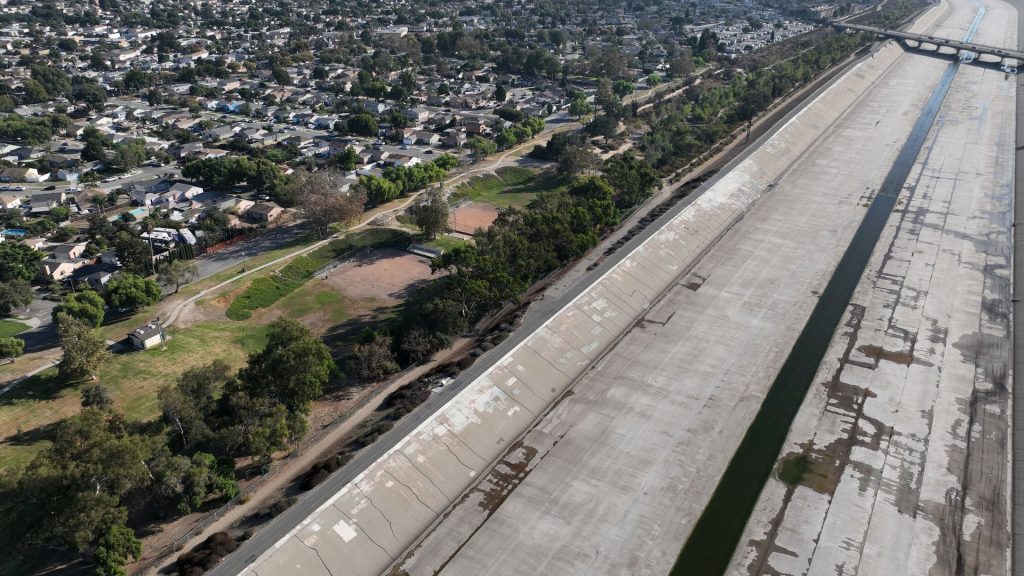
Nine years ago, voters across Los Angeles County approved Measure M, an increased sales tax to fund numerous projects, including public transportation, street and sidewalk repair, and traffic reduction. Among those projects was an eight-mile, $365 million bike path along the LA River.
Nine years later, there’s no bike path, there’s a larger price tag, and there’s no real plan to get that path built.
Measure M approval
Los Angeles is the second-largest city in the U.S., but it ranks 18th in public transit, which partially explains the infamous city traffic.
Measure M received over 70% approval from voters.
“Measure M wasn’t just a bike path along the LA River; it was a lot of bus and train infrastructure,” Michael Schneider, founder and CEO of Streets for All, told Straight Arrow News. “So, what makes it attractive is I think Angelinos are really tired of having to drive for every trip and having no good public transportation or active transportation options.”
While this current attempt has been nearly a decade in the making, it actually goes back even further.
“I was first working on this issue back 30 years ago when I worked with the Santa Monica Mountains Conservancy, and we were envisioning this idea of a 51-mile linear park with this idea of transforming what was the drainage ditch, into a linear park, and there was always the idea of having a bike path,” LA County Councilmember Bob Blumenfield, D-West San Fernando Valley, told SAN.
As for this latest plan, the bike path was expected to open in 2025.
Follow the money
Despite that, nearly all the construction has yet to begin, the environmental review process remains in early stages, and the cost has more than doubled.
The price tag has now increased to $1 billion, and county officials are looking for state funds to bridge the gap. While nearly 25% of the state’s population lives in LA County, the other 75% would be footing the bill if that happens.
LA County Metro officials have outlined several grants they could target from the California Transportation Commission (CTC).
“The CTC administers three discretionary grant programs: the Local Partnership Program (LPP), the Solutions to Congested Corridors Program (SCCP), and the Trade Corridor Enhancement Program (TCEP),” the officials wrote to the Metro’s Board of Directors. “Each program has its own purposes, eligibility criteria, and funding availability.”
Getting the funding for this project has been an issue.
“If we had the money that it would have taken when we first started talking about this nine years ago, it would have been a heck of a lot cheaper,” Blumenfield said. “But of course, costs go up.”
Schneider echoed that sentiment, saying, “Metro has taken a very long time in coming up with a plan, and the plan they have, they can’t afford.”
Besides costs rising year over year, Schneider said that the plan was just too pricey to begin with.
“They dramatically over-engineered it,” Schneider said. “For example, instead of having a bike path on one side of the river with connections at existing overcrossings, they insisted that the path is on both sides of the river.”
That would be nice, but a good bike path is better than no bike path.
“They’ve always chosen the most expensive possible option,” Schneider said. “And don’t get me wrong, I think their plan’s beautiful. If money was no object, I would love it.”
Blumenfield said his district has lined up $60 million for the project, but even that’s not enough.
“The bids came back at closer to $90 million, so that wasn’t able to happen,” Blumenfield said. “So, we’re now rebidding it.” He expects those new bids to come in January.
Metro issues
While Blumenfield has made this project a priority, it hasn’t been that way for other county leaders.
“We have been focusing on that and making real progress over the last several years,” Blumenfield said. “I don’t know that everybody shares that same vision.”
While help from politicians like Blumenfield is crucial, this really is a Los Angeles Metropolitan Transportation Authority project.
“There’s been no leader on the Metro board that’s made this project a priority,” Schneider said. “So that’s kind of how Metro works. There’s a lot of projects, and unless you have a champion, doesn’t move very quickly.”
Last month, Metro did provide an updated timeline, saying the environmental impact inspection should be done by next year. They also said there’s $433 million in Measure M funding available for the project’s construction, clearly well short of the $1 billion price tag, which is where those state funds could come in.
If not, the rest of the money will need to come from an agreement among multiple entities to determine where the funding can come from.
“Cobbling together this kind of money is never an easy task,” Blumenfield said.
What’s next?
Metro doesn’t expect to finalize the environmental impact report until 2026 at the earliest, but possibly not until 2027.
Once completed, this bike path will seamlessly connect a 32-mile corridor from the San Fernando Valley to Long Beach.

It was originally touted as one of the 28 transportation projects to be completed before the 2028 Olympics in LA, also known as the “Twenty-Eight by ’28 Initiative.”
“There’s no realistic way the existing plan gets done by 2028,” Schneider said.
Metro recently said it hopes to complete at least a portion of the project in the next five years.
“At this point, we are not looking to complete any segment, or at least we are looking to complete maybe … groundbreak for Olympic games, but not complete any of the segments,” Mitali Gupta, manager of countywide planning at Metro, said during a community meeting last month covered by SFGate.
Blumenfield said part of the path has been built in his community, and he hopes to get more of it done before the Summer Games.
“I’d love it for people in the West Valley to be able to go to Olympic events by bike,” Blumenfield said.
The post LA County seeks state tax aid after river bike path cost rolls past $1B appeared first on Straight Arrow News.
Ella Rae Greene, Editor In Chief