Why states are pulling the plug on cryptocurrency ATMs
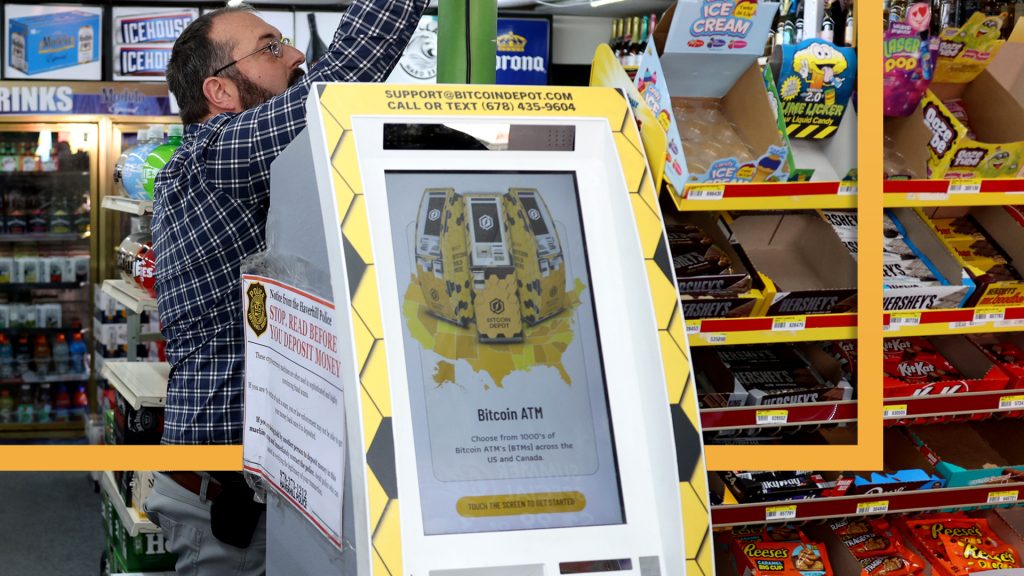
Pam had visited a convenience store in her Connecticut town countless times but never noticed the cryptocurrency ATM until a man she had been chatting with online asked her to use it to send him money.
He gave her detailed instructions.
“They would tell me step by step, how to find the address of an ATM, what machine I was using and how to put my money in,” she said. So Pam, who asked that her last name not be used, would seek out these largely colorless machines, which are roughly the height of a human, covered in messages extolling users to give crypto a try.
The man, who was eventually outed as a scammer, ultimately convinced Pam to send nearly $150,000 in a number of ways, but the ATMs proved the most frustrating.
Pam’s bank worked with state and federal law enforcement to recover some money.
But the cash deposited in the kiosks?
“That money is just gone,” Pam told Straight Arrow.
Stories like Pam’s are a main reason U.S. states and cities banned cryptocurrency kiosks over the past year, citing a high potential for fraud and few practical applications.
Now most states restrict them in some way. Bitcoin Depot, a major cryptocurrency ATM company, declared bankruptcy in May.
A Bitcoin Depot spokesperson did not respond to a request for comment from Straight Arrow.
Cryptocurrency ATM companies have lobbied for regulations over prohibition, arguing that bans won’t end fraud.
Lawmakers were unmoved, citing mounting evidence that the kiosks are a common instrument of scammers.
In research for a lawsuit last year, Washington D.C.’s attorney general found that 93% of transactions on the kiosks are tied to scams.
And the FBI’s annual crime report, released in April, says $389 million was lost to scams tied to crypto ATMs last year.
Why are local governments banning crypto ATMs?
After police made him aware of the kiosks, Larry Odebrecht visited a convenience store to see one.
“I couldn’t think of a use case for them other than ripping off old people and staying out of the banking system,” he told Straight Arrow.
Odebrecht is the city councilman for Stillwater, Minnesota, a scenic Twin Cities exurb and former logging town on the banks of the St. Croix River.
The city draws tourists with summertime boating and the picturesque forests blanketing the banks of the river. On a clear day, Stillwater residents can see the rolling hills and steep river bluffs of northwest Wisconsin.
Stillwater Police said scam victims collectively lost tens of thousands of dollars deposited into crypto ATMs over several years.
The city was only home to a handful of kiosks, although a police investigation revealed that some were unlicensed, raising the possibility that there were even more.
A story about an elderly woman who tried to send money through a crypto ATM because she thought one of her relatives was about to die proved one of the final straws, Odebrecht said.
In April 2025, Stillwater became the first U.S. city to ban the machines.
The state capital, St. Paul, followed, and earlier this year Minnesota’s state Legislature banned the kiosks after police took their story to the statehouse
“The worst part about it was (victims) couldn’t get the money back,” Karin Housley, who represents Stillwater in the Minnesota Senate, told Straight Arrow
Housley co-sponsored the law banning the kiosks.
Thirty-six states have either banned or restricted the machines, according to AARP, which has aggressively lobbied state and federal lawmakers to restrict crypto ATMs.
Individual cities followed Stillwater.
This includes Brigham City, Utah, a quaint town an hour drive from Salt Lake City with buildings that look like transplants from a bygone era and sweeping views of the Box Elder Mountains.
“We’ve seen people losing anywhere from $10,000 to $40,000 by [putting money] into these ATMs,” Detective Crystal Beck of the city’s police department told Straight Arrow.
Do partial restrictions actually prevent crypto kiosk fraud?
Hawaii went a different route.
“We didn’t ban them, we banned one of the functionalities,” Scot Matayoshi, who represents a district on the island of O’Ahu in Hawaii’s House of Representatives, told Straight Arrow. Money can be withdrawn from the kiosks, but can no longer be deposited into them.
“If someone has a crypto wallet and would like to exchange their crypto for cash, that is still allowed,” he said.
Matayoshi said crypto lobbyists came to him with regulatory proposals, including deposit limits and fraud protections.
“In our experience, banning kiosks doesn’t solve the problem – it pushes fraud toward unregulated platforms, making it harder to stop,” a spokesperson for the crypto ATM operator CoinFlip told Straight Arrow in an email.
Matayoshi found those arguments unpersuasive.
“Fraud is still going to happen through other means, but that doesn’t mean you shouldn’t try to cut off as many means as you can,” he said, echoing sentiments from several other lawmakers that spoke with Straight Arrow.
Minnesota tried limited restrictions in 2023, but scammers found a way around them, state Senator Liz Boldon told Straight Arrow.
“Criminals would have people drive to multiple machines to get around” a daily transaction limit, said Boldon, who represents a portion of southern Minnesota.
How are crypto kiosk operators fighting back against total bans?
A CoinFlip spokesperson outlined the precautions the company takes, including multi-factor authentication and regular fraud warnings.
“We support and advocate for legislation and believe all operators should meet consistent regulatory standards. Given our track record of collaborating with public and private stakeholders, we’re disappointed that some policymakers are choosing bans over constructive dialogue on stronger consumer protections,” the spokesperson said in an email.
The company supports regulations including daily usage limits, lower limits for new users, mandatory customer service and a 48-hour refund window, a spokesperson said.
CoinFlip worked with lawmakers to pass such regulations in several states.
How do romance scammers trick victims into using crypto kiosks?
Pam considered deleting her online dating profile when she received a message that piqued her interest.
“It was a really wholesome profile picture,” she said of the man who messaged her. “He was sitting there with his dog next to him.”
He claimed he was in the military and stationed in Syria, which meant he could only chat late at night. He agreed to video calls, but said they still needed to use a chatbox because he was in a top secret area and couldn’t use audio.
Hours of late-night conversations and the scammer’s claim that he was in mortal danger left Pam sleep-deprived and emotionally fraught.
“My emotions weren’t in sync with my brain,” she told Straight Arrow.
Now that she can assess the experience in a clearer mindset, she recognizes the red flags.
The scammer asked for money in all manner of ways, including gift cards and wire transfers, and promised the money would eventually be returned.
“The picture he painted was that they were in a very dangerous situation,” Pam said. “He was supposed to retire but was on a very dangerous mission, so he was receiving some kind of reward.”
Over the course of several months in 2023 and 2024, Pam sent nearly all of her retirement savings. The scam unraveled when a friend put the scammer’s profile picture through a reverse image search.
“You would think you are not a person who would ever fall for this, but if you’re in the wrong place at the wrong time and they start to suck you in, it’s really hard to get out,” Pam said.
A local detective worked with federal authorities and her bank to recover roughly $30,000. But they couldn’t recoup the money from the kiosks.
“Cryptocurrency transactions are nearly impossible to trace and therefore, recovery of funds is rare,” Stillwater’s police department said in testimony to the city council in support of a crypto ATM ban. Merely attempting to recover money “requires significant local, state and federal resources.”
If Pam’s late-night conversations had taken place a few years later, things may have turned out differently.
Connecticut started cracking down on crypto kiosks this year. State regulators ordered Bitcoin Depot to remove its ATMs over compliance issues and in April the state’s attorney general issued a warning about the kiosks.
Round out your reading
- Why Gen Z is staying home on the weekends.
- Autism research is entering a new era. Here’s what scientists are learning.
- The big reason small cities want data centers. Hint: It’s not permanent jobs.
- High school teacher arrested at city meeting after clapping for anti-data center speech.
- Off Script: Everyone’s watching Michigan. Our reporter explains why the race just changed.
Ella Rae Greene, Editor In Chief