Why millions are volunteering to be ‘eyes’ for strangers
Sarah Mielke was lounging around her New York City Upper West Side apartment, watching holiday movies and enjoying down time on Christmas Eve when her phone rang: A call to help a stranger.
Mielke clicked into the video call, where she was greeted by an older gentleman who needed help sorting through documents. He’d been chronicling his life, he told her, in hopes that someone would know his story, even after he was gone. But now he met an obstacle. Because he was blind, he was having trouble sorting the items by date.
He wondered: Could Mielke — a stranger until this video chat — help him?
Of course, she said.
Mielke was on the call for about 10 minutes, and as the two prepared to say goodbye, she noticed another stack of papers in the corner. She offered to help the man continue sorting. Over the course of four hours, Mielke learned his life story as she helped catalog birthday cards, mementos from his first date with his late wife and photos.
“It just was really neat to get an inside peek into what his life looked like and then reflect on my own life after the call,” Mielke, 38, said. “At the end of your life, what really matters? It’s the people you have, the relationships and it’s the moments and the memories that really stay with you forever.”

Bridging the gap for a growing population
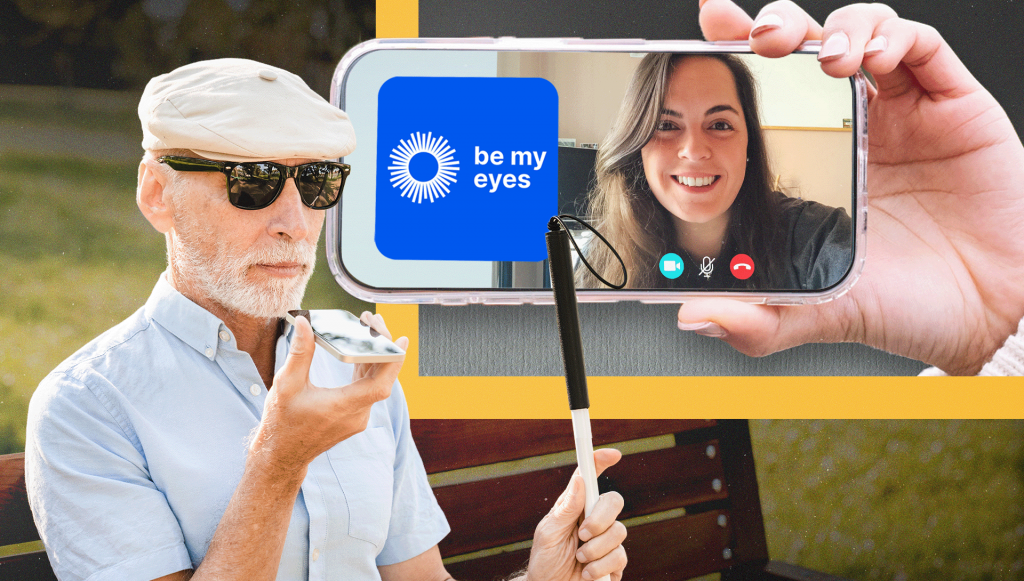
The two were connected through an app, Be My Eyes, which pairs people who are blind or visually impaired with a volunteer that can help tackle various tasks through live video. Sometimes, it’s as simple as telling someone what color apple they are holding at the store; other times volunteers deliver life-changing news by reading a pregnancy test. The app launched in 2015 and has more than 900,000 users around the world with 9.3 million volunteers.
More than 3.4 million Americans aged 40 and older have some form of a visual impairment, though some estimates reach as high as 21 million people, according to the Centers for Disease Control and Prevention. With the number of people with blindness and visual impairment expected to double by 2030 — thanks largely to an aging population and an uptick in diabetes and other chronic conditions that can lead to eye disease, according to the CDC — apps like Be My Eyes are becoming increasingly important.
Tony Stephens, assistant vice president of communications at the American Foundation for the Blind, said Be My Eyes is “wildly” popular among the blind community. An added benefit, he said, is that it is free — a major boon to people who are low vision, who are more likely to live below the poverty line.
“We call it like, a sighted person in your pocket,” he said. “It’s just really convenient.”
Steve Elliot, 57, from Austin, Texas, lost most of his eyesight about 10 years ago. The worry that came with the change pushed him to avoid traveling and other tasks.
It really “shrunk his world,” he said.
Eventually, he gained a guide dog and found apps like Be My Eyes to ease his anxiety, particularly while traveling independently.
Something as simple as having a volunteer tell Elliot which Keurig coffee pods are decaf or caffeinated or which button is cool on the thermostat helps make traveling seem a little less daunting, he told Straight Arrow News .
Recently, Elliot and his guide dog adventured to a puppy club meet up, not far from his house. He was able to navigate there, but once his directions said he arrived at the destination, Elliot said there was “nothing obvious” to indicate he was in the right place. So, he called Be My Eyes.
Over the course of about 10 minutes, a volunteer worked with Elliot to figure out where the puppy club entrance actually was. The volunteer used her computer to pull up a map and examine photos, then directed Elliot down an alley to find the spot.
“You have a lot of anxiety when you do things for the first time when you’re blind and so many things you need to do that are visual, and it’s just so nice to be able to just call someone up with your phone,” he said. “Sure, AI can be helpful, but I prefer the human connection.”

Who can volunteer for Be My Eyes and why does it matter?
For Lauren Warnock, 28, being a volunteer for Be My Eyes is personal.
Warnock is not blind, but two months after the birth of her son, Owen, she learned he had a rare disease that made him go blind. Following a seven-hour surgery, a surgeon mentioned the app to Warnock.
Warnock, from Terre Haute, Indiana, signed up last October as a volunteer and recently, during a lull in her planning period as an eighth grade math teacher, her phone buzzed with a request.
With nearly 10 times volunteers per user, calls are rare. This was the first call Warnock would be able to answer, the second she’d ever received.
She helped a Las Vegas woman set her oven to 350 degrees. When she was done, Warnock said the woman asked her about herself. Warnock told the woman about her son, his disease and visual impairment. The woman told Warnock her son would have a great life even if he didn’t have vision. She would watch out for him spiritually, she promised.
“It brought me to tears,” Warnock told SAN. “My friends and family just don’t fully understand. So, having someone that I would never have talked to in my life, other than through this app, tell me that he will be OK? It’s just very emotional.”

Can technology foster genuine human connection for the blind?
Be My Eyes is not only a tool for those visually impaired, it allows would-be strangers to form connections and learn about one another in unexpected ways.
As Mielke rounded into hour four of helping the older gentleman sort through his items on Christmas Eve, the man told her his phone was dying. So, when he excused himself to the restroom and the line went dead, Mielke had a sneaking suspicion she knew what happened. But she worried. She didn’t want him to think she had been the one to drop the call.
Mielke had learned so much about the man’s life, she was able to track down his landline so the two could say a proper goodbye. They made a mutual offer: If either ever needed anything, they’d call the other.
“At the end of the day, we all want the same thing — we all want human connection,” Mielke said.
The post Why millions are volunteering to be ‘eyes’ for strangers appeared first on Straight Arrow News.
Ella Rae Greene, Editor In Chief