Why journalists say they should be present when states carry out the ultimate punishment
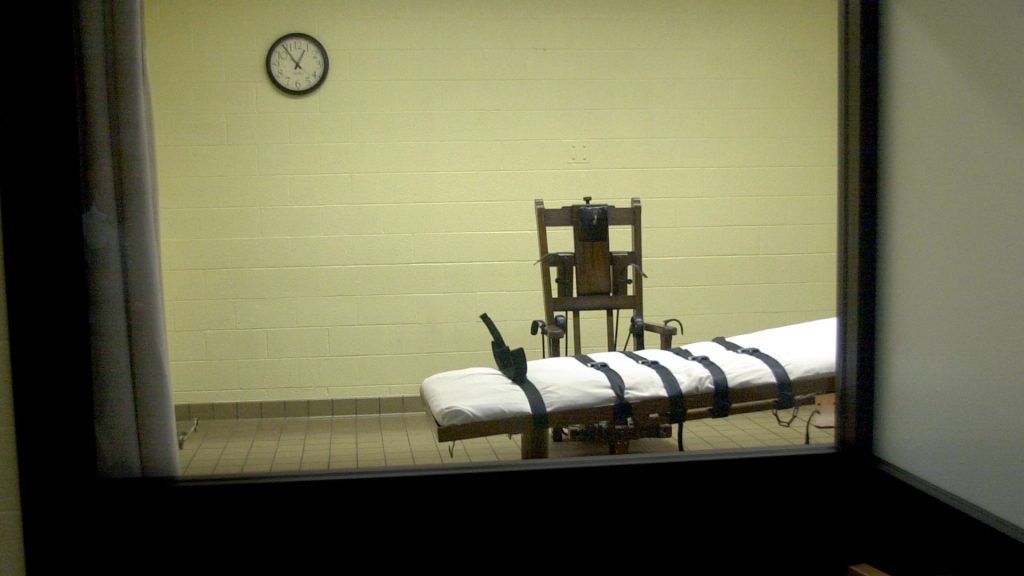
Danny Bible was shaking when he was wheeled into the Texas execution chamber on June 27, 2018. The 66-year-old convicted serial killer suffered from Parkinson’s, a disease his attorneys hoped would prevent the state from carrying out his sentence.
It did not. At 6:17 p.m., prison staff injected Bible with a fatal dose of pentobarbital. Keri Blakinger, who was there to witness the execution as a reporter for the Houston Chronicle, saw Bible quivering from his Parkinson’s tremors as he told prison officials, “It hurts.”
Then he took his final breath.
As soon as Texas prison officials confirmed Bible’s death, Blakinger published her article detailing what she had witnessed. While she did not say the execution went wrong and did not label it as botched, a prison spokesperson did not like Blakinger’s depiction.
“The spokesman called me to harass me about it and try to gaslight me and tell me that what I’ve seen with my own eyes did not happen,” Blakinger said. “My interpretation is that that’s because I think that particular spokesman was very invested in advancing the narrative he thought benefited the state.”
Blakinger’s story underscores the importance of journalists bearing witness when a state carries out the ultimate criminal penalty. Reporters in Florida described gruesome scenes when the state’s electric chair malfunctioned in the 1990s; in one case, The Associated Press recounted, “blue and orange flames up to a foot long shot from the right side” of a condemned inmate’s face.” In 2025, Alabama reporters documented the 40 minutes it took an inmate to essentially suffocate during a nitrogen hypoxia execution — a practice that a federal judge banned earlier this week.
What went wrong in those and other executions might never have become public without the journalists’ first-hand accounts.
But a ruling in Indiana is making it nearly impossible for journalists in that state to independently witness executions and serve as watchdogs as the state carries out death sentences.
On Friday, the 7th U.S. Circuit Court of Appeals upheld Indiana’s policy restricting media access to executions. The court rejected arguments from news organizations that the state’s prohibition violated the First Amendment.
Writing for a 2-1 majority, Judge Michael Scudder said the news organizations that sued over the policy made a “fair and compelling point that increased scrutiny may lead to more humane and competently administered executions.”
However, he added, allowing strangers to witness a condemned person’s execution “risks offending the dignity of their final moments.”
Among the 27 states that impose the death penalty, only Indiana and Wyoming bar journalists from witnessing executions.
The Indiana Department of Corrections told Straight Arrow that it would abide by Indiana state law when it carries out future executions.
The reason for independent witnesses
Government watchdogs say independently witnessing executions ensures they are properly carried out. If the only witnesses are affiliated with the condemned, the victim or the state, only biased accounts are likely to emerge. That’s what happened in May 2025, when Indiana executed Benjamin Ritchie.
One of Ritchie’s defense attorneys, Steve Schutte, who witnessed the execution, said Ritchie lifted “violently” from his gurney when the lethal drug was administered.
“He violently sat up — raised his shoulders — and twitched violently for about three seconds,” Schutte told The Indiana Capital Chronicle. “He didn’t collapse back down. It looked like, from my perspective, that he just kind of relaxed back down and had no movement for another couple of minutes, and then they closed the curtains.”
The Indiana Department of Corrections released a statement that the execution began shortly after midnight and Ritche was pronounced dead at 12:46 a.m. They did not say when exactly they began administering the execution drug, pentobarbital, the Capital Chronicle reported.
The department released no additional details about the execution. Nor did it deny Schutte’s account.
In the case of Bible’s execution in Texas, Blakinger told Straight Arrow that if she hadn’t witnessed it, the public may never have known what happened.
“I simply described what I saw, and the state tried to gaslight me about it afterward,” Blakinger told Straight Arrow. “If I hadn’t been there, that detail wouldn’t be in the public.”
Why would the state not want witnesses?

Robert Dunham, the longtime director of the Death Penalty Policy Project, which advocates against capital punishment, said states often present sanitized versions of how executions unfolded. In multiple executions, in states like Arkansas, South Carolina and Alabama, the state’s official depictions conflicted with what eyewitnesses said they saw, he said.
“Either the government is lying to [the public] — in which case they are not sufficiently trustworthy to carry out executions — or the protocol itself is a problem,” Dunham told Straight Arrow. “Either way, the public has a right to know.”
But Indiana argued in court that it doesn’t want journalists in the room because it might be harmful to the condemned.
“As Indiana underscores, allowing uninvited strangers with no immediate connection to the underlying crime to watch a prisoner die risks offending the dignity of their final moments,” Scudder wrote in his majority opinion.
Blakinger, who now works for ProPublica, pushed back on Indiana’s argument, noting that some condemned prisoners have personally asked her to witness their executions.
“The prison officials who will undoubtedly still witness are typically strangers and certainly uninvited and often unwanted,” Blakinger told Straight Arrow. “This argument also seems to ignore the dignity of allowing inmates to have final statements, which, without media witnesses, will likely not be heard by a neutral party.”
What happens next?
Lin Weeks, an attorney for the Reporters Committee for Freedom of the Press, said the organization is considering its next steps after the appeals court’s ruling. But he said he believed the news organizations that sued have “a strong chance” of ultimately prevailing.
The Seventh Circuit’s ruling affirmed a preliminary injunction, meaning the underlying lawsuit is still pending.
Dunham told Straight Arrow that journalists are an important part of keeping the state accountable.
“We know that states are not going to tell the truth about it,” he said. “Because of that, it is critical that the media be present to tell us what actually happened.”
Round out your reading
- People are overdosing on GLP-1 injections. What does that look like?
- Researchers put chatbots in a simulation. Grok ended the world in 4 days.
- Fearing more e-bike injuries, Illinois looks to become 10th state to mandate registration, insurance.
- Why are young professionals facing such a tough job market? Hint: It’s not just AI.
- We’re building a new Straight Arrow. Help us shape our future by taking our survey.
Ella Rae Greene, Editor In Chief