Why are young professionals facing such a tough job market? Hint: It’s not just AI
As graduation caps fly skyward this spring, many new college graduates have been grounded by a punishing job market.
The unemployment rate for recent college graduates was about 5.7% in the first quarter of 2026, while 41.5% were underemployed, according to the Federal Reserve Bank of New York.
Generative AI has taken much of the blame for the bleak hiring climate facing young workers. Their entry-level professional jobs, the thinking goes, could be done better, faster and cheaper by artificial intelligence.
But new research suggests another culprit may be doing more of the damage: remote work.
“Remote work can explain 64% of the increase in unemployment for all young college graduates between 2017-19 and 2022-24,” researchers wrote in a blog post published Monday by the New York Federal Reserve Bank.
Separately, a paper by economists Peter John Lambert and Yannick Schindler of the London School of Economics posted last month reached a similar conclusion. The authors found that work-from-home exposure was a stronger predictor of the pullback in early-career hiring than exposure to artificial intelligence, at least so far.
‘In-person contact is really important’
Employers might be thinking: recent graduates need more help, and that help is harder to provide from a distance.
“Junior workers rely heavily on training, mentoring, supervision, informal feedback and internal networks,” Schindler said, “which are all things where in-person contact is really important.”
Young people, he told Straight Arrow, are valuable to companies partly because they can become experienced workers. But that requires investment.
Learning on the job is harder when employees are scattered, said Lambert, Schindler’s co-author.
“If junior employees get less feedback, less supervision and fewer chances to learn from colleagues, firms may become more reluctant to hire them in the first place,” Lambert told Straight Arrow.
The New York Fed researchers pointed to proprietary data from an unnamed Fortune 500 company.
When the company’s offices were closed during the COVID-19 pandemic, it hired fewer inexperienced workers and more experienced ones. After offices reopened, the company shifted back toward hiring younger workers — but only for roles that called for workers to be near colleagues. For remote teams, it continued to favor more experienced hires.
Managing tradeoffs
Some young workers say they already feel the trade-offs.
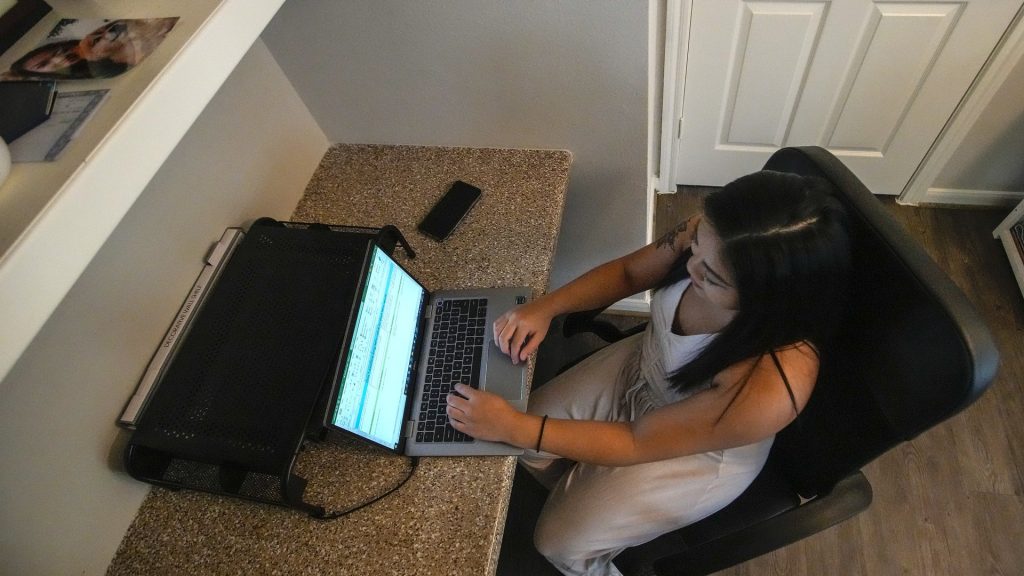
Ecy King works remotely as a data scientist for a large publishing company. She graduated from Stanford University with a bachelor’s degree and a master’s degree in June 2024.
She told Straight Arrow that remote work has been a blessing in many ways, and she praised her colleagues for generously sharing their knowledge. But she said the arrangement comes with real challenges.
“I’m always figuring out how to manage the tradeoffs between flexibility versus isolation, independent learning versus stagnation and struggle,” she said.
King said she also misses “the passive knowledge that comes from working in the office,” along with “water cooler conversations in a community where unexpected connections could be happening.”
Jose Maria Barrero, a professor at the Instituto Tecnológico Autónomo de México Business School who studies the economics of remote work, said people in their 20s are generally eager to work in an office at least part time. The same is true for many workers older than 50, who tend to be more senior, are less likely to have young children at home, and whose jobs often involve more meetings and supervising.
“It’s the people in the middle of those ages — the ones who have families, who don’t need day-to-day mentoring because they’re already well on their career path,” he told Straight Arrow, “who want the flexibility of working from home.”
Two major headwinds hit the same workers
This year’s college graduates face two major headwinds: generative AI and remote work, researchers said. Both bear down most heavily on entry-level, white-collar, knowledge-intensive roles with heavy computer use, Schindler said.
Because of this overlap, Barrero said, “it’s hard to tease out which one is causing the decline in young people getting jobs.”
The recent studies suggest that remote work has been the bigger disruptor largely based on timing: early-career hiring weakened after offices went remote during the pandemic. The link between the broad adoption of generative AI and the decline in junior hiring is less clear.
Unemployment among college graduates under 29 was 3.1% on average in 2017 to 19 before rising to 3.7% in 2022 to 25, the researchers wrote. That amounts to a 20% increase. Among more experienced college graduates, unemployment edged down over the same period, from 1.9% to 1.8%.
“The timing of this surge suggests that remote work — not generative AI — explains the bulk of the rise in youth unemployment,” the researchers concluded.
Schindler echoed that finding: “The shift away from junior workers seemed to begin before the release of ChatGPT or right around that time, which is the date many people use as the start of the GenAI era.”

“It seemed unlikely to us that firms had adjusted hiring en masse and almost immediately” in response to the new technology, he said.
Lambert and Schindler also compared jobs in which remote work is possible and in which it is not. They found larger declines in entry-level hiring for remote-friendly fields such as software development, technical writing and management consulting. The pattern was weaker in jobs such as electricians, janitors and construction laborers, which require the work to be done in person.
A reason for optimism?
“Compared to the ‘AI-doomer’ view, the fact that work from home plays a sizable role in the junior-hiring decline is, we think, cause for optimism,” wrote Lambert and Schindler.
They said that if work from home is responsible for much of the decline in junior employee hires, there are fixes, like finding managerial practices that are better suited to remote-work environments.
“More dramatic policy remedies would be required if GenAI was the main driver of the junior-hiring decline,” they wrote.
Barrero told Straight Arrow that young people can still learn remotely, despite the challenges.
In fact, if he was advising a recent college graduate today, he said he would suggest finding a hybrid arrangement if possible.
In that environment, “you’re going to be able to get that osmosis from your coworkers, be able to interact with people and develop yourself professionally, while also being in a company that recognizes that it’s 2026, and that work from home works to some degree.”
“There’s no reason to commute two hours on a Friday,” he said, “if you can do most of what you were going to do that day at home.”
Round out your reading
- Plea bargains keep America’s courts running. Guilt or innocence barely matters.
- Trump says the media isn’t covering one of his biggest accomplishments. We checked.
- Mike Lindell denied MyPillow was hacked. Its private data is now online.
- Red meat allergy rises with ticks as HHS targets Lyme disease, alpha-gal syndrome.
- We’re building a new Straight Arrow. Help us shape our future by taking our survey.
Ella Rae Greene, Editor In Chief