What does low water at the Hoover Dam mean for power in the American West?
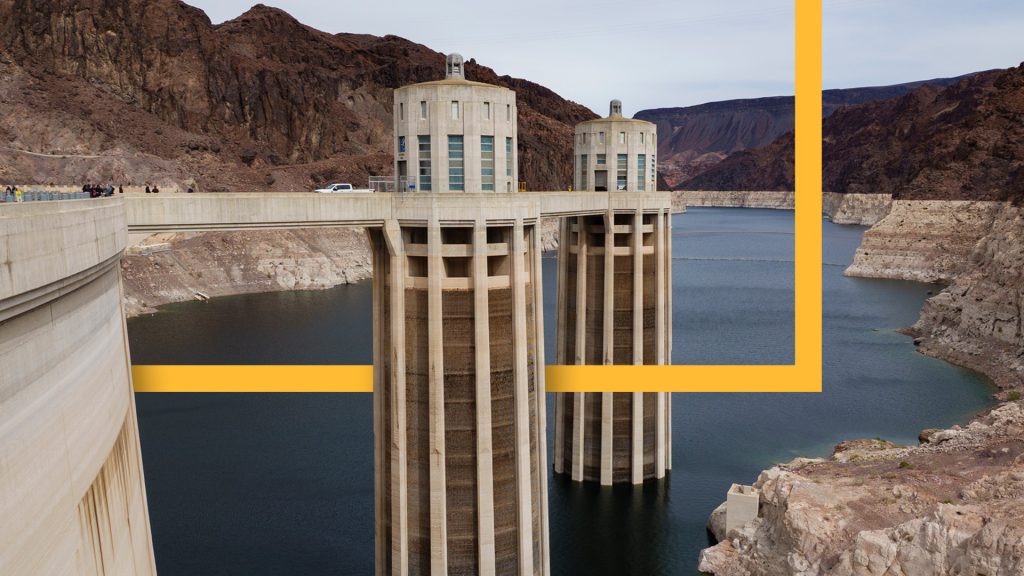
The water level at Lake Mead is less than 10 feet away from rendering most of the hydroelectric turbines at the Hoover Dam inoperable. In a new projection from the U.S. Bureau of Reclamation, the water level is expected to fall below 1,035 feet next April. That figure is critical.
Currently just shy of 1,042 feet, if Lake Mead falls below 1,035 feet — a level not seen since the reservoir was filled in the 1930s — it’s expected that 70% of the Hoover Dam’s current hydropower production will be cut.
The Bureau of Reclamation’s 24-month study released last week forecasts a continued decline in Lake Mead’s water level. The study projects Lake Mead falling to 1,031.6 feet in April 2027 and 1,010 feet by the end of June 2028.
The lake’s decline comes after years of drought facing the American West and the ongoing struggle among the seven states that make up the Colorado River Basin to reach a new river management agreement. The threat of power cuts comes as electricity demand grows. Residents who currently rely on power purchased by their local utility from the Hoover Dam are likely to pay more for electricity as the dam’s output drops.
What is the state of hydropower in the West?
“The hydraulic conditions are upending essentially a century of pretty milquetoast, run-of-the-mill power purchase agreements,” said Kyle Roerink, senior advisor of the Nevada-based nonprofit Great Basin Water Network.
The Hoover Dam’s hydroelectric turbines have historically generated enough electricity to power 1.3 million homes for a year, according to the Bureau of Reclamation. But hydropower production has declined as drought increased, hitting a 22-year low in 2023.

Hydroelectric production is on the rise again in the West, but it’s driven largely by Pacific Northwest states like Washington, which is not part of the Colorado River Basin. Hydropower in Arizona and Nevada is much lower, but continued declines present a challenge for utilities to acquire electricity from other sources.
“We’re working to try to alleviate any rate shock to our customers,” Dane Bradfield, general manager of the rural publicly owned utility Lincoln County Power District, told the Nevada Current. “But for 90 years the customers at Lincoln County Power have relied on cheap hydropower, and unfortunately that’s not the case anymore.”
What will happen next with the Colorado River?
While a drop in Lake Mead’s water levels below the 1,035-foot threshold is likely, experts told Straight Arrow there’s a large degree of uncertainty around how the Colorado River will be managed going forward. Those changes will affect how much water remains in the river system.
Rules governing the river — including how much water the seven basin states can draw from it — are set to expire at the end of this year.
“We don’t have complete information about how the system will operate after 2026,” said Edith Zagona, a professor and director of a water system center at the University of Colorado Boulder. The original Colorado River compact overestimated how much water would be available, and a new agreement aims to restore water flows by cutting consumption.
The hydropower output problem for local utilities, however, could continue either way. While consumption cuts from Arizona, California and Nevada can “keep the water level high by reducing releases, that also will reduce [hydroelectric] generation,” Zagona told Straight Arrow, in an email.
A preliminary deal may be reached soon, as the Southern Nevada Water Authority told local media last week that the seven states were close to signing a two-year agreement. One key point expected in the deal is the share of water released from the river’s other giant hydropower reservoir, Lake Powell, upstream of Lake Mead.
Is there a risk to grid reliability?
Brad Udall, a senior water and climate research scientist at the Colorado Water Center, told Straight Arrow that maintaining Lake Powell’s water level is currently a higher priority than Lake Mead.
Water flowing through the hydroelectric turbines at Lake Powell’s Glen Canyon Dam provides backup power to the Palo Verde nuclear power plant in Arizona.
“This is not something you want to fool around with. You really want a reliable source of backup power,” Udall told Straight Arrow.
The Bureau of Reclamation’s 24-month forecast shows that the level in Lake Powell will remain above its minimum elevation to generate hydropower, 3,490 feet, through June 2028. But next March, water levels are expected to fall to within 2 feet of that elevation.

Infrastructure limitations are also driving the prioritization of Lake Powell’s water level.
“We don’t know if the infrastructure can handle releasing water through the dam 24/7 if it doesn’t go through the turbines,” said Udall.
As an alternate to Glen Canyon dam’s hydroelectric turbines, water can pass through steel bypass tubes. But in 2023, the Bureau of Reclamation documented a troubling phenomena when a high volume of water was released through the bypass tubes. The Bureau observed cavitation, a process where a large volume of highly pressurized water transforms from liquid to vapor, then back again, causing explosive erosion.
To preserve structural integrity at the Glen Canyon Dam, less water is expected to flow to Lake Mead and the Hoover Dam. While that can cause an economic pinch for some local utilities, it’s not expected to destabilize the grid.
Still, to some, it’s symbolic of the larger failures to manage the Colorado River.
“It’s a real irony that in the beginning of the 21st century, the Hoover Dam can represent the failure of our nation to live up to the promises of the 20th century,” Roerink said. “At a time when Americans are struggling to pay for fuel, pay their power bills, it’s a really bad time to have to endure those failures.”
Round out your reading
- From Obama to Trump to Biden: When networks said ‘no’ to presidential speeches.
- ‘The end of American science as we know it.’ White House funding plan sparks alarm.
- AI data centers are popping up everywhere. What exactly do they do?
- The Trump administration is accused of breaking a law built to target the KKK.
- One Republican senator is dead, another is still alive. Both are the center of conspiracy theories.
Ella Rae Greene, Editor In Chief