US-Russia treaty capping nuclear warheads lapses. What happens next?
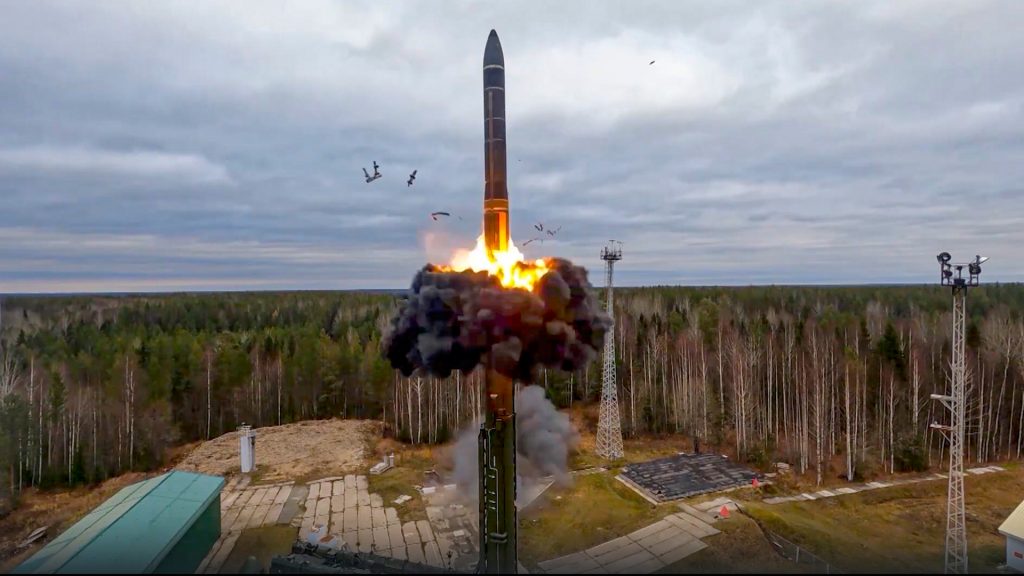
For the first time in more than half a century, the world’s two largest nuclear powers are no longer bound by a single, verifiable arms control treaty. The New START Treaty officially expired Thursday, ending the decades-long era of caps on the U.S. and Russian nuclear arsenals.
Why New START’s expiration matters now
According to arms control expert Nikolai Sokov, the expiration ends a continuous series of agreements between Washington and Moscow dating back to the Strategic Arms Limitation Talks of the late 1960s. Sokov notes that for the first time in more than 50 years, the major powers are operating without any treaty guardrails to prevent a nuclear buildup.
Security experts told Reuters the absence of limits and transparency will make it harder for Washington and Moscow to gauge each other’s intentions, raising the risk of miscalculation.
In a separate move to mitigate the risk of tactical miscalculation, however, U.S. European Command announced Thursday that Washington and Moscow agreed to reestablish high-level military-to-military dialogue following talks in Abu Dhabi.
At the same time, U.N. Secretary-General António Guterres said the risk of a nuclear weapon being used is “the highest in decades,” according to Reuters.
How Washington, Moscow and Beijing are positioning
New START, which took effect in 2011, capped each side at 1,550 deployed strategic warheads, down from the maximum of 2,200 per side set in a 2002 agreement. The treaty also limited each country to 700 deployed long-range delivery systems, such as intercontinental ballistic missiles.
The agreement also provided for 18 on-site inspections per year, biannual data exchanges and launch notifications designed to reduce the risk of “strategic surprise,” according to the State Department. U.S. officials say both sides met those limits by 2018 and remained at or below them while the treaty was in force.
However, CBS News reports that Russia stopped inspections and notifications during the war in Ukraine. Despite this suspension, a recent State Department assessment estimated Moscow had not “significantly” exceeded the numerical caps. Russia has roughly 4,300 nuclear warheads and the United States about 3,700, according to figures from the Federation of American Scientists. Total stockpiles are larger than the treaty limits because New Start does not cover stored warheads or tactical weapons.

In Moscow, Kremlin spokesperson Dmitry Peskov said Russia viewed the expiration “negatively” but would maintain a “responsible and attentive approach to the issue of strategic stability” and be guided by its national interests, according to Reuters. Russia’s Foreign Ministry said both parties are now free to choose their next steps and warned that Moscow was prepared to take “decisive military-technical countermeasures” if it saw new threats, Reuters reported.
On the U.S. side, President Donald Trump told The New York Times in January, “If it expires, it expires. We’ll do a better agreement.” A White House official later told CBS News that Trump will decide a path forward on arms control “on his own timeline” and has indicated interest in keeping limits while bringing China into future talks.
Beijing rejected the invitation.
“China’s nuclear capabilities are of a totally different scale as those of the United States and Russia,” Foreign Ministry spokesman Lin Jian said Thursday.
While China’s arsenal is smaller, it is growing rapidly. The Stockholm International Peace Research Institute estimates that China now possesses at least 600 nuclear warheads, adding approximately 100 annually since 2023.
As of January 2025, China has effectively finished or is nearing completion on approximately 350 new ICBM silos, located in three northern desert fields and three eastern mountainous regions. Depending on how Beijing structures these forces, it could rival the ICBM inventories of both Russia and the United States by 2030, though its total stockpile would remain roughly one-third the size of the superpowers even by 2035.
The path forward: Interim limits vs. a new arms race
With the verification regime frozen, the focus has shifted to voluntary limits. In September 2025, Russian President Vladimir Putin proposed that the United States and Russia continue to observe the treaty’s core quantitative and qualitative limits for one year after the treaty expires.
Rose Gottemoeller, who helped negotiate New START as Undersecretary of State for Arms Control during the Obama administration, testified on Tuesday in front of the Senate Armed Services Committee that Putin’s proposal was “viable,” according to CBS News. She argued that continuing to observe the limits for another year would help “reestablish strategic stability” and keep nuclear weapons “at the negotiating table.”
However, analysts quoted by Reuters warned that without New START’s 1,550-warhead cap, each side could, within a few years, upload “hundreds” more warheads onto existing missiles. Karim Haggag of SIPRI told Reuters that the treaty’s transparency measures were crucial for stability.
“Transparency and predictability are among the more intangible benefits of arms control and underpin deterrence and strategic stability,” Haggag said. “Without them, relations between nuclear weapon states are likely to be more crisis prone — especially with artificial intelligence and other new technologies adding complexity and unpredictability to escalation dynamics and a worrying lack of diplomatic and military communication channels between the USA and both China and Russia.”
Nuclear limits and talks
CBS News reports that Lin has urged the Trump administration to resume negotiations with Russia and accept Moscow’s suggestion that both sides continue to follow New START’s core limits for now. Sokov wrote that such an informal arrangement would be largely symbolic because it would not restore inspections, but it could still offer “a modest — though very small — degree of predictability” over the next two to five years.
He added that a joint U.S.–Russian commitment to observe some of the expired treaty’s provisions, paired with a pledge to resume talks, could ease pressure from non-nuclear states ahead of the next Nuclear Non-Proliferation Treaty review conference.
In the longer term, Sokov argued that any successor framework will likely need to go beyond New START’s narrow focus and address total stockpiles, missile defense, long-range conventional weapons, other nuclear-armed states and new risk-reduction and confidence-building measures.
The post US-Russia treaty capping nuclear warheads lapses. What happens next? appeared first on Straight Arrow News.
Ella Rae Greene, Editor In Chief