Trump’s ‘largely negotiated’ Iran deal lacks details; supporters tout concepts of a plan
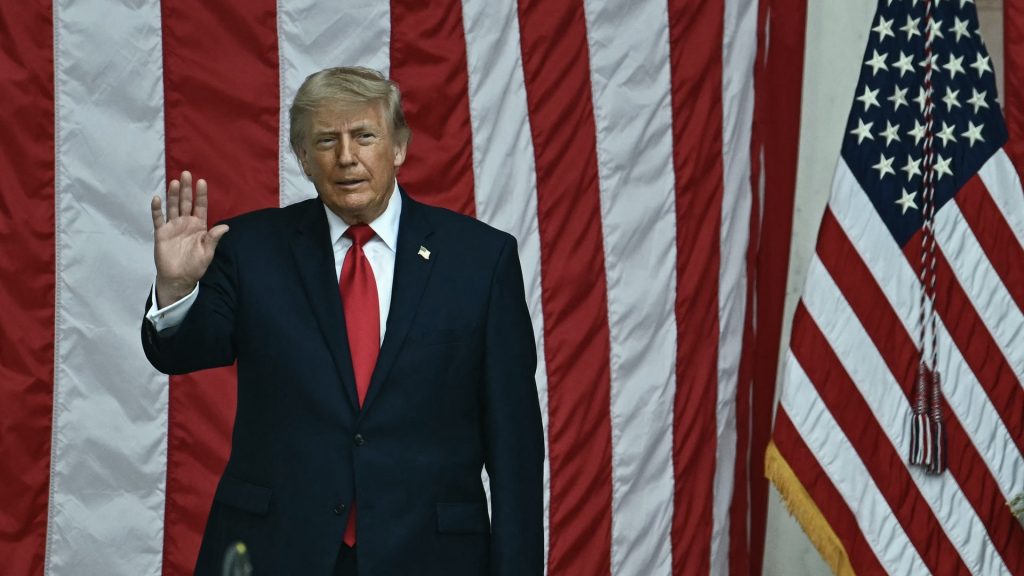
Trump had said the deal was “largely negotiated.” A day later, he said, ‘It isn’t even fully negotiated yet.’
President Donald Trump on Saturday made one of the biggest announcements about the war with Iran since the U.S. and Israel began bombing the country in late February: peace is nearly at hand.
Nearly.
“An Agreement has been largely negotiated, subject to finalization between the United States of America, the Islamic Republic of Iran, and the various other Countries,” Trump wrote on his social media platform. “Final aspects and details of the Deal are currently being discussed, and will be announced shortly.”

With that, Trump had reassured allies and critics alike that the war could soon end. But for top administration officials and allies in Congress, Trump had created a conflict: defend a deal without knowing exactly what is in it. In other words, defend — in the much-mocked Trump parlance about what he would replace Obamacare with — “concepts of a plan.”
Secretary of State Marco Rubio, who was in India for a diplomatic trip, told reporters there on Sunday that any deal with Iran would achieve the president’s previously stated goals of opening the Strait of Hormuz and preventing Iran from acquiring a nuclear weapon.
But Rubio said details of the latter should not be expected anytime soon.
“These are highly technical matters and ones that would probably need to be addressed over some period of time,” he said.
In Congress, Trump allies — some of whom were supportive of the military attack on Iran, were largely left to support previously stated goals and red lines.
Sen. Ted Cruz, R-Texas, on May 23 wrote on X that he was “deeply concerned” about “an Iran ‘deal’” proposed by “some voices in the administration.” After Cruz praised the military attack on Iran, he added, “If the result of all that is to be an Iranian regime … now receiving billions of dollars, being able to enrich uranium & develop nuclear weapons, and having effective control over the Strait of Hormuz, then that outcome would be a disastrous mistake.”
“At a minimum,” Cruz said the next day on his podcast, “there should not be concessions until Iran hands over their nuclear material and opens up the Strait.”
Another Trump ally and Iran hawk, Sen. Lindsey Graham, R-S.C., was strongly encouraging the Trump administration to “hurt them more” in order to force the country into a deal. Graham told NBC’s “Meet The Press” on May 17 that killing Iran’s longtime leader on the first day of fighting did not make the regime “any less committed to destroying Israel,” or attacking the U.S.
“So,” he added, “weaken them further and you may get a deal later, but you’re not going to get a deal with this crowd unless you hurt them more.”
Graham doubled down six days later, warning on social media against making a diplomatic deal with Iran without demonstrating military strength over them.
“If a deal is struck to end the Iranian conflict because it is believed that the Strait of Hormuz cannot be protected from Iranian terrorism and Iran still possesses the capability to destroy major Gulf oil infrastructure, then Iran will be perceived as being a dominate force requiring a diplomatic solution,” he wrote on X.
He went on to write, “Also, it makes one wonder why the war started to begin with if these perceptions are accurate.”
A day later, Graham announced his support for a new element of a possible deal: linking a long-term agreement with Iran to other countries in the region normalizing their relations with Israel, which Iran has repeatedly targeted. Graham on X called it “brilliant” and shared a Newsmax article touting his support for it. That article appeared to credit Graham for breaking news about it, saying the senator’s social media post “strongly suggested that Trump has privately or publicly floated the idea…”
Other Republicans focused their rhetoric on Trump personally, rather than on the details, which are still under negotiation. “At the end of the day,” Rep. Byron Donalds, R-Fla., told Fox News on Sunday that “the president of the United States, he’s the commander in chief and he’s going to make the decision that’s in the best interest of the United States, our allies and our people.” Donalds, whom Trump recently endorsed for governor, added, “And that’s why I trust the president to make those decisions.”
Rep. Mike Lawler, R-N.Y., who recently hosted Trump in his district just north of New York City, sought to paint critics of the president as ill-informed. “I think it’s important that we actually get all of the details,” Lawler told Face the Nation on Sunday. He went on to say it is “imperative before everybody rushed to get to the microphone that they actually understand the terms of the agreement.”
After the Sunday shows, Trump issued another statement about the now much-discussed potential deal. “If I make a deal with Iran, it will be a good and proper one,” he wrote on his social media platform. Then, after criticizing President Obama’s earlier deal with Iran, Trump wrote “Our deal is the exact opposite, but nobody has seen it, or knows what it is.”
In fact, he added, “It isn’t even fully negotiated yet.”
Round out your reading
- Tennessee officials will pay $835,000 for jailing man over Charlie Kirk meme.
- Why the immune system turns on women more often than men.
- More than 340 newspapers block the Wayback Machine. What that means for the future of the internet.
- Why Rep. Cohen filed articles of impeachment against Supreme Court Justice John Roberts.
- We’re building a new Straight Arrow. Help us shape our future by taking our survey.
Ella Rae Greene, Editor In Chief