Trump wants a bigger Middle East deal and the Abraham Accords are key
President Donald Trump wants to revive a major first-term foreign policy initiative by expanding the Abraham Accords and tying that effort to a possible Iran settlement, according to a Truth Social post.
The proposal would connect normalization with Israel to a broader effort aimed at ending the Iran conflict and reopening the Strait of Hormuz. Trump also floated the possibility of Iran joining the accords, a difficult proposition given Tehran’s longstanding position toward Israel and the conflicts already straining the region.
Trump wrote Monday that negotiations with Iran wexre “proceeding nicely,” but warned any outcome would be “a Great Deal for all or, no Deal at all.”
He said the countries discussed in his recent calls should, “at a minimum, simultaneously” sign on to the Abraham Accords simultaneously.
Trump specifically named Saudi Arabia, the United Arab Emirates, Qatar, Pakistan, Turkey, Egypt, Jordan and Bahrain. The UAE and Bahrain are already members, and Trump said he was directing representatives to begin moving the process forward.
What the Abraham Accords are
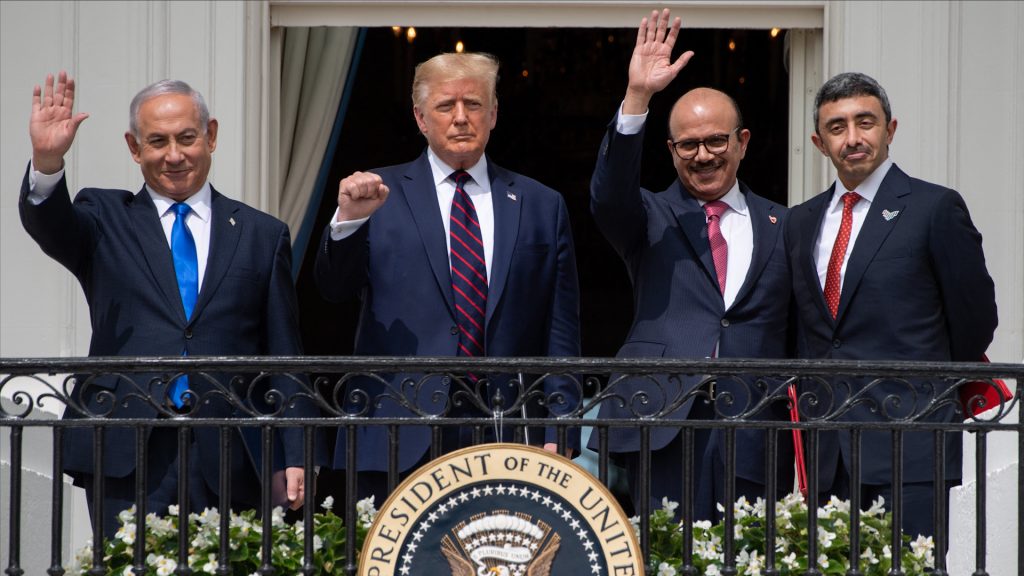
According to the Middle East Institute, the Abraham Accords are a series of U.S.-brokered diplomatic agreements designed to establish formal ties between Israel and several Arab nations.
The first agreements were signed in September 2020 and initially included the United Arab Emirates and Bahrain. Morocco later joined, while Sudan agreed to a preliminary framework. Trump argued Monday that the agreements produced a “Financial, Economic, and Social BOOM” for participating countries.
Republicans split over broader Iran proposal
Sen. Lindsey Graham, R-S.C., backed the proposal, writing on X that requiring expansion of the accords as part of an Iran deal was “simply brilliant.” Graham also wrote that adding countries such as Saudi Arabia, Qatar and Pakistan would be “beyond transformative.”
But support for broader negotiations with Iran is far from unanimous inside the Republican Party. Sen. Ted Cruz, R-Texas, said he was “deeply concerned” about details surrounding an emerging agreement and warned against any deal that would leave Iran with access to significant funding, uranium enrichment capability or leverage over the Strait of Hormuz.
Sen. Roger Wicker, R-Miss., echoed this alarm, arguing on X that a reported two-month truce relying on Tehran acting honestly “would be a disaster.”
Expansion faces major hurdles
Several countries that Trump named have major political and diplomatic reasons for resisting the proposal. Saudi Arabia has repeatedly tied normalization with Israel to progress toward a Palestinian state, according to The Jerusalem Post.
Turkey, Egypt and Jordan also present complications because they already recognize Israel or maintain peace agreements.
Dan Shapiro, a former U.S. ambassador to Israel, wrote on X that expanding the accords is a worthy long-term goal, but tying that effort to a deal ending the Iran war is “needlessly complicated and unrealistic.”
Round out your reading
- Tennessee officials will pay $835,000 for jailing man over Charlie Kirk meme.
- Why the immune system turns on women more often than men.
- More than 340 newspapers block the Wayback Machine. What that means for the future of the internet.
- Why Rep. Cohen filed articles of impeachment against Supreme Court Justice John Roberts.
- We’re building a new Straight Arrow. Help us shape our future by taking our survey.
Ella Rae Greene, Editor In Chief