Trump administration pushes pro-war messaging while attacking media coverage
As the U.S. war with Iran continues, the Trump administration continues to try to control the narrative around the war in a manner different from former leaders. That includes their message to the GOP base while continuing to push back on mainstream media.
Pushing the violence
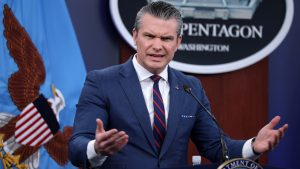
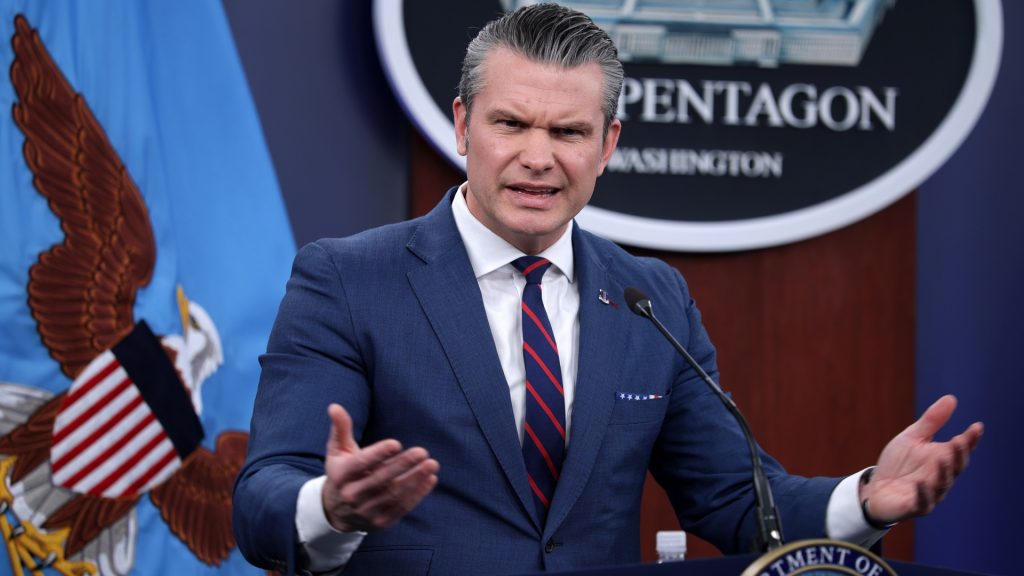
Speaking to the media Friday morning, Secretary of Defense Pete Hegseth opened his press conference by doing both.
“I’ll start, as we often do here at the Department of War, with the bottom line up front, for the world to hear and the press to actually admit that the United States is decimating the radical Iranian regime’s military in a way the world has never seen before,” Hegseth said.
He went on for several minutes speaking on America’s destruction of the Iranian military, their facilities and more.
“Iran’s leadership is in no better shape,” Hegseth said. “Desperate and hiding, they’ve gone underground, cowering. That’s what rats do.”
That’s a pattern the Trump administration has kept mostly consistent.
“We’re seeing attempts to stir up public feeling, to even glorying in carnage,” Nicholas Cull, a professor of public diplomacy at the University of Southern California’s Annenberg School for Communication and Journalism, told Straight Arrow News. “Just a remarkable development. That’s something you expect to see from the bottom of the communication chain, not from the top, not from the White House.”
But it is something now coming from the commander-in-chief as well. President Donald Trump reportedly told Axios, “The war is going great… we have done more damage than we thought possible.”
Trump made comments of a similar type when American forces killed one of Iran’s top military commanders during his first term.
“I keep comparing this with American communication in previous wars, and I can’t imagine Reagan or President Johnson or Eisenhower, let alone FDR, saying or endorsing the kinds of things that President Trump has been saying,” Cull said.
The White House official social media accounts have also continued to post memes and lighter content like this video about the ongoing violence.
“I think it’s really quite upsetting to see a gamification of war and a meme-ification of war,” Cull said.
Why play into the violence?
“This is primarily messaging for a domestic audience,” Cull said, adding that it likely plays more into Trump’s base.
Attacking the media
While promoting what America is militarily capable of, Hegseth continued another plan of railing against the media.
“Another example of a fake headline that I saw yesterday, ‘War Widening,’” Hegseth said. “Here’s a real headline for you for an actual patriotic press. How about, ‘Iran shrinking, going underground?’”
Despite Hegseth’s claim, the press is not supposed to be “patriotic” in supporting the government but rather serve public interest by acting independently.
Not long before Friday’s press conference, the Pentagon banned photographers from the previous two briefings without giving a reason for the change in policy.
Many of the reporters now in those press briefings also come from MAGA-friendly journalists, even though MAGA tends to be more split on their feelings toward this war.
“When you lose the narrative, people start to lose trust, because they have to believe that,” Nancy Snow, visiting distinguished professor of science diplomacy at Başkent University in Turkey and professor emeritus of communications at Cal State Fullerton.
Recent polling from CBS News found that most Americans are still unclear about America’s goals in this war.
“People are very alarmed, and they’re not being given much information,” Snow said. “So, it’s certainly the fog of war.”
Attacking the media is also something the president has done since entering politics.
“This is all about communicating with your base and affirming existing narratives,” Cull said.
He added that’s how effective propaganda works.
“The big mistake people make when they think about propaganda is that they imagine that a dangerous leader thinks up ideas and transmits them into the minds of an innocent population,” Cull said. “The reality is that most powerful propaganda affirms ideas that are already in the mind of the population.”
Fighting with CNN
The president arguably had the most issues with CNN more than any other network.
That continued Friday with White House press secretary Karoline Leavitt pushing back on a recent article from the outlet. That story claimed the Pentagon and National Security Council underestimated Iran’s willingness to close the Strait of Hormuz.
CNN stood by its story and added a clarification reading in part, “the story has been updated to reflect additional developments and clarify that top Trump administration officials briefed lawmakers on long-standing military plans to address a major disruption to the Strait.”
Leavitt called that clarification “pathetic.”
Hegseth also took aim at the network and that article during his morning remarks.
“More fake news from CNN reports that the Trump administration underestimated the Iran war’s impact on the Strait of Hormuz,” Hegseth said. “Patently ridiculous, of course. For decades, Iran has threatened shipping in the Strait of Hormuz. This is always what they do. Hold the strait hostage. CNN doesn’t think we thought of that. It’s a fundamentally unserious report.”
The most recent threat came during the first Trump administration when the U.S. pulled out of the nuclear deal with Iran negotiated by former President Barack Obama.
Hegseth also shared his thoughts on CNN’s soon-to-be new owner, saying the sooner David Ellison takes over the network, “the better.”
“We don’t want to create a nation of competing ideologues,” Snow said. “We want to have some trust in independent media.”
Iraq War
The Trump administration has been giving briefings every couple of days, and things got off to a rocky start with questions over why the war began in the first place.
During the height of the Iraq War, former President George W. Bush’s press secretaries like Ari Fleischer and Scott McClellan gave near-daily briefings. Bush’s Department of Defense also routinely gave daily briefings.
The Bush administration also had a more strategic public relations plan to present the war to the American people and the world.
“He was concerned about the international image of the United States and maintaining the psychological component of American leadership,” Cull said. “I don’t think this is on the agenda for the Trump White House. Their priority is a domestic audience.”
Former Bush Secretary of State Condoleezza Rice was reportedly seen going into the White House recently and has called on the Trump administration to “take care” of Iran for good.
This war with Iran also comes at a time when the country is sharply divided along political lines.
“The narrative is not really playing to the favor of the administration, because it’s already a deeply polarized, divided electorate and in a midterm election year,” Snow said. “And it comes on the heels of the State of the Union address, where you clearly saw that division and anger.”
Following 9/11, there was much broader support of Bush and his administration but still significant pushback. That mirrored the media’s coverage of the war, which took a sharp turn towards pushing back after the claims that Iraq had weapons of mass destruction turned out to be untrue.
When it comes to violence, the media tends to be more critical of American leadership, like the disastrous withdrawal from Afghanistan under former President Joe Biden, or former President Barack Obama’s handling of certain terror organizations.
It’s something that comes with the territory of going to war or putting American lives at stake.
“[During the] Persian Gulf War, we were at the gas pumps, and we were asking them, ‘Well, why did we go to war against Saddam Hussein?’” Snow said. “Now that was a coalition of the world, supposedly. George Herbert Walker Bush got a lot more support then.”
The first Bush took significant steps to get world approval before kicking Iraq out of Kuwait.
“He really took care of the images,” Cull said. “Even, I found, ending the war before the images went really, really bad. The whole thing was about not only doing right but being seen to work properly within the boundaries of international legitimacy.”
Ella Rae Greene, Editor In Chief