These ranchers heal the land. The power company drew a line through it
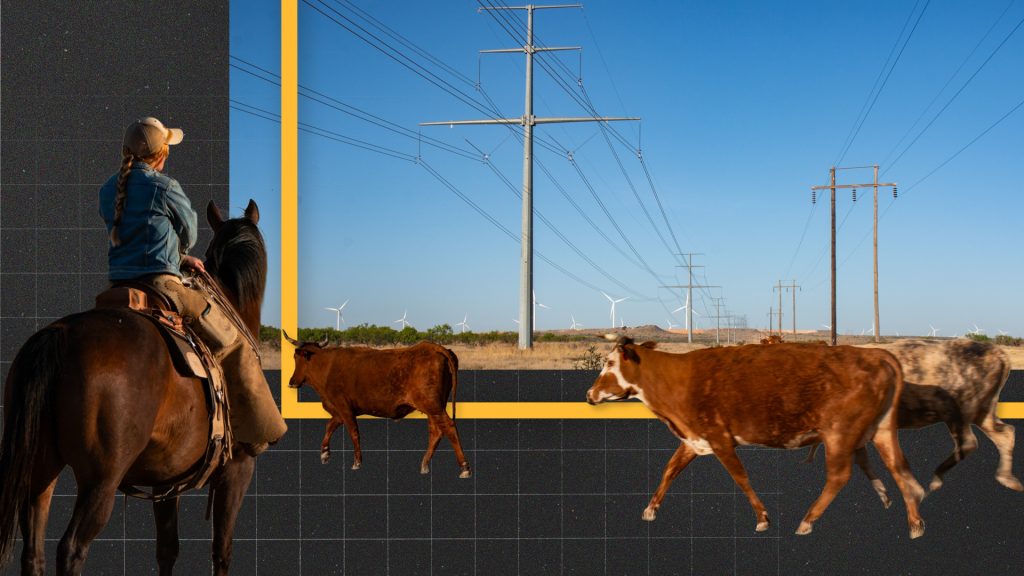
POTTER COUNTY, Texas – Early morning light streams across the Frying Pan Ranch as Claudia Landerville switches off a temporary electrified fence, rolls it in and begins calling hundreds of cows across the new opening.
The sound of “Huuuuuuhwoah,” echoes across the brush-strewn landscape on a crisp, late-April day as Landerville lures the cattle toward her with a call that sounds like the mix of a high-pitched owl and a kettle on the verge of boiling.
It’s calving season at the ranch 18 miles outside of Amarillo, Texas, and the newborn calves follow their elders through an open gate as Landerville hoots and hollers for their attention from atop her homebred quarter horse, Listo. Mike Giordano follows on a dirtbike, looking for newborns, their mothers and other stragglers.
Landerville and Giordano repeat this routine — part of the high-intensity rotational grazing method employed at the 40,000-acre ranch — every few days. The duo works for Ranchlands, a company that runs cattle on leased ranches across the American West. They are also engaged and plan to tie the knot at the ranch later this year.
The grazing method is intended to restore the health of the ecosystem. The cattle graze a small tract within the ranch, then move to another after a few days or a week. After grazing, each tract has about a year to recover before the cattle return. Sometimes called regenerative grazing, the ranchers at the Frying Pan Ranch say the method has improved soil health and biodiversity since they adopted it seven years ago.

“It feels purposeful to me being able to see the changes in the landscape year to year,” Landerville says.
But the ranch is home to more than young love; it’s 1,100 cattle, prairie dogs, white-tailed deer and an array of flora like mesquite trees and native grasses. A power transmission line cuts through the center of the property, and it’s in the path of three more power lines proposed by utility company Xcel Energy.
That’s a problem for the Frying Pan Ranch.
“It reduces our flexibility of course. And it’s now dictating our program,” Giordano says. “The more [power lines] that come on, it’s going to be that much more of a problem.”
The oil and gas industry wants more access to electricity in America’s most productive oilfield in southeast New Mexico and West Texas — the Permian Basin. To meet the demand of oil rigs connecting to the grid rather than relying on diesel generators, a new suite of transmission lines is planned across Texas, including Xcel’s planned Potter-Crossroads-Phantom 765-kilovolt transmission line from a substation in Amarillo to southeastern New Mexico. The construction routes must go across private land, and that’s driving a wedge between two quintessentially Texan industries: oil and cattle.
The ranchers say their electric fence malfunctions when it’s set up under the transmission line. The power company also typically mows and sprays with herbicide on the land beneath the lines. Roads are constructed to build and access the power lines. Once built, crews will need continued access for inspections and maintenance.
“It’s just this murky area where you technically own the land, but they own permanent rights to use it,” says Tim Ingalls, who currently manages the property, which has been in his family since 1881.
What are the benefits of new transmission lines?
Transmission lines deliver electricity across long distances from the power plants and renewable energy sites where it’s generated to where it’s consumed. The new 765-kilovolt transmission lines across Texas will be capable of transporting more power at once than any power lines currently on the system.
At higher voltage, less electricity is wasted, and the whole system can operate more efficiently. Xcel wants to build the transmission line to New Mexico because of “unprecedented demand due to new manufacturing, oil and gas growth, and the increasing needs of existing customers and communities,” Tiffany Hennig, Xcel Energy’s principal agent for siting and land rights, said during a February public meeting.

In 2023, the Texas Legislature passed House Bill 5066, which kick-started the process of building three east-to-west transmission lines. Those three power lines will be within the state’s isolated grid run by the Electric Reliability Council of Texas (ERCOT). The Xcel Energy transmission line is in the neighboring Southwest Power Pool grid.
When the Public Utilities Commission of Texas greenlit the high-voltage, 765-kilovolt lines last April, the commission’s chairman Thomas Gleeson said the plan was about “building an ERCOT grid that will serve Texans reliably for decades to come.”
With higher voltage, he said then, it will take fewer power lines to serve the Permian Basin, “meaning less disruption to Texas landowners, natural habitats and landscapes.”
In addition to feeding oil and gas demand, that upgrade could unlock the full potential of renewable energy. Currently, some electricity generated by wind and solar goes to waste when existing transmission lines are at capacity. And the power lines could prepare the grid for the added challenge of serving large data centers, which are fueling an unprecedented rise in forecasted electricity demand in Texas and nationwide.
“Strategic modernization of our transmission infrastructure is essential to support demand from growing sectors like AI and, critically, the oil and natural gas production and transportation that propel growth in all sectors of the Texas economy,” says Todd Staples, president of the Texas Oil and Gas Association, in a statement to Straight Arrow.
Impact on the Frying Pan Ranch
At the Frying Pan Ranch, Ingalls says Xcel Energy’s transmission line would require a new right-of-way about 7 miles long and 450 feet wide — the length of California’s Hollywood sign. He isn’t sold on the plan’s potential benefits.
“It is more for business by business and somehow they are still granted eminent domain right,” Ingalls says.
Ingalls will face a larger burden than most other landowners along Xcel Energy’s path. For most of the 180-mile route, Xcel will build one 765-kilovolt line. But due to constraints that make the Amarillo substation unable to handle the higher voltage, Xcel plans to build three 345-kilovolt lines across the last 20 to 30-mile stretch, including the part crossing Frying Pan Ranch.

The electric fence that keeps the cattle confined to a few hundred acres at a time is a crucial part of operations at the Frying Pan Ranch.
Xcel Energy says using the fence should not be a problem.
“Electric fencing is commonly used near transmission infrastructure,” says a company spokesperson. “When properly installed and grounded, electric fencing can safely coexist with transmission facilities.”
But Ingalls and his Ranchlands colleagues say it’s not so simple. Even when using grounding rods — metal stakes pounded into the earth that prevent dangerous electric shocks by giving excess voltage somewhere to land — they say the electric fence becomes inoperable.
“If you cross directly underneath the power lines, it will short your electric [fence] line out and it will have frequency when the line is turned off,” Landerville says. “So you end up with a line that you can’t use one way or another.”
The fences are crucial for regenerative grazing. And the regenerative grazing method is itself crucial to Ingalls’ vision to bring increased water to the ranch, which has spurred more diverse plant and animal species.
“A lot of the areas that had deeper cattle trails or arroyos are starting to heal up. We’ve had larger wildlife herds than I’ve really seen growing up here,” Ingalls says.
Beyond the rotational grazing, Ingalls has created structures that mimic beaver dams to store more rainfall. The result is a pond about 20 feet across with emerald green grass shooting up along its edges and patches of moss-colored algae bobbing across the surface.
The United States has a long history of landowners opposing power grid infrastructure.
“Different stakeholders have different perspectives on what a transmission line is doing and for whom and how they are either going to be harmed or going to benefit,” says Julie Cohn, a nonresident scholar with the Center for Energy Studies at Rice University’s Baker Institute for Public Policy.
Cohn, who authored a book on the history of electrification in North America, tells Straight Arrow that this time around, state regulators will face a “really difficult challenge” because in addition to landowners’ usual concerns, electricity load growth from the oil and gas industry and data centers is itself “controversial.”
What is the regulatory process in Texas?
The tension between private property rights and expanding the power grid is playing out across Texas. Three transmission lines within ERCOT are currently further along in the regulatory process than Xcel’s project.
“This process has just been horrible for landowners,” says Dave Clark, a retired accountant who owns property near a proposed transmission line in Central Texas. With the nonprofit Friends of the San Saba River, Clark has worked with his neighbors to file challenges to the transmission line proposal from utility company Oncor and the state-owned Lower Colorado River Authority (LCRA).
That process began in the summer of 2025, when the companies sent notices to landowners who could be affected. Then came three public meetings. In March, the companies sent landowners 90-page packets detailing route options, and filed for approval from the Public Utilities Commission of Texas.
“All of a sudden landowners who hadn’t had any involvement in this in nine months are learning for the first time that they’re impacted,” Clark says.
They then had 30 days to intervene in the case at the PUC — that involves hiring a lawyer for a legal proceeding in which property owners file testimony arguing for the power line to take an alternate route. An administrative judge reviews all of the testimony and makes a recommendation to the commission. The commissioners then decide the final route.
“The whole process is pretty invasive,” says Ingalls.
Although the Xcel Energy power line has not yet filed for approval from the Texas PUC, Ingalls has been through the regulatory proceedings before.
“Basically they have these different routes that they select and then they kind of pit different land owners against each other saying, ‘I want it to go this way.’ ‘I want it to go that way.’”
In the end, the power company makes an offer to buy the rights to the land they need. If the landowner does not agree, the power company is authorized to use eminent domain.

Ingalls says it’s not worth trying to stop the acquisition, but if the transmission line has to be built, he says the power companies should offer annual payments instead of the standard one-time compensation package.
Ingalls has inherited right-of-way acquisitions from previous generations, and he doesn’t want to force the next generation to navigate more power lines without continual payments. At the ranch, family history is tucked around every bend.

Giving a tour of the property, Ingalls shows off a small stone building with a plaque commemorating the site of the first election in Potter County in 1887 on the banks of the Tecovas Creek. Nearly 100 years later, in 1970, the family ranch house designed by Ingalls’ grandmother was built.
The house on a bluff is currently unoccupied, though it has hosted many family gatherings and holidays throughout the decades. Facing north, the vista below is devoid of any other habitable structures. But it’s where the existing power line cuts through, and by 2029, construction on three more is planned to start.
After a long morning rotating cattle and exploring rocky ranch roads from behind the wheel of a white Toyota truck, Ingalls grows thoughtful.
“I think this country was basically founded on the right to have your own property rights without the state taking them or a king taking them,” he says.
Round out your reading
- Not red or blue: America’s politically homeless middle.
- Peter Thiel’s ‘Dialog’ network was super-secret. A data leak changed that.
- The novel legal strategy that Taylor Swift and Matthew McConaughey are using to fight AI.
- Illinois balances budget with new $200 million social media tax that tracks in-state users.
- When Trump serves up ‘Just the News,’ it comes with a side of bias.
Ella Rae Greene, Editor In Chief