Their music may have trained AI. No one asked them either way
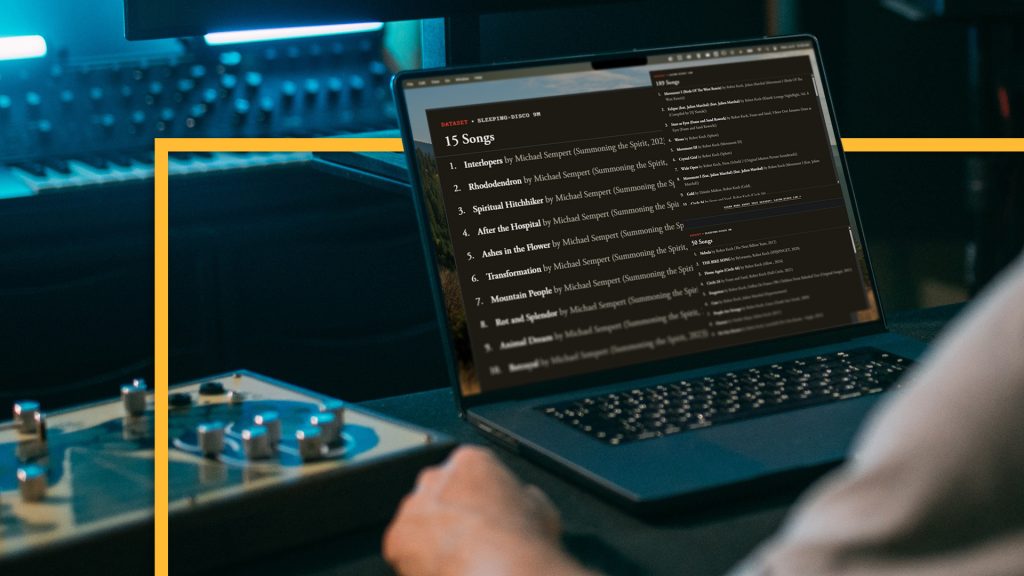
A musician gets a message from their friend saying a group just released a database of music that may have been used to train an artificial intelligence music program. The musician pulls up the website, types in their name and hundreds of their songs fill the screen.
In that moment, their years of work breaking into the music industry — the long hours developing their sound profile, fine-tuning their workflow — are now just a list of parameters and data used to train a machine that, some fear, was built to replace them.
But this isn’t a hypothetical scenario — it’s happened to hundreds of musicians. In mid-June, The Atlantic published a series of searchable databases compiled from datasets used across the AI music development community. For the first time, anyone could search for an artist’s name and see whether their work was swept into a pool of material used to train AI.
The largest of those databases was drawn from a 12-million-track collection largely scraped from YouTube. It quickly gained traction online, where musicians of every level and genre posted screenshots of their own names appearing on the list.
What the databases can’t tell musicians is whether their music was definitively used or simply sitting in a list that may have been. This is because Suno, the AI music company at the center of multiple lawsuits, doesn’t disclose what it trained its models on. For many independent artists, that distinction has started to feel less like a legal technicality and more like a symptom of the problem itself. In the new landscape of AI-generated music, the people whose work built the technology may be the last to find out and the least equipped to do anything about it.
What did AI actually take?
For more than two decades, Robert Koch — the Berlin-born, Los Angeles-based composer who records as Robot Koch — has built his career exploring the space where technology and humanity intersect. During his career, he’s scored films, written music for television shows including “How to Get Away with Murder” and “The Blacklist,” and released multiple albums.
Years ago, BBC presenter Bobby Friction described his music as sounding “like artificial intelligence discovering religion,” a quote Koch embraced and put on his own website. None of that prepared him for what he found when he typed his name into the database — more than 200 of his songs were in those datasets. And it wasn’t just metadata like titles and playlist information that had been scraped.
“There was music ripped from Spotify, which is part of these data sets,” he told Straight Arrow. “If that’s being used for training, then the actual music is being used for training.”

His frustration sharpened when the conversation turned to what he could do about it, which right now is very little. The opt-out system some AI companies have introduced requires artists to actively request removal, sometimes within narrow time windows.
Koch is also skeptical that the major-label settlements with AI companies have changed things much for independent artists. He described the results as “murky” and said that it didn’t feel like the major labels “fought or defended anyone here.”
But what troubles him the most isn’t just the financial angle — it’s something harder to quantify. He describes the act of creating music as an intrinsically valuable process, not just something an AI can generate.
“You’re taking the most fun thing away from me right now, which is the creative exploration and the creative process,” he said. “It’s almost like not wanting to eat the meal. Let me just feel satiated and full with the press of a button. And you just didn’t have all the taste sensation and the amazing experience of eating your favorite dish. You just cut that piece out and go to: now I’m full on the couch. Why?”
For Koch, the question reaches beyond lost income or stolen data.
“I’m not just worried about the jobs being lost and all the disruption of artistic livelihood,” he said. “Zooming out further, just as a species — why do we cut ourselves off from the creative process?”
Who’s fighting back?
Koch is not the only one who found his catalog waiting for him in the database. Mike Sempert, a Boston-based composer, co-founder of the commercial music house West Channel and the man behind the score for “Cotton Fever,” which just won Best Narrative Feature at the Tribeca Film Festival last month, found more than a dozen of his songs on the list. His response to the discovery wasn’t resignation but rather a driving force to act.

“For me, this isn’t really about me or my music, or any one artist,” Sempert told Straight Arrow. “It’s really about all of us. It’s about our industry. And frankly, I think it’s about the future of our species.”
Like Koch, Sempert has no way to confirm whether Suno or Udio specifically trained on his music. But he said that didn’t matter, saying that it’s still a major copyright violation and that needs to be addressed. When speaking to Straight Arrow, Sempert didn’t hesitate over the scale of it, calling it “probably the greatest copyright heist of all time.”
Sempert isn’t standing by either, he’s already organizing against it. He has signed on as a plaintiff in a class action lawsuit filed on behalf of independent artists. Those musicians had no seat at the table when companies settled with Suno and Udio, unlike those represented by Warner, Universal and other major labels. Sempert described what he’s seen as a deliberate strategy by AI companies to neutralize resistance before it can form.
“It kind of reminds me of somebody saying, ‘Help me weave this beautiful rope that I can hang you with,'” he said. “‘Jump on board, help us get this thing in motion’ — that we can then use to essentially replace you.”
Sempert said he was equally skeptical about the idea that AI’s dominance of the music industry is inevitable, saying it’s no coincidence that many people feel that way.
“That is a PR party line that has been pushed and pushed and pushed,” he said. “If you ask people what they really want — do you want AI to replace your job? Do you want to listen to AI music and watch AI TV shows? No. Nobody wants this.”
What Sempert is defending, he says, is something that can’t be generated on demand. “Cotton Fever,” which he describes as “incredibly tender and empathic and human,” is the work he has in mind. For him, that’s not a stylistic preference — it’s a matter of what music is actually for.
“Music is part of how we connect with each other and with ourselves,” Sempert said. “It’s part of how we create meaning out of life. The minute that the tech oligarchs are able to capture and flatten that down to data points, we will become unrecognizable to ourselves.”
Is the fear warranted?
Monica Corton has heard this kind of alarm before. As the CEO of Go To Eleven Entertainment and a veteran independent music publisher who has spent years filing comments with the U.S. Copyright Office on creator rights, she’s watched the music industry work itself into a panic over new technology before. She doesn’t dismiss what Koch and Sempert are feeling, but she does offer a different diagnosis.
“They’re living in a big fear bubble,” Corton told Straight Arrow.
She said the solution is licensing, not litigation. She pushed back directly on the idea that music supervisors might start generating free AI music rather than commissioning original work. Studios, she said, won’t take the risk on “something that could potentially have infringing material in it.”
On the settlement gap between what major labels negotiated and what independent artists received, Corton was matter-of-fact.
“Those lawsuits were fought by the majors,” she said. “They usually fight the lawsuits, and then once they get settled and everybody realizes they have the license, then we move in and we help license.”
What concerns her most is what was left off the table entirely. After reviewing the opt-in agreement sent to members of Merlin — the global licensing group negotiating on behalf of independent labels — she was not reassured.
“It didn’t say anything about compensation, it didn’t say anything about an attribution engine, and it threatened them if they didn’t say yes within 48 hours,” she said.
Attorneys at Hagens Berman, a law firm that recently joined the class-action lawsuit that Sempert signed on to, offered a sharper characterization of what the major-label deals actually cost artists.
“Those settlements appear to have forfeited those artists’ copyright claims,” the firm told Straight Arrow in a written statement. “Although those settlements now give Universal and Warner artists the option to opt in to having their names, voices and compositions used in future AI music generation, it gives no compensation to artists for Suno and Udio’s past conduct.”
The law firm noted that the American Federation of Musicians has filed a lawsuit attacking the settlements as unfair. For independent artists outside those deals, Hagens Berman said the class action offers something the settlements did not — a direct payment for past harm.
“What makes class actions powerful is that they allow people with individually small claims and resources to pool together,” the firm said. “This strength-in-numbers approach can force bad corporate actors to pay larger penalties on a mass scale.”
Corton draws a direct line to an earlier moment when the music industry faced a similar choice and took it badly.
“The mistake that the independents made in the beginning of the change to digital was we relied on the majors to be making good tech deals, and they weren’t,” she said. “We’re still suffering from the problems of those deals not being set right from the beginning. I will not let that happen with AI.”
What’s next?
The question of whether training AI on copyrighted music without consent constitutes copyright infringement remains unanswered in court, but not for much longer. Sony Music remains in active litigation against both Suno and Udio, with a key hearing scheduled for later this month.
What a ruling might mean for Koch and Sempert is also unclear. Even a favorable decision wouldn’t undo the training that has already occurred, since the data can’t be extracted from the model and the songs can’t be unlearned. What it might do is establish that consent to use that music was never given.
Koch said that the experience hasn’t changed what he does but it has sharpened the reason he does it. He argues AI can replicate a sound but not the actual emotion it came from.
“AI doesn’t struggle,” he said. “It doesn’t have any psychological or emotional struggles that it needs to express. It can only rip off what other people have done. It’s just going to be the rip-off of the rip-off of the rip-off.”
Sempert has already decided where he stands — in the lawsuit, off the major platforms and focused on the work a machine can’t be hired to do.
“I want to be a part of beautiful, meaningful stuff made by humans for humans,” he said. “And I think there’s enough people out there who feel the same way.”
Round out your reading
- Scientists are now eyeing a possible ‘Mega El Niño’.
- Critics mocked Mamdani’s AC request. Republicans made the same ask.
- Social Security was supposed to be a safety net. To young Americans, it’s a broken promise.
- What happens when the water dries up? Much of the American West is close to finding out.
- Political insiders are targeting the two-party system’s grip on America.
Ella Rae Greene, Editor In Chief