Their military careers were cut short in combat. Now they’re fighting Congress for their full benefits.
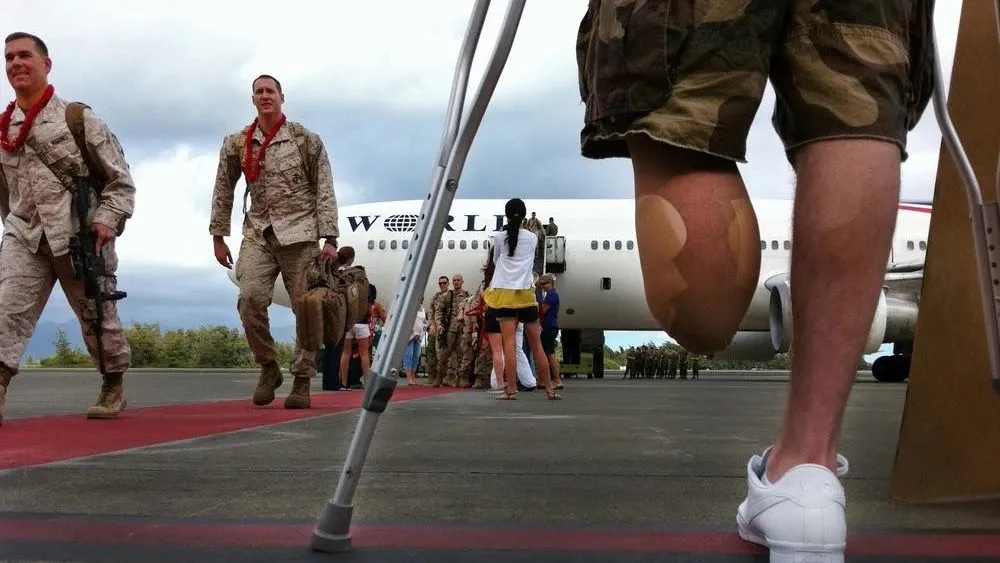
Editor’s Note: This article first appeared on The War Horse, an award-winning nonprofit news organization educating the public on military service. Subscribe to their newsletter.
The fall lasted only seconds, but the consequences would span a lifetime.
Under the cover of darkness in Balad, Iraq, Army Sgt. Will Fisher was moving into position for an overnight mission. He fell roughly 40 feet and landed on his feet while wearing about 100 pounds of gear. The force of the fall crushed the talus bone in his right ankle and broke his back. He was medically evacuated to Landstuhl Regional Medical Center in Germany.
That fall eventually cost him his leg and his career — the latter more than a decade earlier than he had hoped, and five critical years short of his qualifying for a full military pension.
“I wasn’t planning to leave the Army,” he said. “The injuries made that decision for me, and that was it. The retirement I’d spent almost 15 years working towards was gone.”
Service members qualify for full pensions after two decades of service, but only 17% reach the necessary 20-year mark of eligibility, a 2011 Defense Department report found. An estimated 54,000 veterans sustain career-ending combat injuries before reaching that threshold.

Consequently, medically retired veterans lose part of their retirement pay because they also receive disability compensation from the Department of Veterans Affairs. Last fall, those reductions averaged roughly $1,650 a month, or nearly $20,000 a year, according to the Congressional Budget Office.
The Major Richard Star Act would change that. The bill — named after an Army major who was medically retired after being injured in combat — has backing from nearly 80 senators, more than 330 House members, and Defense Secretary Pete Hegseth.
“It is unacceptable that tens of thousands of combat-injured veterans are denied the full military benefits they earned,” said Sen. Richard Blumenthal (D-Conn.), one of the bill’s lead sponsors, who characterized the offset as “one of the deepest injustices in our present veterans’ disability system.”
Some lawmakers support the bill’s premise, but worry about the cost: $78 billion over a decade, according to the CBO.
Sen. Mike Crapo, an Idaho Republican, is one of them. In a statement provided to The War Horse, a spokesperson for Crapo said, “We owe combat-injured veterans nothing less than our full support when they return from their military service.”
But his office also said Crapo is concerned about the bill’s overall price tag and “remains willing to work with his colleagues to address cost-related concerns.”
The cost previously prompted Sen. Ron Johnson, R-Wisc., to block the legislation, arguing the long-term financial impact required greater scrutiny.
The cost question Congress hasn’t resolved
When it was introduced in 2023, the Major Richard Star Act applied only to those who were medically retired due to combat injuries and was estimated to cost about $10 billion to $13 billion over 10 years. Eligibility was later extended to an additional 255,000 medically retired veterans regardless of how they became injured, inflating costs nearly sevenfold over the same period.
In an effort to help it finally pass, lawmakers in June included the Major Richard Star Act as part of the Take Care of America’s Veterans Act (TCAVA), a legislative package with more than 60 veteran-related measures. The version in that bill would again limit the benefits to only those 54,000 injured in combat, according to advocates and legislative language reviewed by The War Horse.
Candace Wheeler, senior director of government and legislative affairs at the Tragedy Assistance Program for Survivors, said advocates ultimately focused on combat-injured retirees because broader proposals would “balloon the cost” and be harder to move through Congress. But after TCAVA failed to get a floor vote in July, its chances of passing this fiscal year are dwindling, leaving some confused about the status of the standalone bill.
According to congressional staff in Sen. Blumenthal’s office, lawmakers intended the amended Major Richard Star Act to extend eligibility to just 1,124 additional combat-wounded veterans, but the bill’s legislative language was interpreted by the DoD Office of the Actuary as applying to roughly 255,000 medically retired veterans, an estimate the Congressional Budget Office used in scoring the bill, accounting for the additional $68 billion.
However, Disabled American Veterans opposes the larger bill because of its funding mechanism, which would reduce future disability claims for some conditions, including tinnitus and sleep apnea. The group said the proposal asks one group of veterans to finance benefits for another and could set a precedent for future reductions in benefits.
“We would be 100% supportive without the poison pill,” said Todd Hunter, DAV’s deputy national communications director.
Currently, there are two similar bills before Congress: The original targeting combat-injured veterans only, and the expanded version that would apply to a broader group of medically retired veterans.
A career cut short five years before retirement
As lawmakers debate the cost, combat-injured veterans say they earned both their military retirement pay and disability benefits.
After serving eight years as a Marine and spending a few years as a civilian, Fisher joined the Army. He deployed repeatedly throughout Iraq, Afghanistan, Kosovo, Panama, and elsewhere. Then, on Oct. 19, 2009, while serving as an infantryman with Task Force 16, 155th Brigade Combat Team, in Balad, Iraq, rotor wash from a nearby U.S. helicopter knocked him from a ladder during overwatch operations, ending his career.
For four years, Fisher lived with chronic pain, heavy medications, and repeated efforts to save his right leg. Eventually, he chose to have it amputated below the knee.
“The pain was unbearable,” he said. “The surgeries didn’t work, and I was exhausted from daily medications that I didn’t want to be taking, and after all that, my right ankle was dead.”
Two days after surgery, Fisher was back on his feet. Nine weeks later, he was fitted with a prosthesis and walking.
“I have more legs than I have shoes,” said Fisher, who now owns 11 prosthetic legs.
Within months, he was running. Eight months after surgery, he returned to service as a volunteer firefighter. Later, he became Fort Hood’s first amputee civilian police officer, a job that allowed him to work alongside soldiers and train others for duties he once performed himself.

But because he served in that role as a civilian employee after medical retirement, the work did not count toward the 20 years of military service required for a full military pension.
The retirement they wanted but never received
Fisher wanted so badly to stay in the military that when the war with Iran began earlier this year, he called the recruiter’s office to ask whether the Army was taking retirees. He wanted to serve as a military police officer again, this time on active duty.
When Fisher left the Army in 2014, he had earned a military retirement worth $2,166 a month. He has never received it. The Army assigned him a 40% disability rating during his discharge process, which made him eligible for about $2,700 a month in disability compensation.
Under a federal policy known as the VA Waiver, Fisher’s disability compensation reduces his military retirement pay dollar for dollar. Since his disability pay exceeds the value of his retirement benefit, his retirement check is wiped out. But if both benefits were paid, Fisher’s monthly military-related income would be nearly $4,900.
“My retirement pay was earned through my years of service,” Fisher said. “My VA disability compensation is because I lost my leg serving my country. Those are two completely different things, and I don’t think one should cancel out the other.”
Fisher also earns a salary from his full-time job as a logistics manager for an appliance company. But he said the offset still affects his long-term financial stability. With the extra money, he would have more flexibility.
“I’d pay off debt, save some money, and I could enjoy my family a lot more,” he said.
Naomi Mathis understands the strain.
During the invasion of Iraq in 2003, the former Air Force staff sergeant’s convoy came under attack amid what she described as “total chaos.” Mathis witnessed the aftermath of multiple combat incidents, including the death of a fellow service member. After returning home, she was diagnosed with post-traumatic stress disorder.

The condition led to a 100% disability rating from the VA. She was medically retired after serving 7.5 years, far short of her goal of serving at least 20 years and eventually becoming a chief master sergeant.
Like Fisher, Mathis said the loss was not simply financial. It was the loss of a career she intended to finish.
“My career was cut short,” she said. “I was not given the opportunity to serve out those 20 or 30 years. But I would have.”
Mathis qualifies for a special combat-injury compensation fund that partially supplements the offset. Even with that assistance, the shortfall still stings: nearly $800 a month less than if she received her full retirement and disability pay.
With three young children at home, Mathis said financial pressure forced her back into the workforce before she had fully recovered.
“I couldn’t pay rent or feed my kids. I needed a job immediately,” she said. “I wasn’t able to heal.”
Mathis now serves as DAV’s deputy national legislative director. She said she remains grateful for the life she built after military service, but still believes the country’s promise to injured service members should not end when their careers are cut short.
“I signed my name on the dotted line, and I wasn’t just under the impression — I was told — that the military would be there for me when I put up my boots,” Mathis said. “Well, they put my boots up for me.”
Ella Rae Greene, Editor In Chief