The little robot that could … fix America’s sidewalks?
TYLER, Texas — The city’s newest subcontractor is stuck. It’s high noon on a sweaty Texas day in late June, and Dax Flynn cannot figure out a way to cross the street. Flynn is surveying more than 90 miles of sidewalks across Tyler to assess their compliance with the Americans with Disabilities Act. And here, at the corner of Shelley Drive and Old Bullard Road, Flynn has already hit the first of several bumps along the day’s road.
Because the opposite side of the intersection lacks a ramp to access the sidewalk, there is no safe, rollable way to cross this street without having to battle traffic.
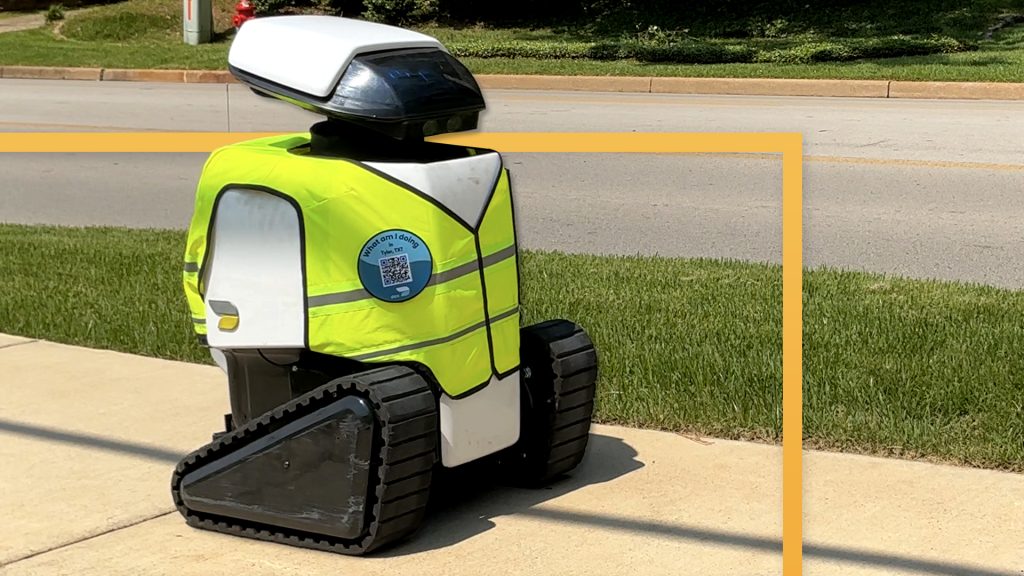
Most city employees would pause for a second to think. Flynn can’t. Thinking is for humans. And this subcontractor is a 3-foot-tall robot that looks like it just rolled out of the Stormtrooper paint factory.
So Flynn starts computing like somebody’s life depends on it.
Traffic accidents kill more than 7,000 pedestrians each year in America. And about 11% of those deaths occur in Texas — a state known for big trucks, open roads and a “don’t mess with” attitude.
For decades, city halls in the Lone Star State and across the nation have wrestled with how to bring those numbers down. But with so many issues factoring into pedestrian safety — city budgets, infrastructure constraints, public will — a perfect solution has yet to appear.
Perhaps that perfect solution never will, but in Tyler, Texas, a city of 113,000 people in the state’s northeastern corner, city officials have stopped chasing perfect. They’ll settle for better. And a better approach to sidewalk safety in Tyler, it turns out, means calling in a team of safety-vested robots.
Flynn is one of several Daxbots rolling along Tyler’s sidewalks in this summer’s early months in the name of accessibility. It’s a bit of a glow-up, really, for a robot originally designed to deliver food.
To hear Miriam Sullivan, a spokeswoman for Daxbot, tell it, sidewalks were never in the plan. But a few years ago, the company received a phone call from a city in which the robots were already slow-rolling delivery orders from pizza joints to apartments.
“Could you potentially do data collection on sidewalks?” the city asked.
Daxbot’s engineering team was excited by the idea of a new challenge.
“Yeah,” the company replied. “Let’s get to work.”
Daxbot worked with a college in Illinois to create a scoring system that weighs a sidewalk’s flaws, giving higher scores for problems that present greater difficulties, says Sullivan. So a “large uplift” (essentially a giant section of broken sidewalk, lifted by tree roots) will have a higher difficulty score than a “two-way cross slope” (a sidewalk that peaks like a pitched roof).
“This involves a lot more information than (cities) had before, because what they were more or less doing before was having someone walk the sidewalk, who was obviously not an engineer,” says Sullivan.
That employee would record their findings on things like sidewalk slopes, grades, uplifts and other issues, handing off a preliminary report to engineers. Once engineers used this information to determine which sidewalks most needed fixing, they would head back for another round of assessments to record the nitty-gritty.
The robots are constantly scanning, which means they collect more complete data, all in one slow roll.
“Basically, it can collect enough specifications for engineers to actually work off over a large expanse of sidewalk,” Sullivan tells Straight Arrow.
“And people can do that really, really well for small sections,” she says. “But the amount of information you need gathered becomes impractical when you’re talking about a city-wide infrastructure idea.”
Flynn spends several minutes at the corner of Shelley and Old Bullard. Some of that time is social: The robots have been A-list celebrities across the city of Tyler since their rollout a few weeks prior. Over a couple of hours on this Thursday, Flynn “met” at least a half-dozen groups of people.
A few minutes earlier, Daylin Arriaga spotted Flynn from her SUV as she drove down Old Bullard Road.
She turned into a parking lot, stepping out with her two young sons, Aiden, 5, and Alejandro, 4, phones already out and recording.
“Look at his eyes!” Daylin squealed as Flynn tilted its head, its digital visor blinking into a pair of pixelated hearts.
“He’s blinking!” Aiden cheered, waving both hands at the machine.
Daylin had seen several Daxbot sightings from her friends on Facebook over the past couple of weeks, as folks from every corner of Tyler track the robots with the dogged determination of storm chasers. She was thrilled to finally have her own encounter.

Overwhelmingly, Flynn’s adoring fans address the robot with he/him pronouns, despite Flynn’s clear status as a dishwasher-sized it.
“He’s so cute.”
“Look how his eyes make heart emojis.”
“Hey, little guy.”
Flynn occasionally chirps a response: “Beeeeyoooooo.”
More than one passer-by-turned-selfie-photographer compares Flynn with the beloved Pixar robot, Wall-E. They’re not far off, though Wall-E’s top speed of 35 mph puts Flynn’s speed to shame. At one point on Old Bullard Road, Flynn is lapped by a postman.
And at the intersection with Shelley Drive, Flynn takes several minutes to figure out the safest way to cross. Eventually, it moves forward with a whirring zzzzzzzt, after determining it is best to roll along the road’s shoulder for a few yards until it can find an incline to safely return it to the sidewalk. It beams plenty of notes about its troubles crossing the intersection back to the human worker a few miles away who monitors Flynn and its animatronic colleagues throughout the day.
* * *
The city of Tyler is one of the nation’s first to hire Daxbot for this very 21st-century odyssey.
“All governments have to have some sort of ADA transition plan in place, and you need to update that periodically, just because things change, laws change,” says Michael Howell, Tyler’s ADA coordinator. The city hired a consulting company to help with the task. And as Howell and his team planned to begin their decennial survey of the sidewalks, the company, Kimley-Horn, suggested hiring Daxbot.

Credit: Maggie Gordon for Straight Arrow.
“It would be cheaper and faster than it would be to have a human do it,” the consultants told Howell.
That was two marks in the robot’s pro-column. The third?
“It’s peak summertime in Texas. So to have someone walking that full 90 miles with a level,” he says, is not the preferred definition of a hot job.
And this job, Howell says, is critical.
While 16% of pedestrian traffic deaths occur in crosswalks, according to the National Highway Traffic Safety Administration, most pedestrians who are killed in traffic — 75% — happen along open roadways. Those pedestrians, Howell says, are often pushed into the streets because of a lack of safe, accessible sidewalks. Because of this, Howell says he views Tyler’s sidewalk conditions as a major public health concern.
The city invested $434,000 in this year’s ADA self-evaluation project, about $350,000 of which was set aside for the robots to survey 90 of the city’s hundreds of miles of sidewalks.
“We couldn’t afford to do everything,” Howell says. “It would have been multimillions of dollars.”
So Howell prioritized some of the stretches that could have the greatest public effect. Like that on-ramp orphan near Shelley Drive.
Good, but not perfect.
* * *
A couple hundred miles south of Tyler, the sprawling city of Houston is home to some of the nation’s deadliest stretches of road for pedestrians. The city is also home to Lex Frieden, one of the chief architects behind the 1990’s landmark ADA. Frieden is near-completely paralyzed, and has used a wheelchair since he broke his neck in college more than a half-century ago.
Frieden is no stranger to on-ramp orphans and sudden sidewalk uplift mountains, pushed up by Texas live oaks. Near his home in one of Houston’s midcentury residential neighborhoods, Frieden has about 200 feet of new, fresh sidewalk in any direction. That’s relatively smooth sailing, “until I run into the old sidewalk,” he says. “Now I’m stuck. Literally stuck.”
According to Google Maps, it should take Frieden about two blocks to travel from his house to a nearby Walgreens. But thanks to the condition of his neighborhood’s sidewalks, he either has to wheel in the street or “go eight blocks to get to Walgreens,” he says. “I need to have a person with me at least over one of those blocks where the new sidewalk has already cracked.”
It’s dangerous territory.
“If you get that wheel caught in that crack when you try to get over it, well, you may be stuck there for a long, long time,” Frieden says. And this goes beyond him: It’s dangerous for others in wheelchairs, or, he says, parents pushing strollers. “You may fall over and hurt yourself or your baby.”
Houston is widely known as a problem area for pedestrians. In 2024, 116 pedestrians were killed in traffic accidents in the city, roughly one every three days, according to the NHTSA, making Houston the second deadliest city for pedestrians in the nation. But those problems extend way beyond Houston’s highways.
When weighing pedestrian crashes against total vehicle miles traveled, Tyler’s rate actually outpaces Houston’s.
“We have a higher ratio than Houston does,” Howell says.
* * *
The Daxbots have not been immune to the dangers of Texas roads.
Brooklyn Cobb, an employee at a bank on Old Bullard Road, took note of some of the wear and tear on Flynn’s body after running out to the sidewalk for a selfie.

“Look at all the scratches,” Cobb says.
“He’s working hard,” her co-worker, Ashley Arroyo, coos.
But Flynn is in pretty pristine condition, all things considered. And not every Daxbot has been so lucky during the weeks-long deployment to Tyler. On Thursday, June 11, a Daxbot was struck by a truck making a right turn on red at the corner of West Martin Luther King Jr. Boulevard and North Palace Avenue.
No human injuries were reported. But the robot was shipped back to Daxbot’s headquarters in Oregon to determine whether it should be repaired or scrapped for parts to repair other units. A new robot took its place the following day.
As for Flynn, the little dings and scratches along its casing are surface level — what would be called flesh wounds if Flynn had flesh.
Lucky him.
Round out your reading
- Why Gen Z is staying home on the weekends.
- Autism research is entering a new era. Here’s what scientists are learning.
- The big reason small cities want data centers. Hint: It’s not permanent jobs.
- High school teacher arrested at city meeting after clapping for anti-data center speech.
- Off Script: Everyone’s watching Michigan. Our reporter explains why the race just changed.
Ella Rae Greene, Editor In Chief