The hidden cost of dwindling agricultural research
Organic vegetable farmer Harriet Behar grows rye on her fields in the winter, then flattens the crop with a roller in the spring, creating natural mulch for her vegetables, which sustains her crops and saves her money.
Rather than letting her sweet corn fields lie fallow in the winter, she plants rapeseed to keep weeds at bay and hold both the soil and the precious nutrients buried within it in place.
“It’s a smart way to farm,” said Behar, whose fields lie hidden between the hills and valleys of southwest Wisconsin.
For the past few years, Behar has worked with a research scientist at the University of Wisconsin–Madison to develop planting techniques to maximize her farm’s efficiency. It’s helped.

However, farmers like Behar and researchers across the nation worry that research institutions will need more money as a growing population needs more food on less acreage.
“Research is so important,” Behar said. “We have so much more to learn.”
READ MORE: How high corn production hides the financial strain of US farms
Lawmakers, however, are going in the opposite direction. Agriculture research funding fell over the past two decades, even as the barriers standing in the path of American farmers — worsening floods and droughts, crop and livestock diseases, dwindling acreage — loom larger.
“Research is constantly needed to adapt to those challenges,” said Dan Blaustein-Rejto, the director of food and agriculture for the Breakthrough Institute, an environmental think tank. “More food with smaller land and fewer inputs, that’s core to making food affordable. Without agriculture research, we wouldn’t have the basic science to make higher yield seeds, or to protect against new expanding weeds, or new insect pests.”
Why does public agricultural research funding continue to fall?
Public funding for agriculture research dropped 32% — or about $4.7 billion — in 2023 compared with its peak in 2002, according to a new American Enterprise Institute study. And observers like Blaustein-Rejto said the decline has continued in the three years since.
The second Trump administration asked for cuts in agricultural research, but Congress largely ignored those requests. Instead, the USDA and related agencies’ discretionary budget increased from $25.9 billion for the 2025 fiscal year to $26.6 billion for 2026.
But even that won’t be enough.
A paper published by the National Academy of Sciences last year determined that agricultural research funding needs to grow between 5% and 8% annually to offset climate change.
“The largest share of the [funding] decline seems to be at the state level,” said Blaustein-Rejto. “Typically federal funding and grants to universities are matched by state support, and often they are matched at more than one to one.”

That trend continues. Michigan’s House of Representatives in April approved a 10% funding and staff cut to the state’s Department of Agriculture and Rural Development. Meanwhile, Oregon’s state Legislature is considering a $7 million cut to agriculture programs at Oregon State University.
And even with federal funding holding steady, the USDA has stymied research in other ways, Blaustein-Rejto said.
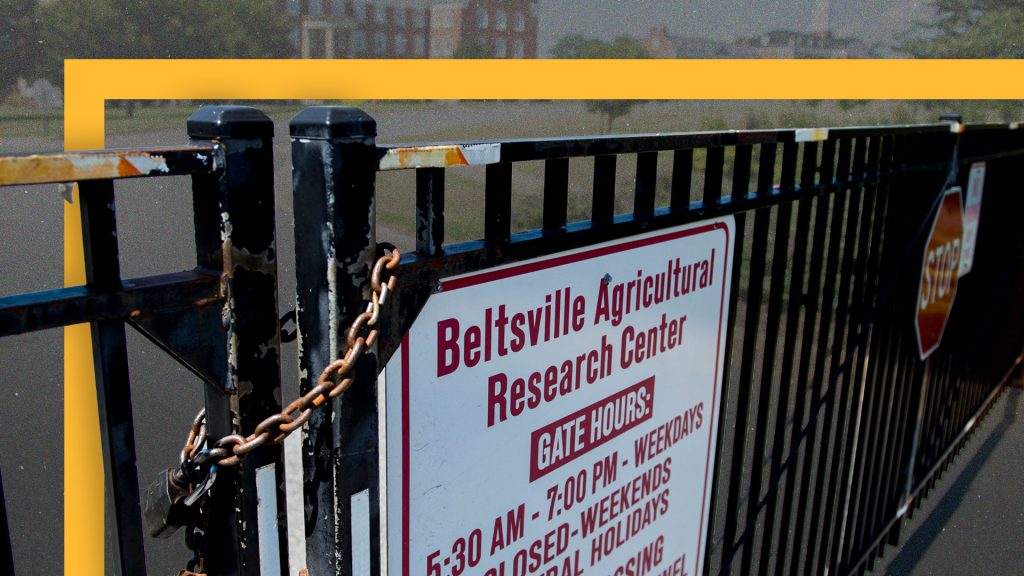
The agency, for example, plans to close the 6,500-acre Beltsville Agricultural Research Center in Prince George’s County, Maryland, in an effort to move researchers to rural areas. But in a recording obtained by Politico, Agricultural Research Service Administrator Joon Park contradicts this, stating that more than a dozen research projects would be cut or see a funding decrease.
And the White House budget proposals for the 2026 and 2027 fiscal years targeted Agricultural Research Service sites in Vermont, Massachusetts, Delaware and Illinois for closure.
How did the United States lose its lead in global farm science?
In the meantime, “the rest of the world has been growing at a much faster pace than us,” said Philip Pardey, a University of Minnesota economics professor who studies agricultural development. “Brazil, India and China collectively moved past the U.S. back in 2008.”
That makes United States agriculture less competitive in the long run, putting American farmers who rely on international markets at a disadvantage, he said.
Money cut from agriculture at the state level is often made to plug budget gaps, but Pardey suspects a lack of political willpower is also a problem.
The data shows agriculture research funding is beneficial: Every dollar spent on public agriculture research in the U.S. equals $20 in economic benefit, according to a March study from the Food Security Leadership Council. But years often pass before that research bears fruit, Pardey said. New crop varieties, for example, take up to a decade to develop.
“Therein lies the political problem,” he said. “It takes persistence and patience.”

Most members of the U.S. House and Senate agriculture committees did not respond to Straight Arrow’s requests for comment. Those who did emphasized their support for public institutions.
“Sen. Tuberville is 100% supportive of ag research and has helped secure money for our land grant universities — Auburn, Tuskegee, and Alabama A&M — that all contribute to ag research,” a spokesperson for Alabama Sen. Tommy Tuberville said in an email.
A USDA spokesperson did not respond to a request for comment.
How do farm research cuts affect food prices and productivity?
Scientists studying crops and livestock have a singular goal: productivity.
Weather disasters threaten harvests, and the acreage dedicated to growing crops is shrinking, requiring farmers to grow more food on less land.
“There are fewer new things coming out for farmers to adopt that would raise their productivity,” said Keith Fuglie, chief economist for the Food Security Leadership Council. “And old threats that were under control have re-emerged, and are starting to create problems again.”
READ MORE: Small farmers face a new era of hemp prohibition
Those old threats include screwworm — a parasite spreading in Latin America that reduced cow herds — and a disease devastating Florida orange groves.
If farmers fail to maintain productivity in the face of these challenges, grocery prices will rise and produce shelves will empty out.
American agriculture is coasting off the research conducted in past years, but that knowledge can only go so far, experts say.
What agricultural research is being funded?
The Citrus Research and Development Foundation saw its budget cut in recent years, even as it battles an existential threat to Florida’s world-renowned orange groves, chief operating officer Rick Dantzler told Straight Arrow.
“I’m not sure we could responsibly spend as much as we used to,” he said.

The citrus greening disease Huanglongbing [HLB] was first detected in the Sunshine State in the mid-2000s and has ravaged orange production there. Florida farmers produced nearly 250 million boxes of oranges in 1999 compared with 12 million last year, something Dantzler attributed to HLB.
The funding cuts have forced the organization to narrow its focus, although Dantzler stressed that much of the work needed to combat the disease has already been done.
He also noted that state support for other research organizations has more than offset any cuts to the foundation, and he’s hopeful that researchers will find a way to counter the disease.
But the type of research that receives funding is changing.
“Anything climate related or focused on inequality is no longer supported,” said Ariel Ortiz-Bobea, a Cornell economist who studies how climate change affects agriculture, echoing private comments by other researchers.
And less research money seems to be dedicated to producing more food in challenging conditions, Blaustein-Rejto said.
“Something that often is overlooked is that a declining share of that [research and development] funding is focused on farm production and productivity as more and more issues have cropped up like nutrition and environmental sustainability,” he said.
Round out your reading
- Are aliens real? Pentagon’s newly released UFO files suggest the truth is out there.
- A million Americans get this knee surgery every year. But does it work?
- Is the apocalypse now? One man is tracking flights by the rich to find out.
- ‘No Mow May’: A boon for the bees or a well-intended mistake?
- We’re building a new Straight Arrow. Help us shape our future by taking our survey.
Ella Rae Greene, Editor In Chief