The FBI’s secret fight to track down American traitors in Europe during WWII
Monumental battles between Allied and German forces in Holland, Belgium, eastern France, northern Italy and along Germany’s western frontier were still being waged when two American men — Frederick Ayer Jr. and Donald L. Daughters — stepped foot upon the pavement of the newly liberated Paris in August 1944.
“The reality of the men’s identities and their reason for traveling to newly liberated Paris would likely have surprised even the most observant and intuitive onlooker,” writes author and historian Stephen Harding in his latest, “G.I. G-Men.”
The men were not military intelligence officers, nor from the vaunted Office of Strategic Services helmed by William Joseph “Wild Bill” Donovan. They were, in fact, special agents of the Federal Bureau of Investigation tasked with rooting out American citizens who had collaborated with the Nazis or Italian Fascists.
Harding spoke with Military Times regarding his impeccably researched, superbly paced, stranger-than-fiction book, “G.I. G-Men,” and how and why “there have always been Americans willing to sell out America for money, power or a combination of all of those things.”
Military Times: For most Americans, the war ends on May 8 and Sept. 2, 1945, respectively. There’s a decided lack of awareness or understanding about the days, weeks, months — even years following the end of World War II. Can you talk about the work of the Army Liaison Unit in 1944 and in the immediate aftermath of the war?
Stephen Harding: The Army Liaison Unit was set up by the FBI specifically to track down and interrogate American citizens who had remained in Axis territory or Axis-controlled territory during the war and were suspected of collaborating with either the Italian fascists or the Nazis — either through radio or print propaganda or by, in some cases, providing money to them or simply sleeping with Germans or Italian fascists.
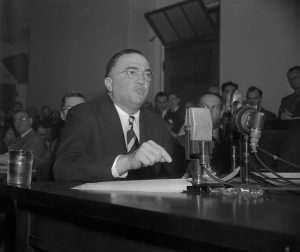
The program was an outgrowth of the FBI called the special intelligence service, the SIS, which [J. Edgar] Hoover had started as a way for FBI agents to operate in Central and South America in a counterintelligence role. Unfortunately, when they first started the program, he was sending agents down there who didn’t speak Portuguese or Spanish, so they kind of stood out.
Pretty quickly after America got into the war, [Hoover] sent an agent named Art Thurston to London. Thurston worked very closely with MI6, Britain’s Foreign Intelligence Service, which was already formulating plans to do the same thing for British subjects. Hoover thought this was a great idea, and he especially wanted to edge out Donovan because Hoover thought the OSS was a bunch of amateurs who were going to not do the job well.
All of these agents who were going to go to Europe needed to speak at least one European language fluently, not out of a Berlitz school or anything else. They had to be almost native speakers, and a couple of them were in the sense that of the roughly 20 guys who ended up going to Europe before the program ended, several of them had grown up in Europe or had been born in the United States of immigrant parents and spoke the language in the in the house.
The first agent sent overseas was a guy named Frank Amprim, who was the son of Italian immigrants. He had been a lawyer in Michigan and after Pearl Harbor he joined the FBI. He had no military background at all, however, and Hoover’s idea was that, because the war in Europe was ongoing, he wanted these guys to work under Army cover — meaning they were going to wear Army uniforms, have Army ranks. To do that, they needed to know something about the Army. So Amprim was the guinea pig.
In the meantime, as Amprim’s crossing North Africa, Hoover wants to put together a team that will operate in continental Europe after the Allied invasion of occupied Europe. The person he chooses to lead this effort is a gentleman named Frederick Ayer and his second in command, Don Daughters.

MT: When one thinks of collaborators, you think of Lord Haw Haw, Tokyo Rose, Coco Chanel. Never the Americans. What did you discover in “G.I. G-Men” that contradicts this notion?
Harding: I think what people have to remember is — and this is something we sort of very conveniently forgot — in the years leading up to the outbreak of the Second World War there were thousands of Americans who were pro-Nazi or pro Italian Fascist. It was a huge movement in the United States, and it was supported by the German government. There were huge rallies at Madison Square Garden that attracted 10-12,000 people, many of them wearing Nazi style uniforms the swastikas. There were huge banners flying from the upper galleries with pictures of [Adolf] Hitler and George Washington. Fascism was a popular idea in the United States in the mid to late 30s.
A lot of Americans who ended up in the U.S. military during the war very conveniently forgot that they had been fascists before the war. And so you might have been a person of German heritage who had been a pro-fascist right up until you ended up going to shore on D-Day.
The interesting thing was, a lot of these files I had to do FOIA requests, both with the National Archives and with the FBI. The FBI was saying, “Well, all this stuff has been sent to the National Archives.” Not true. And unfortunately, when the first Trump administration existed, it started making a lot of stuff in the National Archives harder to get to. I was finding files on people that the FBI had investigated with the ALU that were still classified — and that was all still 75 years after the fact. I started wondering why these files are classified, and some of them were newly classified, meaning within months, in some cases, before I got to them.
These files weren’t redacted in 1945. Interestingly enough, a lot of the stuff that got newly classified at the National Archives was not classified at the U.K. National Archives. It wasn’t classified in the French archives either. I would have a document that I got from the U.S. National Archives that was redacted to the point that the only thing that wasn’t redacted was the heading. I found the same document in the U.K. with absolutely no redaction.

MT: From your research, how many American collaborators were there?
Harding: I had a list that I put together of about 135 people that the ALU either intensely investigated or looked at in a documentary sort of way. Now, they weren’t all German collaborators. There were a lot of French communists and French socialists, and remember, the French Communist Party played a huge role in the French Resistance against the Germans. There was a lot of politics involved.
MT: You write in the acknowledgements that you went into something you call “research rapture.” What was your favorite tidbit while working on “G.I. G-Men”?
Harding: I found out a lot of interesting little things, but there was this German spy who actually operated in the United States. He was one of the more successful. A successful spy should be invisible, both in looks and actions. And Ignatz T. Griebl, who was a doctor and ran a practice in the German parts of New York City. He was one of the most effective spies the Germans had until he split because he was under suspicion.
But it’s interesting, because he was successful despite the fact that he was a serial womanizer. This gentleman was prolific in his affairs, and he was married. He was having affairs with everybody and their sister and yet he was the mousiest looking guy you could ever imagine, in terms of the being invisible. Physically, you’d walk right by this guy and not notice him.
He had several sub-agents working for him, and I found that interesting. He eventually escaped from the United States, and he kept his head down in Austria for all of the war before he got popped by the ALU. He was brought into be interrogated but then he disappeared. He was never charged. He was interrogated, but never charged, and he was never found.
They did look for him because there was some thought that he’d gone over the Soviets. A lot of the files that I found in the U.S. National Archives on Griebl were hugely redacted. Why? What’s the story on that? That’s the kind of thing that catches my attention.
Ella Rae Greene, Editor In Chief