Texas school board approves making Bible passages required reading for students
The Texas Board of Education approved a book list that would make Bible passages and stories required reading for millions of elementary and middle school students. Traditionally, reading lists are chosen by individual schools or teachers.
Texas is home to about 5 million public school students, about 11% of the nation’s public school population, according to The New York Times. The Times reports that the list will lean into the priorities of the state’s Republican-led school board.
The list stems from a state law enacted in 2023 that requires education officials to pick at least one literary work for each grade level. This list names multiple for each grade.
Teachers will still be able to teach books that are not on the list, but those will have to be in addition to state-chosen titles, not in lieu of.
The new required reading will put focus on classics like E.B. White’s “Charlotte’s Web,” Charles Dickens’ “Great Expectations” and William Shakespeare’s “Hamlet.” Education officials in Texas who back the plan argue that the Bible is essential literature for understanding American history.

Separation of church and state
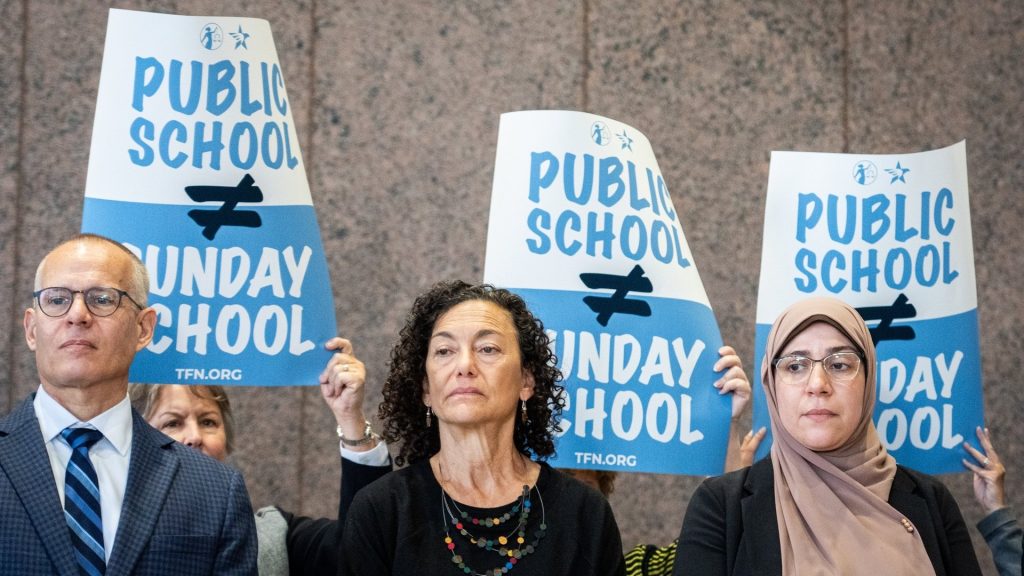
Critics say making Bible passages and stories required reading violates the First Amendment principle of separation between church and state. Many say it favors Christianity over other religions.
“Kids of all faith backgrounds and no faith are served by Texas schools and they should all feel welcome in Texas schools,” Elva Mendoza, legislative communications associate for the Texas Freedom Network, said, according to ABC News. “But this is sending the message to children that one and only one religious text — a Christian one — is worthy of making this required reading list.”
Critics have also voiced concerns that the list’s emphasis on classic literature limits diversity, since they’re commonly written by white and male authors. More than half of Texas’ students are Hispanic or Black, according to The Times.
Markesha Tisby, president of the Texas Council of Teachers of English Language Arts, is pushing for the board to narrow the list to allow teachers more room to teach books from diverse authors.
Unbiased. Straight Facts.TM
About 1 in 3 Texas adults identify as non-Christian, according to the Pew Research Center.

“With a list that’s so extensive, would teachers have the time or space to choose texts that are a great fit for their students, their classrooms, their region?” Tisby posed, according to The Times.
Some parents have also raised concerns that implementing Biblical texts infringes on their right to shape their children’s religious education, especially for those who are not Christian.
“We don’t have to incorporate every religious belief in our history or in our literary works, because our nation was founded on Judeo-Christian values,” Susan Perez, founder of Citizens for Education Reform — a Christian advocacy group — argued during a school board meeting on Monday.
Not their first rodeo
This would not be the first controversial Christianity-related change to impact Texas schools.
The state’s education code already requires K-12 schools to teach “religious literature, including the Hebrew Scriptures (Old Testament) and New Testament, and its impact on history and literature.”
And in 2023, Texas became the first state to allow chaplains to counsel students. Then, in 2024, the board approved a measure to give more funding to elementary schools that teach an optional Bible-infused curriculum.
And just this year, a federal appellate court upheld a Texas law allowing the Ten Commandments to be displayed in all classrooms.

Other changes to consider
The required reading list is not the only big decision the state board is voting on Friday.
The change to statewide social studies curricula — which includes the controversial book list — would dramatically transform how Texas teachers give lessons on history, geography, economics and government. It would eliminate the current sixth-grade world cultures course, deemphasize world history outside of European tradition and dedicate more focus to Texas and the United States, according to The Texas Tribune.
While many Democrats say they are not in favor of the plan overall, they are hopeful some of the changes will make lessons more accurate and inclusive of historically underserved groups, according to The Tribune.
If approved, the K-8 reading lists will go into effect in the 2030-31 school year. Part of the board’s vote on Friday will also decide whether to phase the social studies changes in or introduce them all at once in that same school year.
Round out your reading
- Not red or blue: America’s politically homeless middle.
- Peter Thiel’s ‘Dialog’ network was super-secret. A data leak changed that.
- The novel legal strategy that Taylor Swift and Matthew McConaughey are using to fight AI.
- Illinois balances budget with new $200 million social media tax that tracks in-state users.
- When Trump serves up ‘Just the News,’ it comes with a side of bias.
Ella Rae Greene, Editor In Chief